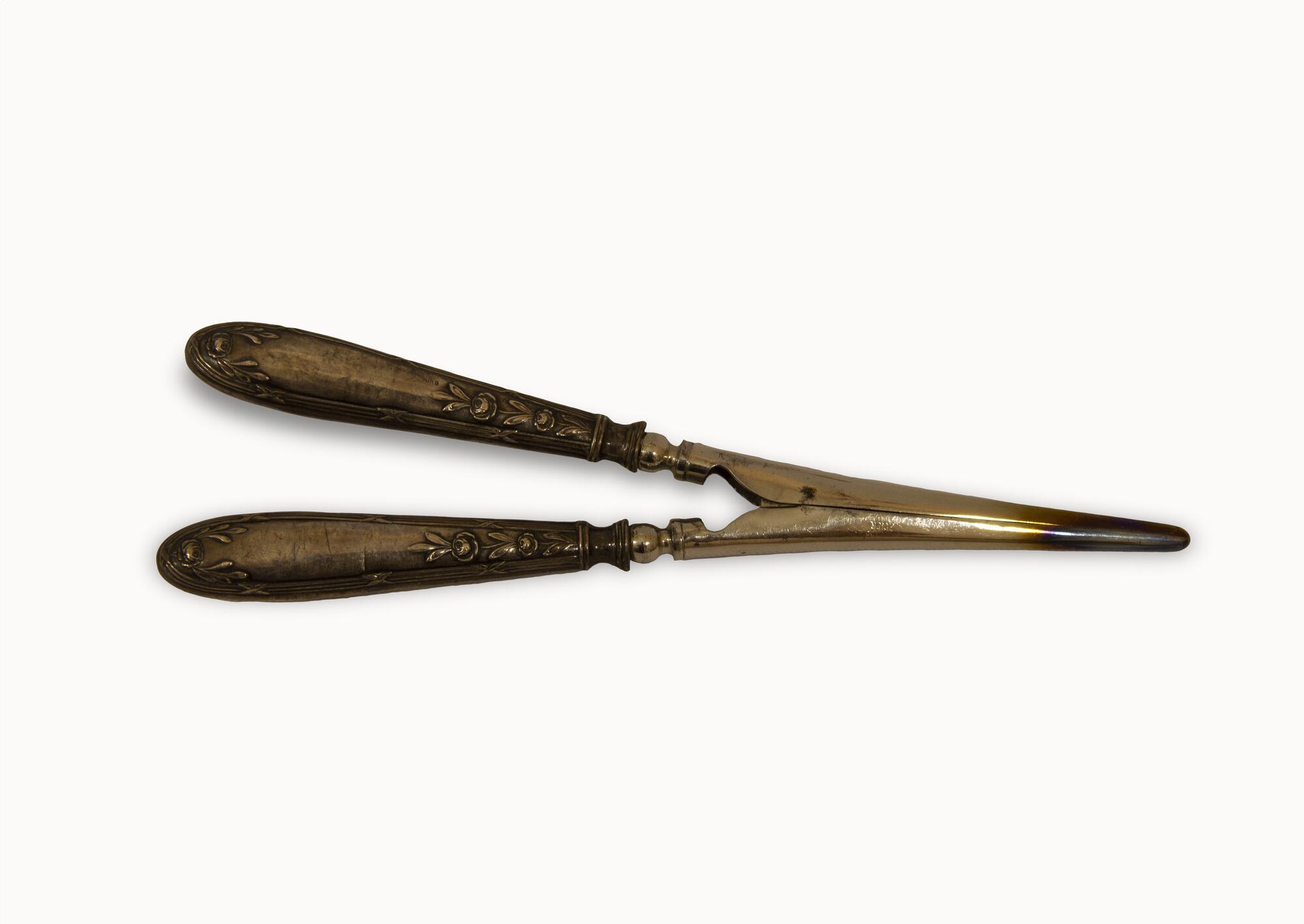


These curling tongs were made from steel (there is a French inscription — Acier), and their handles with the stamp “006” were made from cupronickel. The tongs come with a corset hook, eyebrow tweezers and a manicure knife.
Such curling tongs were invented in 1872 by the French hairdresser Marcel Grateau. He revolutionized hairstyling by inventing a way to create perfect undulation — a new type of curling, which later became known as the “Marcel Wave”, and the curling tongs — as “Marcel tongs”. The significance of the new method was immense, and the famous French hairdresser René Rambaud, in his work “L’Ondulation bouclée”, regarded Marcel’s discovery as “revolutionizing the art of women’s hairstyling.” Creating a hot undulation was incredibly complex. A special technique was used to create waves in dry hair. A comb and tongs had to be warmed on any source of heat available at that time — a kerosene burner, candle, or gas stove. This technique was not at all safe and the hairdresser had to be especially careful, because if the tongs got too hot, they could singe the hair. The tongs were heated, and then a piece of paper was used to check the temperature. If the paper became a little darker, this meant that the tongs were ready for use.
In 1882, Marcel Grateau opened his barbershop in the very center of Paris. It must be said that at first his new way of hairstyling did not gain popularity, and women remained wary of the innovation for a long time. Marcel’s big break came when he styled the hair of the popular French actress Jane Hading with his waving technique. Jane actually made the style popular in high society. Marcel kept his technique secret for a long time, offering his services to very wealthy women in closed rooms. The fashionable “wave” hairstyle cost a lot of money, and only the richest could afford it. It was only after amassing a fortune of one million francs and buying a castle in Normandy that the Parisian king of hairstyling decided to retire and revealed his technique by sharing it with others.
Such curling tongs were invented in 1872 by the French hairdresser Marcel Grateau. He revolutionized hairstyling by inventing a way to create perfect undulation — a new type of curling, which later became known as the “Marcel Wave”, and the curling tongs — as “Marcel tongs”. The significance of the new method was immense, and the famous French hairdresser René Rambaud, in his work “L’Ondulation bouclée”, regarded Marcel’s discovery as “revolutionizing the art of women’s hairstyling.” Creating a hot undulation was incredibly complex. A special technique was used to create waves in dry hair. A comb and tongs had to be warmed on any source of heat available at that time — a kerosene burner, candle, or gas stove. This technique was not at all safe and the hairdresser had to be especially careful, because if the tongs got too hot, they could singe the hair. The tongs were heated, and then a piece of paper was used to check the temperature. If the paper became a little darker, this meant that the tongs were ready for use.
In 1882, Marcel Grateau opened his barbershop in the very center of Paris. It must be said that at first his new way of hairstyling did not gain popularity, and women remained wary of the innovation for a long time. Marcel’s big break came when he styled the hair of the popular French actress Jane Hading with his waving technique. Jane actually made the style popular in high society. Marcel kept his technique secret for a long time, offering his services to very wealthy women in closed rooms. The fashionable “wave” hairstyle cost a lot of money, and only the richest could afford it. It was only after amassing a fortune of one million francs and buying a castle in Normandy that the Parisian king of hairstyling decided to retire and revealed his technique by sharing it with others.