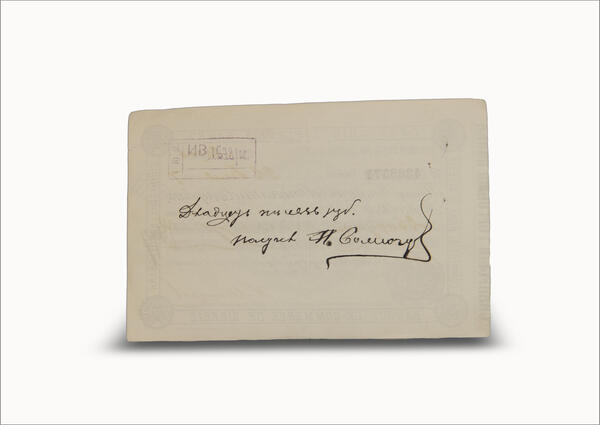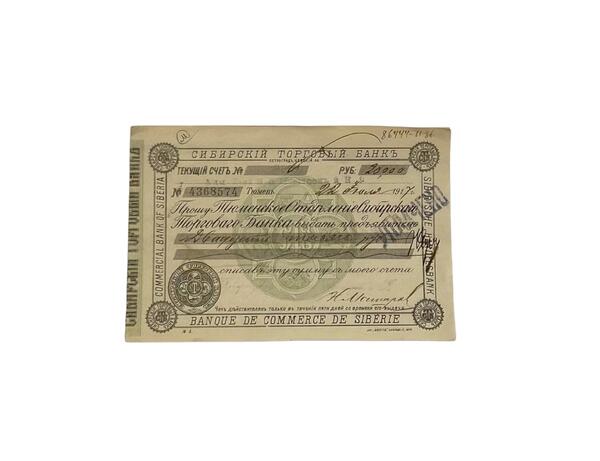
N.D. Masharov signed the check of the Siberian Trade Bank No. 4368574 for 20,000 rubles on July 22, 1917. It is not known for sure what the purpose of this money was.
The bank was located on Irkutskaya Street in a stone mansion built in the 1870s in the neoclassical style. This mansion belonged to the merchant Prokopy Ivanovich Podaruev. In 1914, the building received a one-story stone extension designed by the city architect K.P. Chakin. The Siberian Trade Bank was located in the building from 1899 to 1919. In the 1990s, the building was restored according to the project of the architect A.I. Klimenko.
The Siberian Trade Bank was founded during the reign of Empress Catherine II in 1872 and had its branches throughout the Russian Empire. There were two boards of the bank: the first was located in St. Petersburg at 44 Nevsky Avenue, and the second — in Yekaterinburg at 27 Main Avenue. V.A. Poklevsky-Kozell, a well-known Ural-Siberian entrepreneur, had property in Tyumen. The building of his store on Lenin Street (before the revolution — Spasskaya Street) has survived. The Bank was mainly involved in refining gold nuggets and silver ore into bars in laboratories located in Yekaterinburg, Tomsk and Irkutsk. The bank’s business was flourishing; it had a reputation as one of the most promising enterprises. By 1914, the Siberian Bank had a network of 57 representative offices throughout the empire and ranked seventh among Russian credit institutions in terms of assets.
However, the Siberian Trade Bank, along with other private banks, was nationalized by being merged with the State Bank of the Russian Republic by a decree of the All-Russian Central Executive Committee of December 14 (27), 1917. By a decree of the Council of People’s Commissars of January 23 (February 5), 1918, the share capital of the Siberian Trade Bank, along with the share capital of other private banks of the Russian Empire, was confiscated in favor of the newly formed State Bank of the Russian Republic.
The bank was located on Irkutskaya Street in a stone mansion built in the 1870s in the neoclassical style. This mansion belonged to the merchant Prokopy Ivanovich Podaruev. In 1914, the building received a one-story stone extension designed by the city architect K.P. Chakin. The Siberian Trade Bank was located in the building from 1899 to 1919. In the 1990s, the building was restored according to the project of the architect A.I. Klimenko.
The Siberian Trade Bank was founded during the reign of Empress Catherine II in 1872 and had its branches throughout the Russian Empire. There were two boards of the bank: the first was located in St. Petersburg at 44 Nevsky Avenue, and the second — in Yekaterinburg at 27 Main Avenue. V.A. Poklevsky-Kozell, a well-known Ural-Siberian entrepreneur, had property in Tyumen. The building of his store on Lenin Street (before the revolution — Spasskaya Street) has survived. The Bank was mainly involved in refining gold nuggets and silver ore into bars in laboratories located in Yekaterinburg, Tomsk and Irkutsk. The bank’s business was flourishing; it had a reputation as one of the most promising enterprises. By 1914, the Siberian Bank had a network of 57 representative offices throughout the empire and ranked seventh among Russian credit institutions in terms of assets.
However, the Siberian Trade Bank, along with other private banks, was nationalized by being merged with the State Bank of the Russian Republic by a decree of the All-Russian Central Executive Committee of December 14 (27), 1917. By a decree of the Council of People’s Commissars of January 23 (February 5), 1918, the share capital of the Siberian Trade Bank, along with the share capital of other private banks of the Russian Empire, was confiscated in favor of the newly formed State Bank of the Russian Republic.