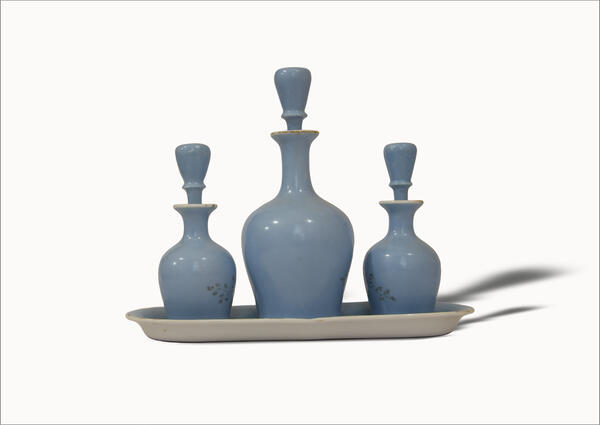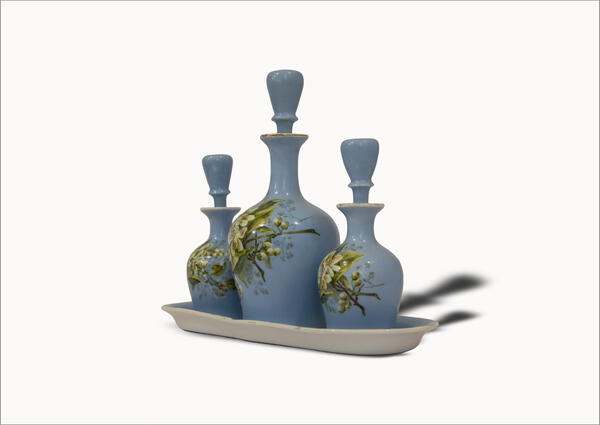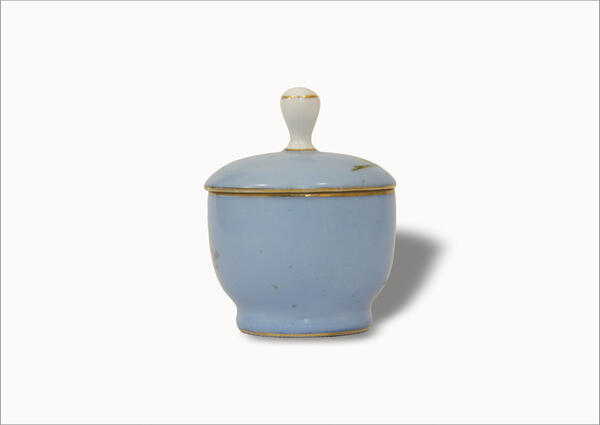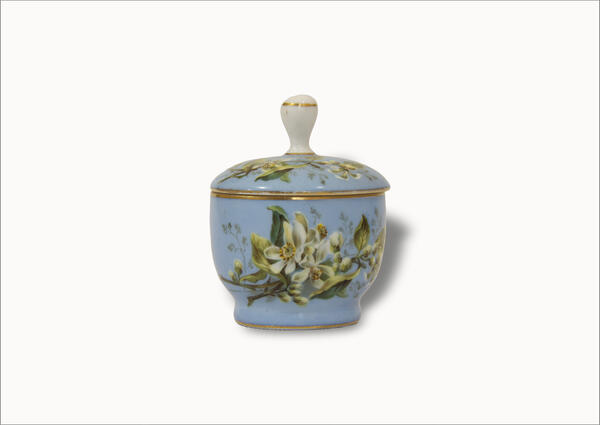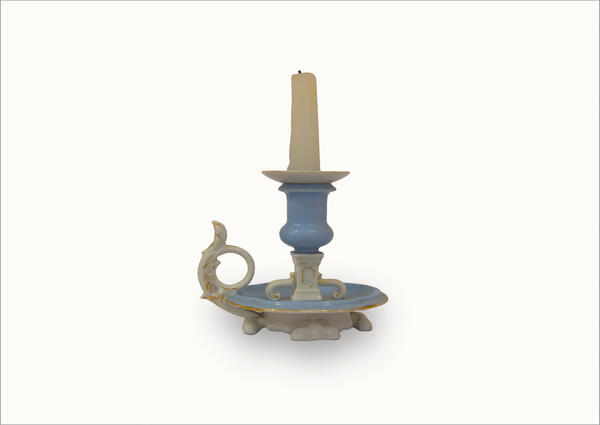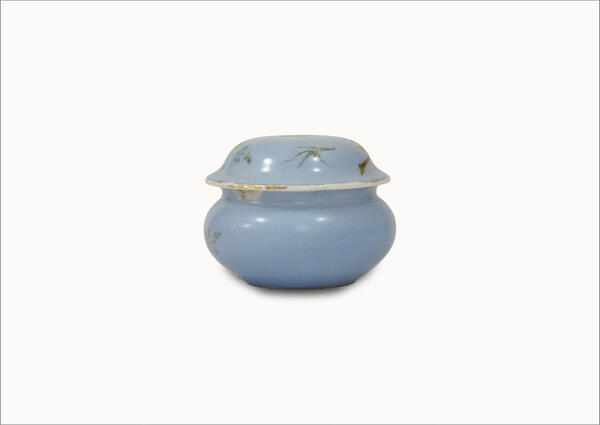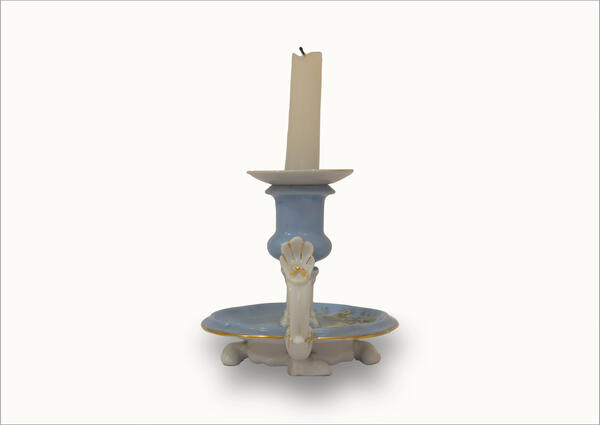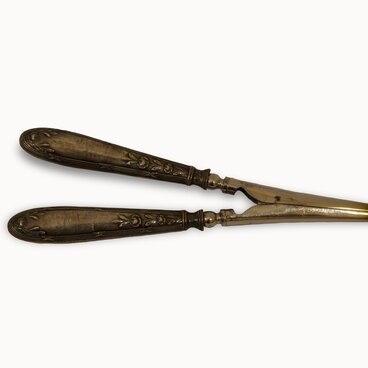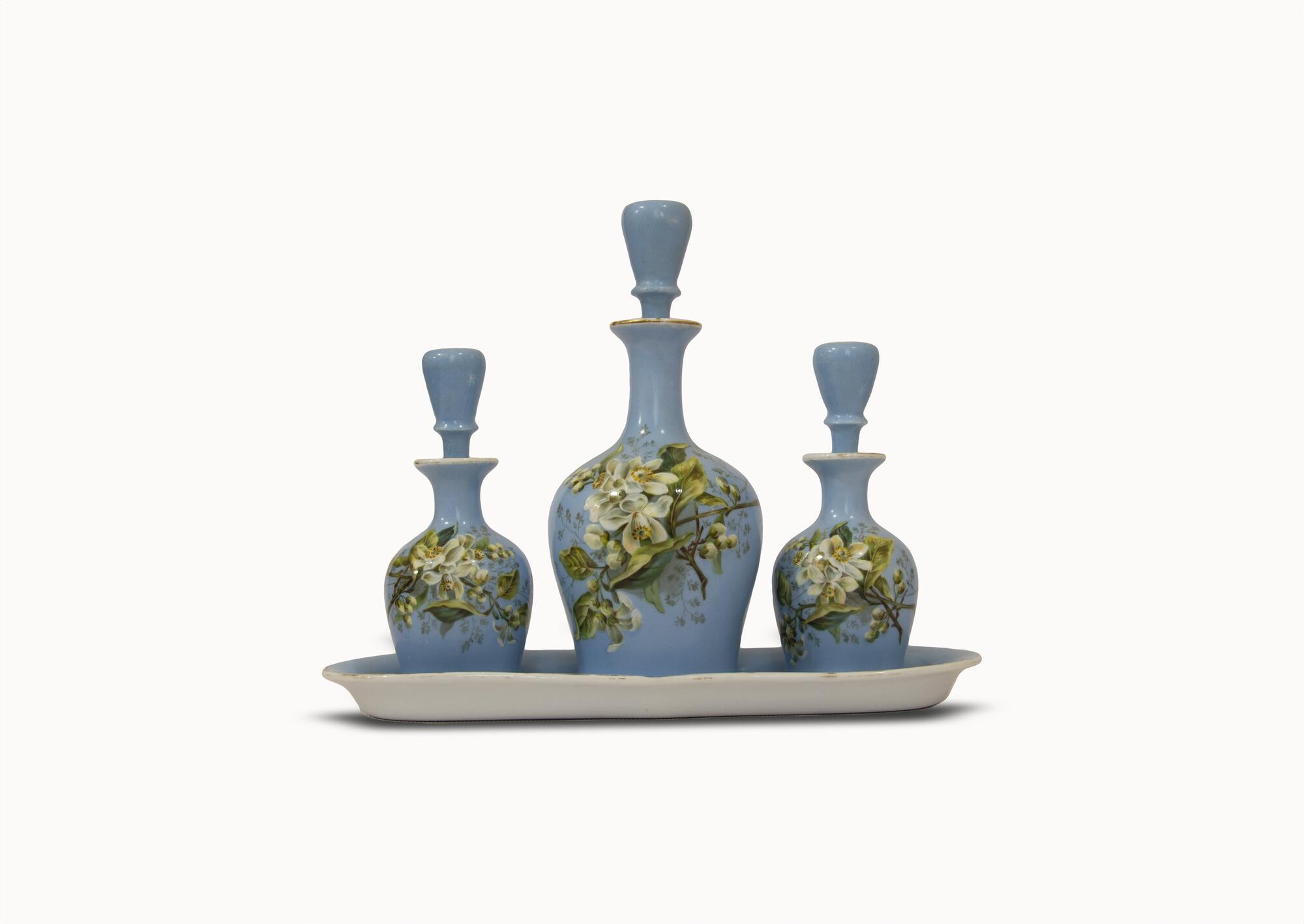


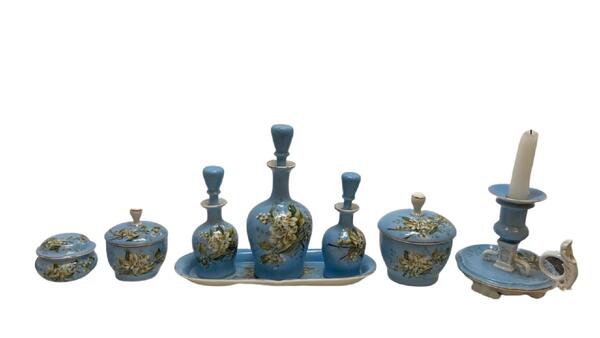
The Masharov’s House Museum presents a set for a dressing table, consisting of a powder box, two jewelry boxes, three perfume vessels and a candlestick.
A dressing table with a mirror appeared in Western Europe in the middle of the 17th century and was designed to foster both beauty and cleanliness. In the morning, women would wash their faces in front of the mirror, and put on make up before going out. This piece of furniture was used not only by ladies, but also by gentlemen. The dressing table was crowned with a large mirror, it was used to store perfume, jewelry, and powder.
In Russia, powder has been known since the 17th century. Ladies and gentlemen used rice and wheat powder, which they flavored and tinted. Face powder was made from high-quality starch with an admixture of talc and fragrant oils. Such a delicate product needed to be stored in an elegant container, namely a powder box. These were small jars with a lid, made of valuable metals, crystal or porcelain, decorated with various kinds of paintings and even precious stones.
Perfume bottles of this type, as in the presented set, adorned the dressing tables of gentlemen and ladies, while simple bottles that did not differ much from apothecary bottles or wine bottles of that time were displayed in perfume shops. People often bought perfumes or colognes in simple containers and then poured them into beautiful vessels. In this case, the bottle expressed the idea of a perfume in general, rather than any particular fragrance. Next to the “fragrant water” and powder, precious jewelry was also stored on the table, in a special vessel, decorated in the same style as the set.
At the turn of the 20th century, small gemstones were in vogue. The main criteria for a piece of jewelry were its small size, elegance, and a complex shape of the product. Hair jewelry was made in the form of butterflies and shamrocks, beetles, bows, and stars. The rings had intersecting ends and precious stones. There were heart rings with a crown of gems. Star brooches, sun brooches, crescent moon brooches with diamonds and insect brooches were worn several at a time.
A dressing table with a mirror appeared in Western Europe in the middle of the 17th century and was designed to foster both beauty and cleanliness. In the morning, women would wash their faces in front of the mirror, and put on make up before going out. This piece of furniture was used not only by ladies, but also by gentlemen. The dressing table was crowned with a large mirror, it was used to store perfume, jewelry, and powder.
In Russia, powder has been known since the 17th century. Ladies and gentlemen used rice and wheat powder, which they flavored and tinted. Face powder was made from high-quality starch with an admixture of talc and fragrant oils. Such a delicate product needed to be stored in an elegant container, namely a powder box. These were small jars with a lid, made of valuable metals, crystal or porcelain, decorated with various kinds of paintings and even precious stones.
Perfume bottles of this type, as in the presented set, adorned the dressing tables of gentlemen and ladies, while simple bottles that did not differ much from apothecary bottles or wine bottles of that time were displayed in perfume shops. People often bought perfumes or colognes in simple containers and then poured them into beautiful vessels. In this case, the bottle expressed the idea of a perfume in general, rather than any particular fragrance. Next to the “fragrant water” and powder, precious jewelry was also stored on the table, in a special vessel, decorated in the same style as the set.
At the turn of the 20th century, small gemstones were in vogue. The main criteria for a piece of jewelry were its small size, elegance, and a complex shape of the product. Hair jewelry was made in the form of butterflies and shamrocks, beetles, bows, and stars. The rings had intersecting ends and precious stones. There were heart rings with a crown of gems. Star brooches, sun brooches, crescent moon brooches with diamonds and insect brooches were worn several at a time.