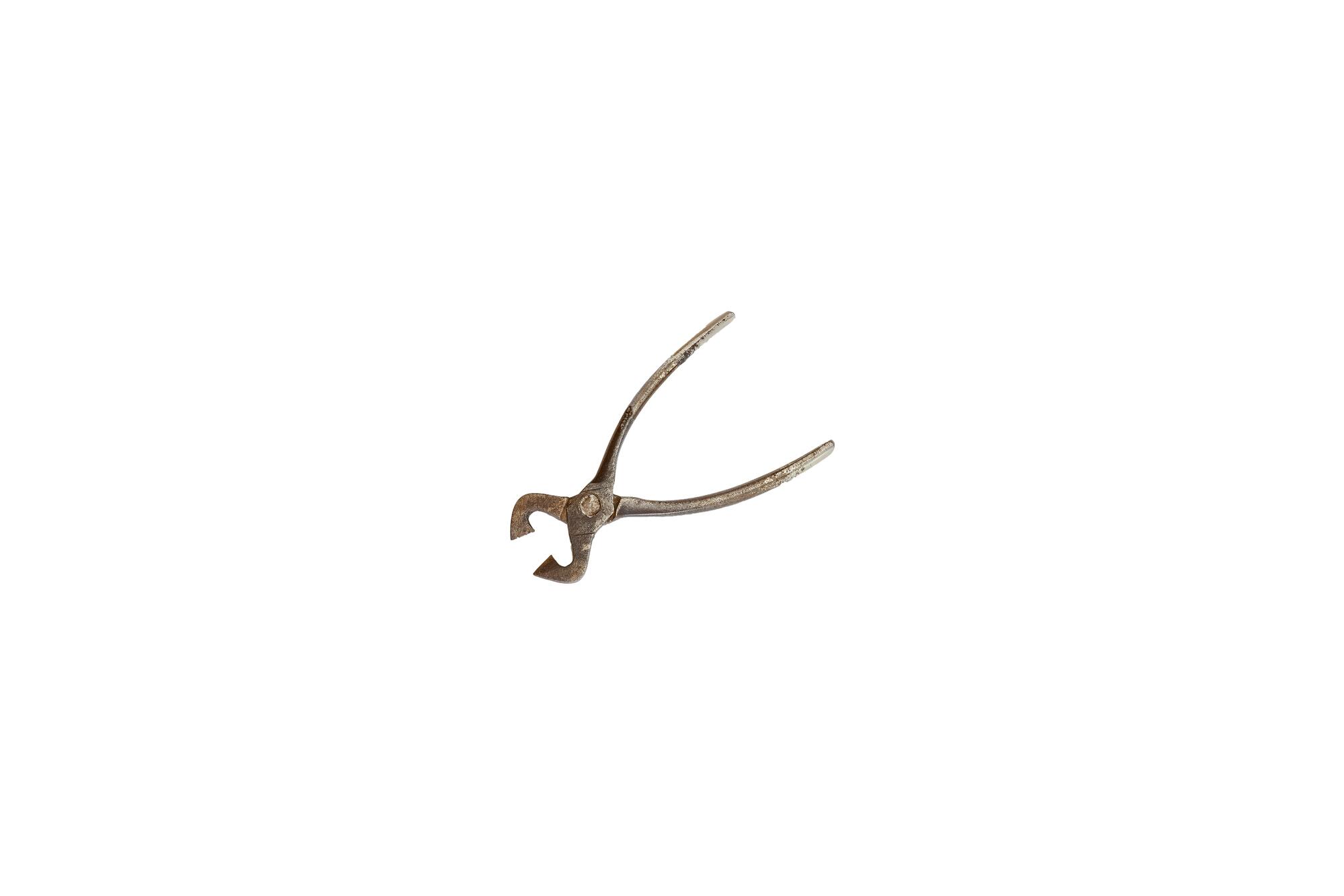


Tongs for sugar splitting were made in the second quarter of the 20th century at the steel products factory “Trud” [“Labor”] in the Gorky (nowadays Nizhny Novgorod) Region. They consist of two identical metal parts joined in the center. When connected, the working ends of a tool form a through hole in the form of a heart. The handles of the tongs are semicircular and slightly bent. There is a factory stamp on one side in the place of the rivet. One-half of a tool is slightly deformed. Its working part is bent away.
Previously, sugar was produced in large pieces, which were called sugar loaves or sugar cones. To bring it to the table or use it in the process of cooking, it was necessary to split such a loaf into several smaller pieces. First, it was broken with a special sugar hammer, and then its large fragments were divided into smaller ones with tongs. People also could buy crushed sugar, but it cost more.
Tongs for sugar splitting were made of different kinds of metal. Among them were stainless steel, brass, and cupronickel. In aristocratic families, it was customary to serve the guests with silver tongs. Their working parts were figured, embossed, or engraved on the handles. They were combined. Such tongs could be used to both chop sugar, and take it out of a container to put in tea or eat a bite. The cooks, who worked in a kitchen, used simpler models, which were intended only to chop sugar.
The first sugar tongs appeared in England in the 18th century. Sweet tea became popular exactly in this country. From the very beginning, it was drunk mainly by women, and later the sweet drink was also appreciated by men. The peak of the popularity of this device was in the 19th century. Every second family in Great Britain had tongs for sugar splitting. At the same time, they were brought to other countries, including the Russian Empire.
Previously, sugar was produced in large pieces, which were called sugar loaves or sugar cones. To bring it to the table or use it in the process of cooking, it was necessary to split such a loaf into several smaller pieces. First, it was broken with a special sugar hammer, and then its large fragments were divided into smaller ones with tongs. People also could buy crushed sugar, but it cost more.
Tongs for sugar splitting were made of different kinds of metal. Among them were stainless steel, brass, and cupronickel. In aristocratic families, it was customary to serve the guests with silver tongs. Their working parts were figured, embossed, or engraved on the handles. They were combined. Such tongs could be used to both chop sugar, and take it out of a container to put in tea or eat a bite. The cooks, who worked in a kitchen, used simpler models, which were intended only to chop sugar.
The first sugar tongs appeared in England in the 18th century. Sweet tea became popular exactly in this country. From the very beginning, it was drunk mainly by women, and later the sweet drink was also appreciated by men. The peak of the popularity of this device was in the 19th century. Every second family in Great Britain had tongs for sugar splitting. At the same time, they were brought to other countries, including the Russian Empire.