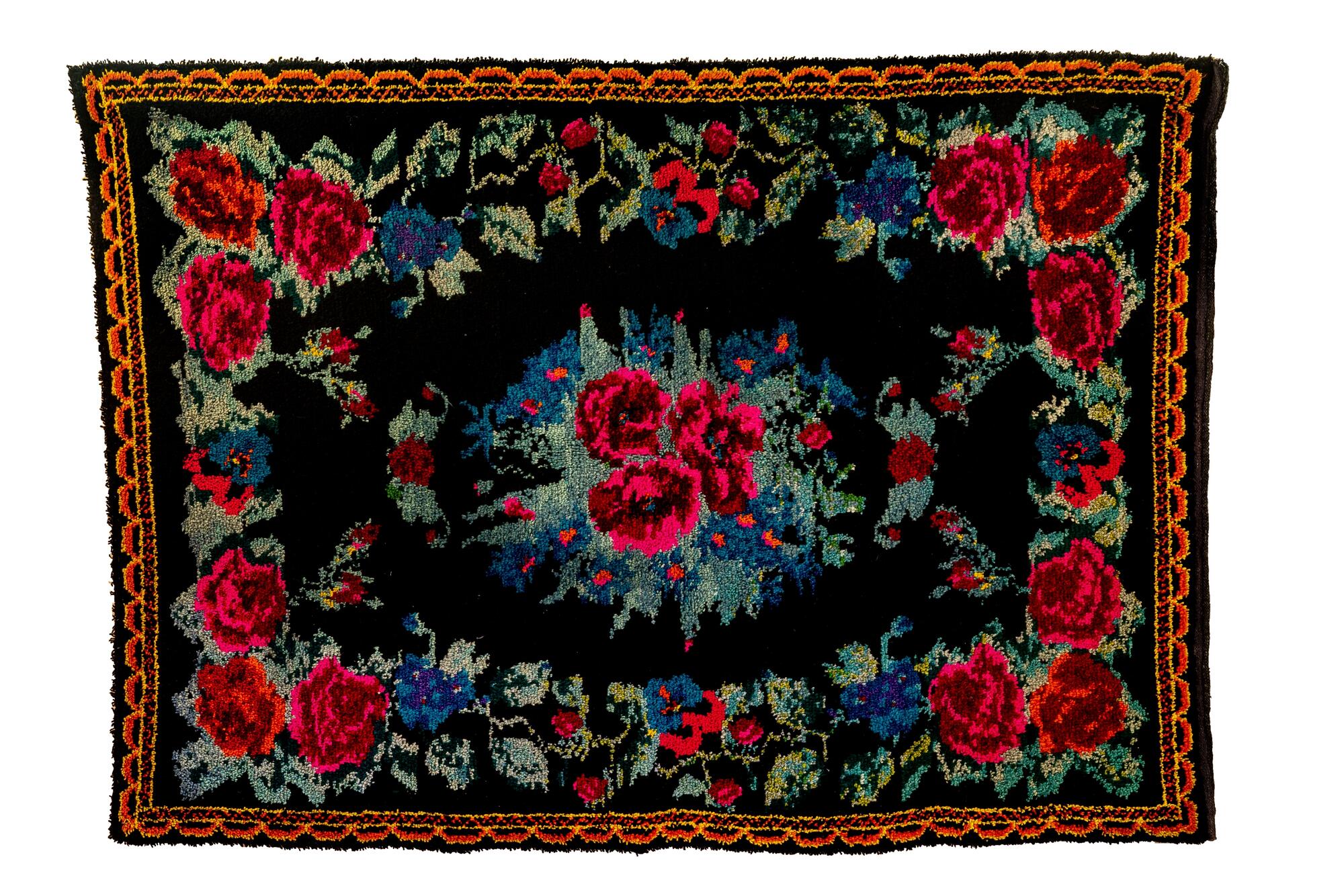


Tyumen tufted carpet with floral ornament was woven according to old patterns in the middle of the 20th century. The craftsmen used brightly colored woolen threads in order to make it. The main part of the carpet is woven in black. In the center, there are three big burgundy-crimson roses against a blue background. Small blue forget-me-nots surround them. The same ornament frames the edges of the carpet. The whole composition has a yellow-orange border.
Handmade home carpet weaving was widespread in all districts of the Tobolsk Governorate since the 18th century. Tyumen was its largest center. This carpet type got its name from this place. The craftswomen were taught from their early childhood. In the beginning they were assistants of the senior artisans, after that they worked independently. In addition to expensive carpets with bright ornaments, Tyumen was famous for floor mats and rugs with simple ornaments, coverings for benches and chests, as well as horsecloths.
The background, as a rule, was black. This color was a symbol of fertile land. Bright patterns with different shades of mostly red symbolized wealth and strength. It was believed that such carpets would bring good luck and wealth. If they were inherited from ancestors, then they also served as protective talismans.
Tyumen carpet craft reached its peak by the 19th century. The city was located on the main trade route — the Siberian Route. Merchants from different cities often passed through Tyumen. Local citizens sold their products to those merchants.
Even the king of Hawaii used the Tyumen carpets. At the beginning of the 19th century, the Russian ships “Nadezhda” and “Neva” sailed around the world. The Hawaiian Islands was one of the support bases during this journey. There, the team could exchange the goods for meat and vegetables. Tyumen carpets were among the exchange items: they were gifted to the local king.
The Grand Duke Vladimir Alexandrovich of Russia, son of Emperor Alexander II, visited the city in 1868. The citizens presented him with one of the local carpets. The Grand Duke also bought one more carpet himself. In addition, the Grand Duke personally allocated money for awards and commendation certificates for the local craftswomen.
The carpets made by the Tyumen carpet weavers took part in international exhibitions. As a result of one of them, Vasilisa Vikulova from the village of Kamenka was awarded a gold medal in Paris in 1900.
Handmade home carpet weaving was widespread in all districts of the Tobolsk Governorate since the 18th century. Tyumen was its largest center. This carpet type got its name from this place. The craftswomen were taught from their early childhood. In the beginning they were assistants of the senior artisans, after that they worked independently. In addition to expensive carpets with bright ornaments, Tyumen was famous for floor mats and rugs with simple ornaments, coverings for benches and chests, as well as horsecloths.
The background, as a rule, was black. This color was a symbol of fertile land. Bright patterns with different shades of mostly red symbolized wealth and strength. It was believed that such carpets would bring good luck and wealth. If they were inherited from ancestors, then they also served as protective talismans.
Tyumen carpet craft reached its peak by the 19th century. The city was located on the main trade route — the Siberian Route. Merchants from different cities often passed through Tyumen. Local citizens sold their products to those merchants.
Even the king of Hawaii used the Tyumen carpets. At the beginning of the 19th century, the Russian ships “Nadezhda” and “Neva” sailed around the world. The Hawaiian Islands was one of the support bases during this journey. There, the team could exchange the goods for meat and vegetables. Tyumen carpets were among the exchange items: they were gifted to the local king.
The Grand Duke Vladimir Alexandrovich of Russia, son of Emperor Alexander II, visited the city in 1868. The citizens presented him with one of the local carpets. The Grand Duke also bought one more carpet himself. In addition, the Grand Duke personally allocated money for awards and commendation certificates for the local craftswomen.
The carpets made by the Tyumen carpet weavers took part in international exhibitions. As a result of one of them, Vasilisa Vikulova from the village of Kamenka was awarded a gold medal in Paris in 1900.