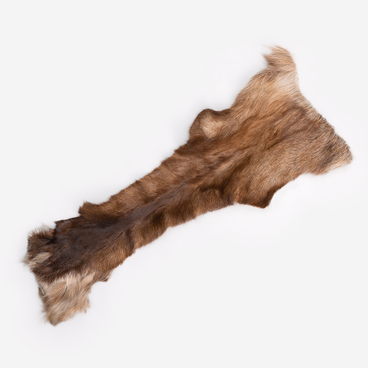
By the end of the 20th century, the economic life of the Sami people was based on reindeer herding: the reindeer was a means of transportation across the tundra, reindeer meat was a source of food, and reindeer skins were used for clothing, footwear and housing. Besides reindeer hides, tanned skins, fox, hare and beaver pelts, which were dressed in households, were used for sewing and finishing clothes, as well as such textiles as cloth, canvas and calico that were bought at the fair in Kola. Some types of shoes were made of sea-calf and seal skins.
Some items of Sami clothing differed depending on whom they belonged to. Sami headdresses are quite distinctive. The most common winter headdress was a cloth hat.
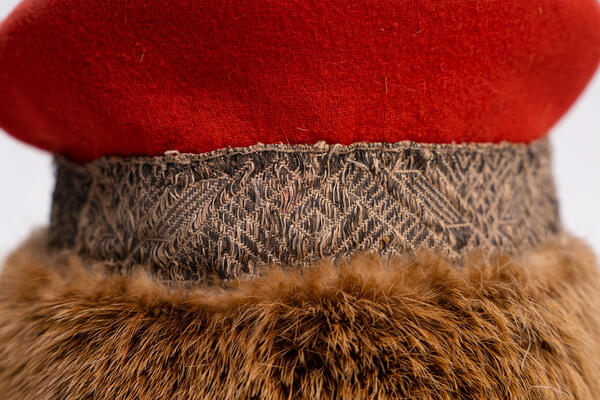
A woman’s winter hat (nizan kabper’) had a round or oval top and earflaps with straps. It was covered with red cloth, decorated with brocade ribbon, and lined with marten and red fox fur.
The craftswomen created compositions of fur pieces of contrasting colors and sewed them together. Anna Pavlovna Kosmenko, a specialist in the decorative and applied art of the Sami people, distinguishes four types of mosaic compositions: zone, border, grid and single motifs.
To decorate fur with cloth, cloth fabrics of yellow, blue and red colors were used. They were sewn into the product along with pieces of fur, stitched with edgings into the seams of the product, and used as pendants or accessories. Pendants were made of triangles of different size and color sewn together, attached to the product with leather straps strung with beads. Cloth was also used to decorate not only hats, but also other fur, leather or cloth garments.
Beads became one of the common materials of
decoration for Sami craftswomen. The
motifs of the bead embroidery patterns are typically both geometric and
pictorial: stylized anthropomorphic figures, patterns depicting separate parts
of an animal or a bird. Each type of products had its own peculiarities of
lines and figures. Compositionally, appliqué and bead embroidery used the same
motifs as fur mosaics.