

The national costume is a remarkable manifestation of folk craft. Clothing can tell a lot about the wearer’s age and social status. The traditional folk costume is the most striking indicator of national identity.
A headdress was considered an obligatory element of the Tatar traditional women’s costume. Women had to cover the head in order to comply with Sharia (a set of prescriptions that determine the life of every Muslim). Tatar women’s costume included a shawl as an obligatory component. The veils came in various versions — “yaulyk” (“yaulok”) and shawl (“shel”). Wearing a scarf or shawl was mandatory for a Siberian Tatar woman, even in combination with other types of headwear. The headdress of a married Tatar woman consisted of three obligatory parts. Underdresses (volosniki) were used to gather and cover the hair. The main (middle) headdresses — veils — came in different shapes: they could be triangular, square, and towel-shaped. Top hats were worn over the veils, firmly securing them on the head. The girls’ headdress — kalfak — had a cap-shaped design and was worn without a volosnik. Over time, the kalfak underwent changes, turned into a pinned headdress and a kind of skullcap, secured on the head with the help of small hooks sewn from the inside. Married Tatar women also began to wear such kalfaks, wrapping light veils, scarves or silk shawls on top when leaving the house.
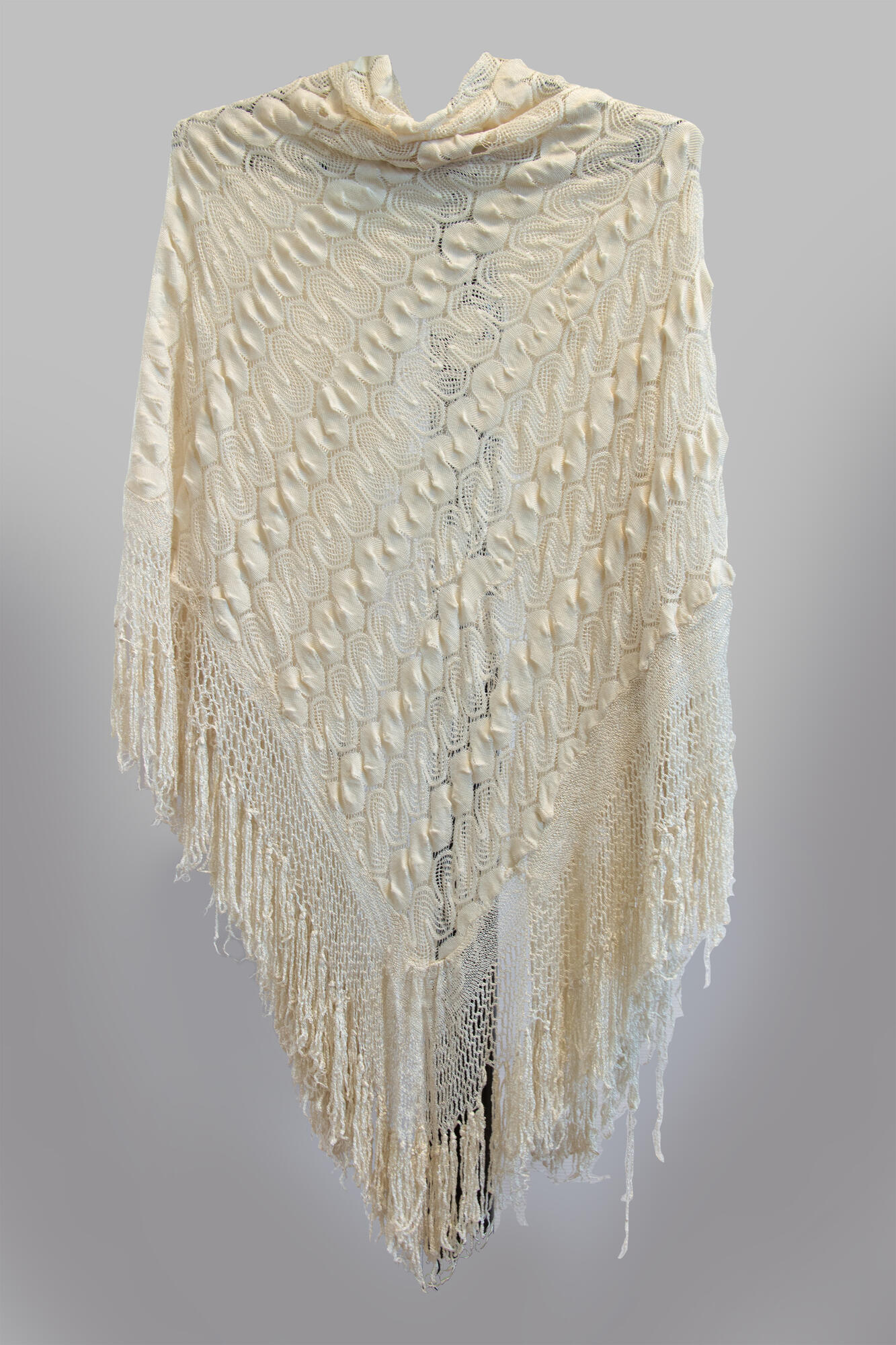
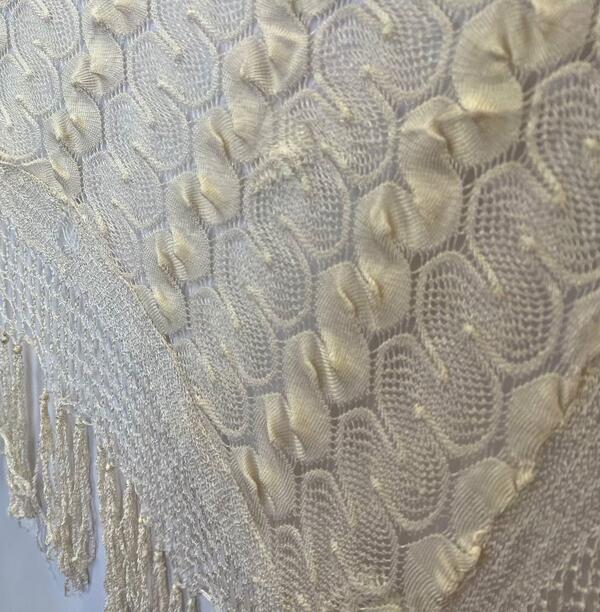
Shawls were widespread, but at the same time they were considered a luxury item, and not all women could afford them. There were several types of shawls: silk fabric (“evyak shel”), silk openwork (“mershite shel”), cashmere (“chachakly shel”), as well as downy winter ones (“momyk shel”). The museum exhibits include a shawl called “mershite shel”. It is made of beige silk threads and was an expensive gift. It is believed that caravans brought these shawls to Russian fairs from China. The shawl features a three-dimensional zigzag pattern. The edges are trimmed with a long silk fringe.
A headdress was considered an obligatory element of the Tatar traditional women’s costume. Women had to cover the head in order to comply with Sharia (a set of prescriptions that determine the life of every Muslim). Tatar women’s costume included a shawl as an obligatory component. The veils came in various versions — “yaulyk” (“yaulok”) and shawl (“shel”). Wearing a scarf or shawl was mandatory for a Siberian Tatar woman, even in combination with other types of headwear. The headdress of a married Tatar woman consisted of three obligatory parts. Underdresses (volosniki) were used to gather and cover the hair. The main (middle) headdresses — veils — came in different shapes: they could be triangular, square, and towel-shaped. Top hats were worn over the veils, firmly securing them on the head. The girls’ headdress — kalfak — had a cap-shaped design and was worn without a volosnik. Over time, the kalfak underwent changes, turned into a pinned headdress and a kind of skullcap, secured on the head with the help of small hooks sewn from the inside. Married Tatar women also began to wear such kalfaks, wrapping light veils, scarves or silk shawls on top when leaving the house.
Shawls were widespread, but at the same time they were considered a luxury item, and not all women could afford them. There were several types of shawls: silk fabric (“evyak shel”), silk openwork (“mershite shel”), cashmere (“chachakly shel”), as well as downy winter ones (“momyk shel”). The museum exhibits include a shawl called “mershite shel”. It is made of beige silk threads and was an expensive gift. It is believed that caravans brought these shawls to Russian fairs from China. The shawl features a three-dimensional zigzag pattern. The edges are trimmed with a long silk fringe.