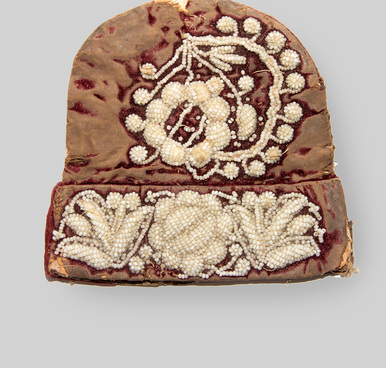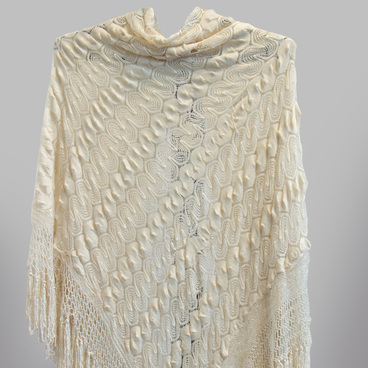
The kalfak headdress is the only element of the Tatar costume that is still worn today. Many women from the Embaevo village own a kalfak. This ancient Tatar women’s headdress was widespread primarily among Kazan Tatars. From the late 19th century, it became popular in other regions of the empire and with almost all groups of Tatars.
Throughout its existence, the kalfak has been constantly changing. A certain color or a certain material became especially fashionable, or there was a change in the fashion for jewelry — precious and semiprecious stones, gold coins, pearls and other objects used to decorate velvet kalfaks. The cost of a kalfak could reach up to 2,000 rubles, so sometimes it was even insured and kept in special cases.
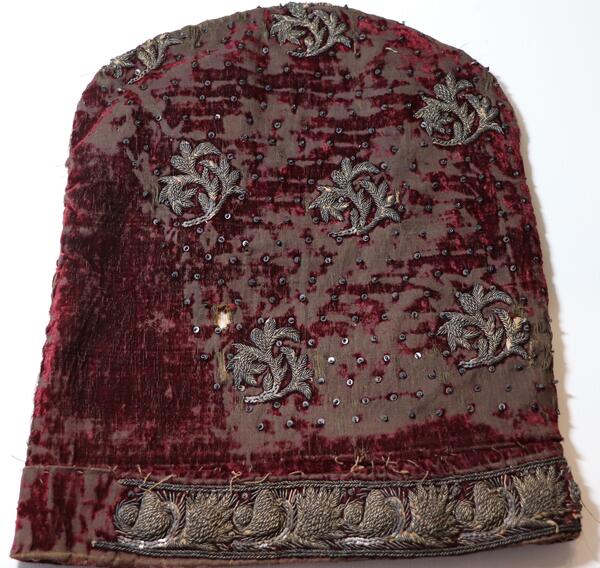
This item dates back to the late 19th — early 20th centuries. The soft hemispherical hat is made of red velvet. The top features a floral motif — a pattern of undulating twigs — embroidered with gold threads.
The traditions of Tatar gold embroidery, rooted in antiquity, have evolved for many centuries. This art was enriched by numerous borrowings from neighboring cultures and at the same time retained its originality and uniqueness.
Since the second half of the 18th century, gold embroidery has become widespread both in Asian and Russian manufactories producing fabrics, gimps and auxiliary decorative material. Tatar gold embroidery was performed mainly on velvet, less often on silk, wool and cotton. Craftswomen used high-quality velvet of the finest finish and deep shades that was imported from Central Asia, Iran, Turkey, India, and Western Europe. The precious metal palette harmoniously matched the soft and iridescent texture of velvet, creating original improvised pictorial compositions on its surface. A golden thread featured an elegant floral miniature on velvet of pomegranate, moonlight, cherry, golden, and blue shades.
Throughout its existence, the kalfak has been constantly changing. A certain color or a certain material became especially fashionable, or there was a change in the fashion for jewelry — precious and semiprecious stones, gold coins, pearls and other objects used to decorate velvet kalfaks. The cost of a kalfak could reach up to 2,000 rubles, so sometimes it was even insured and kept in special cases.
This item dates back to the late 19th — early 20th centuries. The soft hemispherical hat is made of red velvet. The top features a floral motif — a pattern of undulating twigs — embroidered with gold threads.
The traditions of Tatar gold embroidery, rooted in antiquity, have evolved for many centuries. This art was enriched by numerous borrowings from neighboring cultures and at the same time retained its originality and uniqueness.
Since the second half of the 18th century, gold embroidery has become widespread both in Asian and Russian manufactories producing fabrics, gimps and auxiliary decorative material. Tatar gold embroidery was performed mainly on velvet, less often on silk, wool and cotton. Craftswomen used high-quality velvet of the finest finish and deep shades that was imported from Central Asia, Iran, Turkey, India, and Western Europe. The precious metal palette harmoniously matched the soft and iridescent texture of velvet, creating original improvised pictorial compositions on its surface. A golden thread featured an elegant floral miniature on velvet of pomegranate, moonlight, cherry, golden, and blue shades.