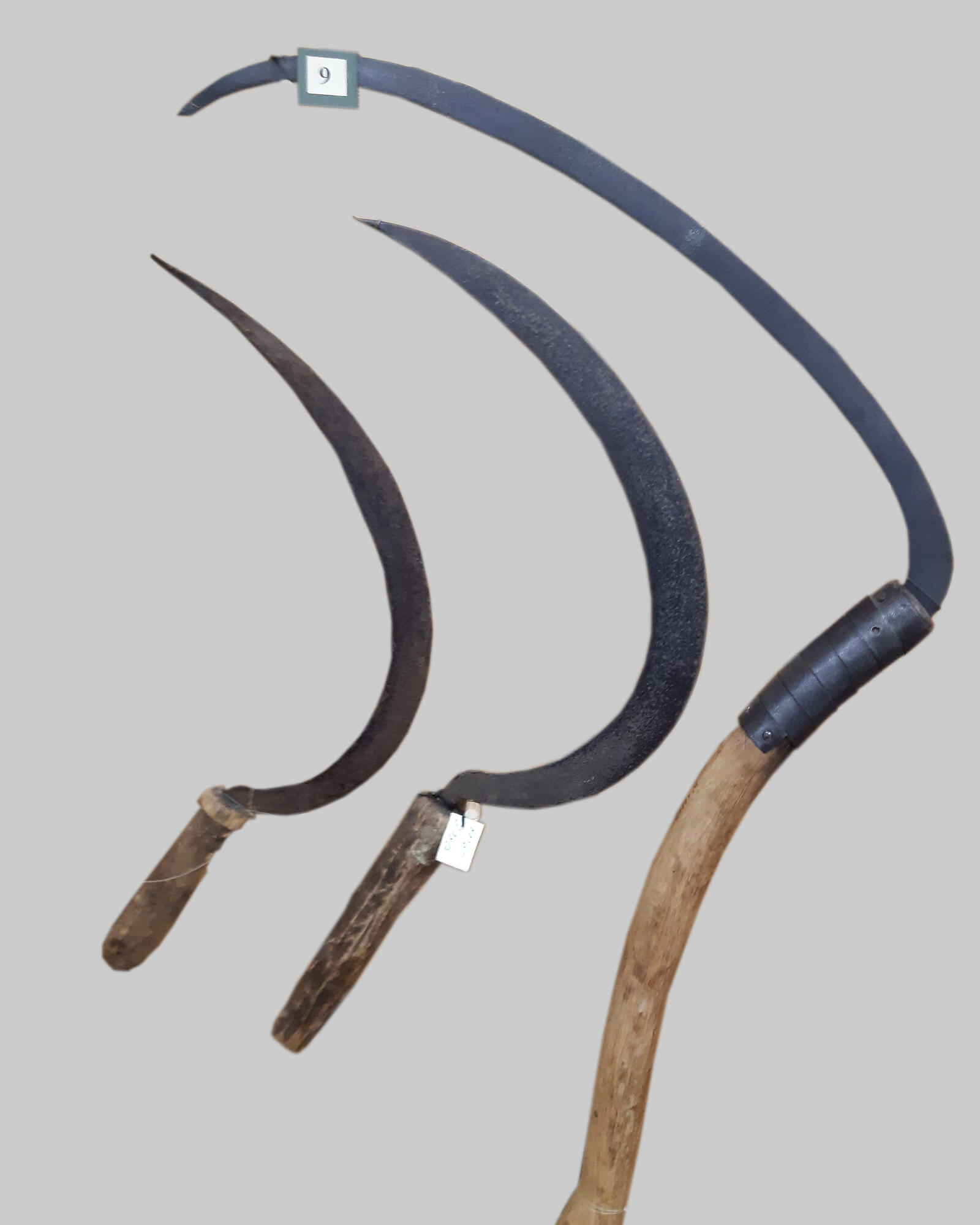


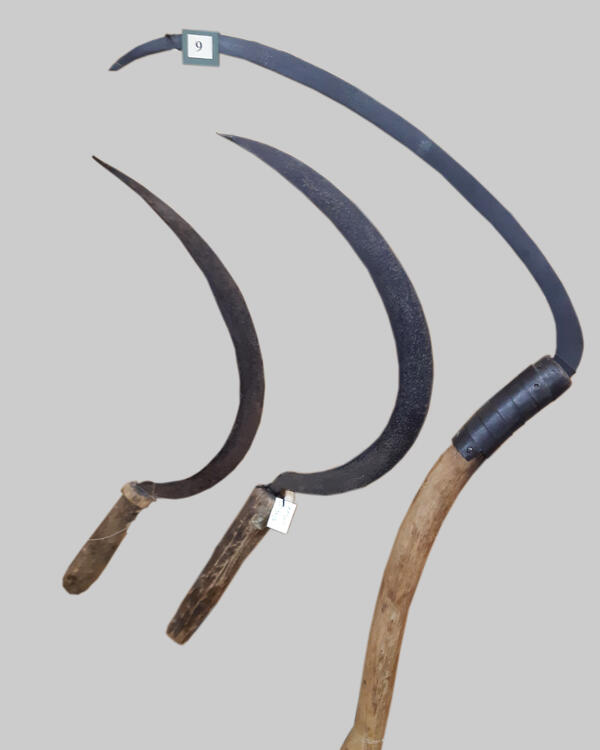
In the 18th and 19th centuries, a sickle was the main tool for harvesting grain crops. A sickle is a curved knife with a straight sharp end and a short wooden handle. The way the handle was situated relative to the blade increased force applied in the middle of the blade curve. The sickle was an invaluable tool for harvesting grains. Holding the sickle in her right hand, the reaper separated a bundle of ears for a cut with the narrowed blunt end of the sickle, grasped it with her left hand, and then cut the bundle with the sharp middle part of the blade. Rye, wheat, and barley crops were usually reaped with a sickle almost everywhere. If the wheat was bad and could not be reaped with a sickle, it was uprooted. Buckwheat, oats, and peas were typically reaped with a scythe.
During the harvest period, special rules of conduct and prohibitions were observed. In order not to incur thunderstorms and fires on the grain harvested in the field, household work was stopped on calendar holidays that fell on the time of the harvest. During the harvest, people even tried to avoid lighting fires in their homes or firing up their stoves.
Udmurt people were traditionally dedicated to agriculture. Farming traditions informed a reverent attitude of Udmurts towards their lands. When describing their lands, they would often refer to earth itself with kindness and reverence, calling it ‘mother earth, earth the provider’. The plow and the harrow were the most important agricultural tools.
In addition, the farms used sickles for the harvest and the flails for threshing grain. These tools have remained virtually unchanged for a very long time. The tools, essential for the farmers' trade, were manufactured in factories and artisan workshops.
The peasants bought them at fairs, bazaars, or commissioned them directly from artisans. All traditional peasant tools, with the exception of tillage tools, were uniform throughout Russia. Sickles were used for harvesting, flails were used to thresh grain crops, rolls were for threshing flax and hemp, and shovels were for winnowing.
Unique local features of these tools and devices manifested only in select details — if at all — and did not affect their overall design. These tools were cleverly constructed and well adapted to various specifics of nature and the climate. We can say with confidence that for their time they were quite perfect, and only the march of the technical progress gradually phased them out of the peasant’s work process.
During the harvest period, special rules of conduct and prohibitions were observed. In order not to incur thunderstorms and fires on the grain harvested in the field, household work was stopped on calendar holidays that fell on the time of the harvest. During the harvest, people even tried to avoid lighting fires in their homes or firing up their stoves.
Udmurt people were traditionally dedicated to agriculture. Farming traditions informed a reverent attitude of Udmurts towards their lands. When describing their lands, they would often refer to earth itself with kindness and reverence, calling it ‘mother earth, earth the provider’. The plow and the harrow were the most important agricultural tools.
In addition, the farms used sickles for the harvest and the flails for threshing grain. These tools have remained virtually unchanged for a very long time. The tools, essential for the farmers' trade, were manufactured in factories and artisan workshops.
The peasants bought them at fairs, bazaars, or commissioned them directly from artisans. All traditional peasant tools, with the exception of tillage tools, were uniform throughout Russia. Sickles were used for harvesting, flails were used to thresh grain crops, rolls were for threshing flax and hemp, and shovels were for winnowing.
Unique local features of these tools and devices manifested only in select details — if at all — and did not affect their overall design. These tools were cleverly constructed and well adapted to various specifics of nature and the climate. We can say with confidence that for their time they were quite perfect, and only the march of the technical progress gradually phased them out of the peasant’s work process.