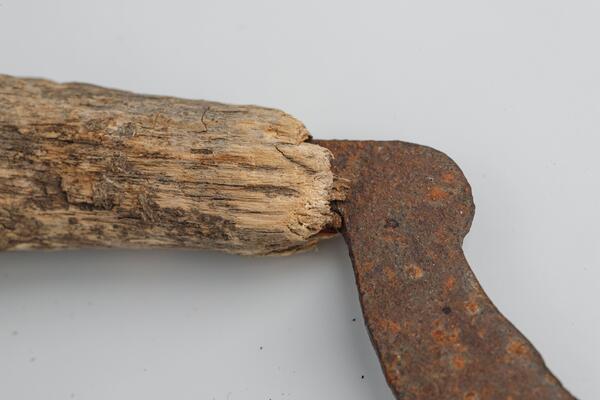
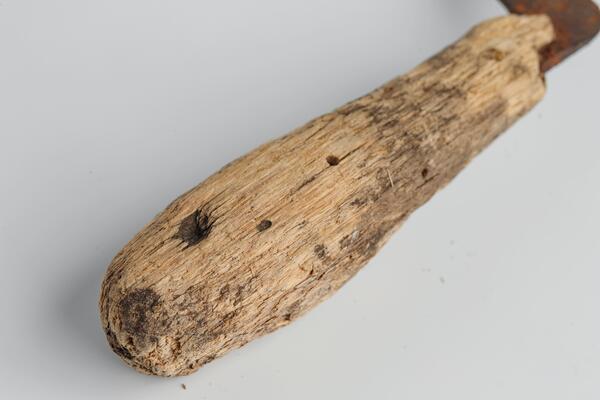
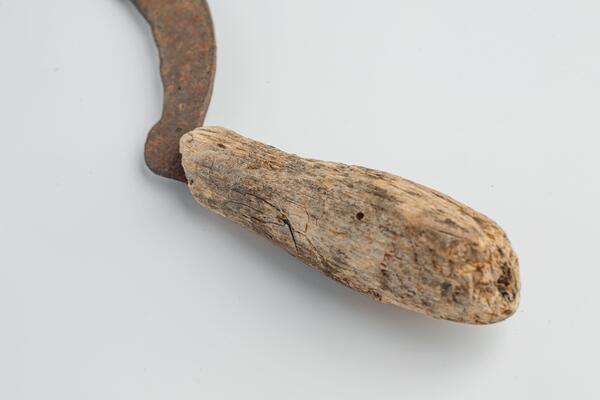
The sickle on display in the Museum of Intelligence Officer Nikolai Ivanovich Kuznetsov was crafted at the turn of the 20th century. Its blade was factory-made, while the wooden handle was hand-carved. The upper, curved portion of the blade is flat, and the lower edge is carefully sharpened — ensuring a precise and efficient cut. Securely fastened to the handle, the sickle allowed for prolonged use without excessive fatigue.
The sickle is one of humanity’s oldest agricultural tools. Archaeological evidence shows that the earliest sickles appeared during the Neolithic era — roughly 10,000 years ago — coinciding with the dawn of agriculture. Depictions of reapers wielding sickles adorn the walls of Egyptian tombs and appear in ancient Greek art. Farmers used this tool to harvest cereals and grasses: grasping the stalks with one hand and slicing them near the base with the sickle in the other. While the scythe gradually replaced the sickle for large-scale harvesting, the sickle remained indispensable for small plots.
In the Kuznetsov household — a modest peasant family — the sickle was an essential part of daily life. Harvesting was an annual ritual demanding patience, strength, and skill. Yet for the Kuznetsovs, labor was more than a chore; it embodied culture, craftsmanship, and a commitment to excellence.
Nikolai’s father, Ivan Pavlovich Kuznetsov, was a man of rare qualities for his time — not merely a peasant, but what villagers called an “innovator”: literate, curious, and dedicated to rational, efficient farming. He read books and agricultural journals, visited neighboring villages to learn new techniques, and rejected outdated superstitions — all in pursuit of sustainability and productivity.
His guiding principle was culture — in household management, daily conduct, and human interaction. He maintained close ties with the rural intelligentsia of the Balair volost center, forming friendships with a paramedic, schoolteachers, a clerk, and even a priest. In 1912, he helped establish a local consumer cooperative, and later became a founding member of the Balair Credit Partnership. He firmly believed that education, cooperation, and modern technology were the keys to rural survival and prosperity.
When fall plowing was introduced in the region, Ivan Kuznetsov was the first in the municipality to purchase a specialized plow and adopt the technique, significantly boosting his yields. In 1917, his fellow villagers unanimously elected him village headman in recognition of his literacy, integrity, and leadership.
Even amid the turmoil of the 1920s, Ivan Kuznetsov demonstrated remarkable foresight. When the Soviet government began purchasing clover seeds at fixed prices, encouraging peasants to cultivate forage crops, he was the first in the parish to sow clover.
The entire family took part in the harvest, and young Nikolai contributed from an early age — cutting grass, raking, drying hay, threshing grain, and sorting seeds. The income from seed sales often became the family’s sole means of survival.