Font
Color
Graphics
Изображение точки

To see AR mode in action:

1. Install ARTEFACT app for iOS or Android;

2. Find the exhibition «Man from the Legend»

3. Push the «Augmented reality» button and point your phone's camera at the exhibit;

Скрыть точки интересаПоказать точки интереса
Показать в высоком качестве

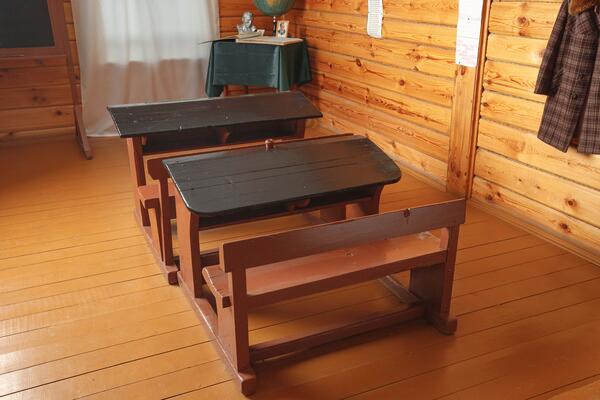
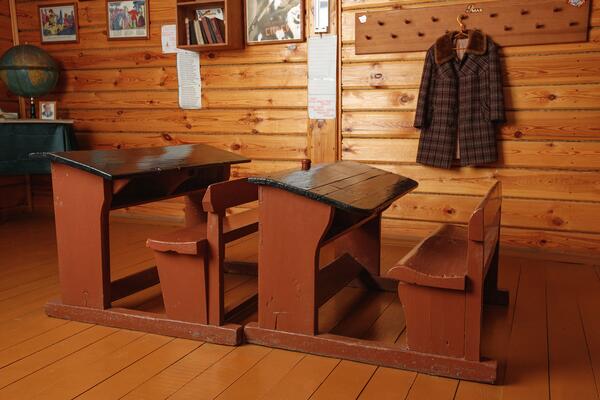
Double school desk

Creation period
the 1920s
Dimensions
111,5x96x73 cm
Technique
wood
0
Open in app
#14

The Museum of Intelligence Officer Nikolai Kuznetsov in the village of Zyryanka houses a double school desk — a silent witness to the school days of students at the local elementary school. Desks of this type were used there from the 1920s until the early 1950s. In the early 1920s, the future legendary intelligence officer Nikolai Kuznetsov, then a pupil at Zyryanka Elementary School, sat at one just like it.


The foundations of Russia’s education system began to take shape under Peter the Great, who introduced early modern higher education and founded the Academy of Sciences. The system was further developed through the reforms of Catherine II and Alexander I, who established the Ministry of Public Education and created a nationwide network of gymnasiums.


However, the history of specialized school furniture dates only to the late 19th century. Before then — when education was neither widespread nor compulsory — little attention was paid to the organization of the learning process. Most children began working at an early age, and those who did receive instruction typically studied at home or in classrooms furnished with ordinary communal tables.


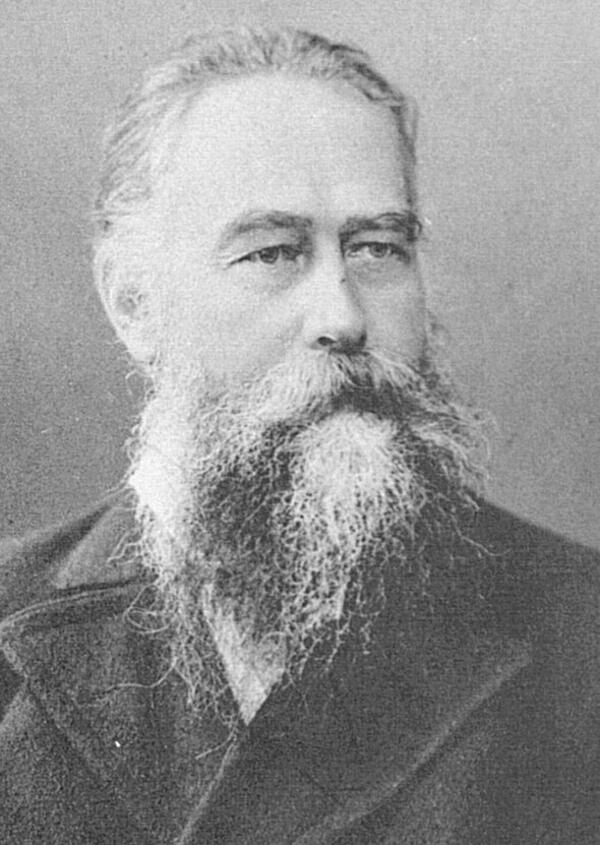
By the second half of the 19th century, physicians in gymnasiums began to notice a troubling trend: students’ eyesight and posture were deteriorating on a massive scale. The Swiss-born Russian hygienist Fyodor Fyodorovich Erismann identified the root cause: students were seated at tables not designed for study, leading to chronic health problems.
#2
Fyodor Fyodorovich Erismann
#15

Erismann designed a school desk with a sloping tabletop that ensured proper ergonomics. This innovation maintained the optimal distance between the eyes and the book — 30 to 40 centimeters — and helped prevent posture and vision issues. Although similar concepts existed earlier (such as the Swiss Farner desk), Erismann refined the design by scientifically calculating ideal proportions. His single-seat desk was soon adopted across educational institutions in the Russian Empire.


Later, modified versions based on Erismann’s model appeared — double desks with hinged, folding tabletops that allowed students to rise comfortably from their seats. These desks also featured hooks for briefcases, a practical solution in village schools that lacked lockers.


Mass-produced from inexpensive pine, this double-desk model became the standard in Soviet schools for decades. It remained the dominant school desk across the country until the 1950s and 1960s, when foreign design trends prompted a shift toward simpler, cheaper models with flat tabletops and separate chairs.

#13

Double school desk

View in the State Catalogue
read morehide
00:00
00:00
1x

Double school desk

Creation period
the 1920s
Dimensions
111,5x96x73 cm
Technique
wood
0
Point your smartphone camera to open in the app
Share
VkontakteOdnoklassnikiTelegram
Share on my website
Copy linkCopied
Copy
Open in app
To see AR mode in action:
  1. Install ARTEFACT app for 
  2. iOS or Android;
  3. Find and download the «Paintings in Details» exhibition
  4. Push the «Augmented reality» button and point your phone's camera at the painting;
  5. Watch what happens on your phone screen whilst you flip through the pictures.
 
We use Cookies
Cookies on the Artefact Website. We use cookies to ensure that we give you the best experience on our website. If you continue without changing your settings, we'll assume that you are happy to receive all cookies on the Artefact website. However, if you would like to, you can change your cookie settings at any time.
Learn more about useHide
Content is available only in Russian

X

Нашли опечатку?...

%title%%type%