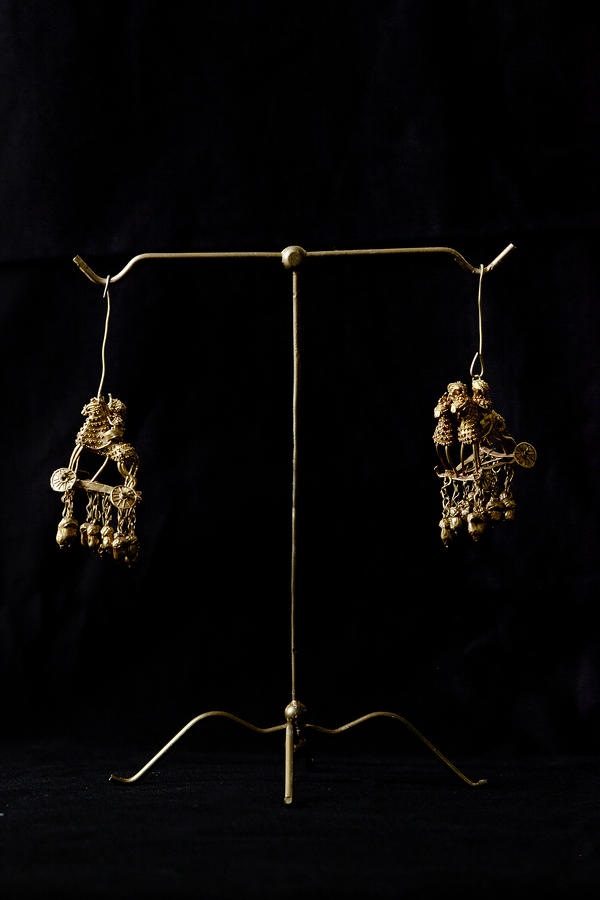
The earrings in the shape of riders were found in the course of archaeological excavations in the Astrakhan Region, in the SolYonoye ZAymishche village (ChernoYArsky District) in 1963. They are dated back to the V century BC.
Probably the earrings were made in one of the Greek colonies located in the ancient Iberia. They came to the Lower Volga Region as a result of a trade exchange with the tribes of the North Caucasus.
The earring is made in the shape of a rider on a horse. The rider is standing on a chariot that has a form of a rectangular frame made of four narrow stripes. The fifth longitudinal strip divides the frame in half. The chariot is equipped with laminar round wheels; an ancient craftsman depicted their rim and spokes with soldered ribbed wires. The acorn-shaped pendants are attached to the chariot from below on chains. Each of them is soldered from two hollow halves. Their surface is decorated with stripes of grain — decoration made of tiny hollow balls. Individual parts of the figures are made of sheet gold/thin wire and soldered: riders' arms and legs, horse legs, tails, ears, manes.
In ancient times, the horse, along with the sheep, was the main domestic animal among the Iranian peoples. It played a decisive role in the spread of Indo-Iranian peoples over a vast area. Among the ancient Iranians there was a certain worship associated with this domestic animal. The text of the Avesta (a collection of religious texts by the Zoroastrians, the oldest monument of ancient Iranian literature) also testifies of the special significance of the horse. One of the hymns about Mitra (the deity of harmony, friendliness, contract and sunshine) said that Mitra rides across the sky in a beautiful golden chariot, carried by four white and fast horses. The chariot is operated by the deity of good fortune — Ashi. And all of the evil and hostile deities (the demons of the Zoroastrian religion) — are afraid of her.
The horse accompanies the glorious Iranian knights from the very beginning to the end in the Iranian epic poem Shahnameh. The horse also occupied an important place in the funeral rites — it was believed that it accompanies the owner in the afterlife, so they were buried together.
The earrings in the shape of riders were exhibited in 2005 at the Astrakhan Steppe Treasures show at the National Museum of the Palazzo Venezia in Rome.
Probably the earrings were made in one of the Greek colonies located in the ancient Iberia. They came to the Lower Volga Region as a result of a trade exchange with the tribes of the North Caucasus.
The earring is made in the shape of a rider on a horse. The rider is standing on a chariot that has a form of a rectangular frame made of four narrow stripes. The fifth longitudinal strip divides the frame in half. The chariot is equipped with laminar round wheels; an ancient craftsman depicted their rim and spokes with soldered ribbed wires. The acorn-shaped pendants are attached to the chariot from below on chains. Each of them is soldered from two hollow halves. Their surface is decorated with stripes of grain — decoration made of tiny hollow balls. Individual parts of the figures are made of sheet gold/thin wire and soldered: riders' arms and legs, horse legs, tails, ears, manes.
In ancient times, the horse, along with the sheep, was the main domestic animal among the Iranian peoples. It played a decisive role in the spread of Indo-Iranian peoples over a vast area. Among the ancient Iranians there was a certain worship associated with this domestic animal. The text of the Avesta (a collection of religious texts by the Zoroastrians, the oldest monument of ancient Iranian literature) also testifies of the special significance of the horse. One of the hymns about Mitra (the deity of harmony, friendliness, contract and sunshine) said that Mitra rides across the sky in a beautiful golden chariot, carried by four white and fast horses. The chariot is operated by the deity of good fortune — Ashi. And all of the evil and hostile deities (the demons of the Zoroastrian religion) — are afraid of her.
The horse accompanies the glorious Iranian knights from the very beginning to the end in the Iranian epic poem Shahnameh. The horse also occupied an important place in the funeral rites — it was believed that it accompanies the owner in the afterlife, so they were buried together.
The earrings in the shape of riders were exhibited in 2005 at the Astrakhan Steppe Treasures show at the National Museum of the Palazzo Venezia in Rome.