The vessel lid was found in the BEra burial mound near the KOsika village in the YenotAyevsky District. This burial was opened and destroyed in 1984, when a water culvert trench was laid there.
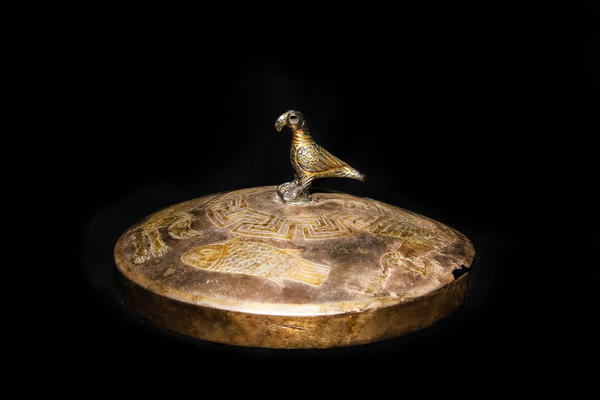
The top of the lid is decorated with a handle. It is crafted as a cast silver figurine of an eagle with folded wings. Its plumage and claws are engraved; traces of gilding have been preserved on the figure. There are depressions in the place of the bird’s eyes, most likely, precious stones used to be inserted into them earlier. There is an engraved and gold-plated drawing on the slope of the lid. To plate an item with gold plating, a thin layer of a precious metal was applied over the base, as a rule, made of other metals.
The drawings shows two fish and two dragon-like creatures with toothy jaws, and also a meander stripe. The meander is a geometric Greek ornament formed by a line broken at a right angle or by spiral curls. The ornament has been known since the Neolithic (New Stone Age). As for its name, most researchers agree that it originated from the Meander River (now Big Menderes) in the Aegean region of Asia Minor, in southwestern Turkey. The river has a very meandering course and was first mentioned by Homer in the Iliad. In ancient Greece, the meander symbolized eternity, which supposed that a young creature replaces an aging one. Thus, the aging creature becomes immortal.
The image of a bird of prey occupied an important place in Eurasian art. Wherever the animal style was widespread and images of animals were used in decor, the image of a bird of prey was popular. In the Iranian epic, such a bird personified the world of the gods.
In the Ossetian epic, the daughter of the god of the sea DzerAssa appeared near the apple tree (world tree); she was embodied as a bird of a predatory nature which was manifested by an iron beak.
In 2005, the vessel lid and other valuable items from the Astrakhan Museum Reserve were exhibited at the Astrakhan Steppe Treasures show at the National Museum of the Palazzo Venezia in Rome.
The top of the lid is decorated with a handle. It is crafted as a cast silver figurine of an eagle with folded wings. Its plumage and claws are engraved; traces of gilding have been preserved on the figure. There are depressions in the place of the bird’s eyes, most likely, precious stones used to be inserted into them earlier. There is an engraved and gold-plated drawing on the slope of the lid. To plate an item with gold plating, a thin layer of a precious metal was applied over the base, as a rule, made of other metals.
The drawings shows two fish and two dragon-like creatures with toothy jaws, and also a meander stripe. The meander is a geometric Greek ornament formed by a line broken at a right angle or by spiral curls. The ornament has been known since the Neolithic (New Stone Age). As for its name, most researchers agree that it originated from the Meander River (now Big Menderes) in the Aegean region of Asia Minor, in southwestern Turkey. The river has a very meandering course and was first mentioned by Homer in the Iliad. In ancient Greece, the meander symbolized eternity, which supposed that a young creature replaces an aging one. Thus, the aging creature becomes immortal.
The image of a bird of prey occupied an important place in Eurasian art. Wherever the animal style was widespread and images of animals were used in decor, the image of a bird of prey was popular. In the Iranian epic, such a bird personified the world of the gods.
In the Ossetian epic, the daughter of the god of the sea DzerAssa appeared near the apple tree (world tree); she was embodied as a bird of a predatory nature which was manifested by an iron beak.
In 2005, the vessel lid and other valuable items from the Astrakhan Museum Reserve were exhibited at the Astrakhan Steppe Treasures show at the National Museum of the Palazzo Venezia in Rome.