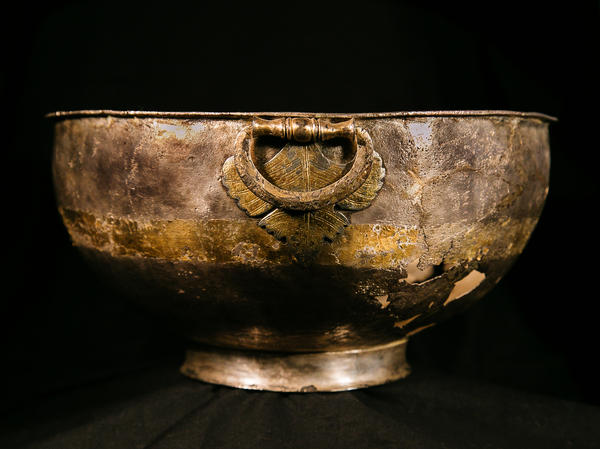
The boiling pot from the Astrakhan Museum Reserve collection was found in the BEra burial mound near the KOsika village in the YenotAyevsky District. This burial was opened and destroyed in 1984, when a water culvert trench was laid there.
The boiling pan was crafted in the 1st century BC. It is hemisphere-shaped; the collar of the vessel is bent and has two attachés (two decorative repoussé plaques) beneath. Such elements — usually they come in different shapes — are used to decorate jewelry, manufacture ceremonial tableware, and even used in architecture. In our case, the attaches are grape leaves-shaped; there is a baluster brace is soldered on the wide side of the leaf to insert a crescent moon-shaped handle. Only one handle has survived.
All these elements are decorated with gold plated as a thin layer over the metal. This technique is called plating. An ancient craftsman embossed veins on the grape leaf, and filled the space between the veins with dotted pattern.
A wide ribbon is also plated over the pot. There are four fish swimming one after another inside the vessel. The Iranian mythological picture of the world portrays a giant good fish Kara living in the Ranghe river that washed one side of the world and personified the edge of the world. The fish guarded the world tree that grew in the middle of the Vorukasha Lake.
A punch, a sharp tool, was used to scribe a Greek inscription on the collar. The text is ‘King ArtevAzd. Made by AmpsalAk.’ Historians for the most part come to the conclusion that the Armenian monarch Artavazd II is mentioned here, who ruled between 55 and 34 BC. And the buried person may have taken part in the campaign of the Bosporan king Pharnaces to Asia Minor in 49-47 BC and was a noble warrior or, most likely, a leader of one of the Sarmatian tribes.
The boiling pot could have been made in Armenia: the traditions of exquisite handling of precious metals were already developed in the country that time.
In 2005, the boiling pan and other archaeological values from the Astrakhan Museum Reserve were exhibited at the Astrakhan Steppe Treasures show at the National Museum of the Palazzo Venezia in Rome.
The boiling pan was crafted in the 1st century BC. It is hemisphere-shaped; the collar of the vessel is bent and has two attachés (two decorative repoussé plaques) beneath. Such elements — usually they come in different shapes — are used to decorate jewelry, manufacture ceremonial tableware, and even used in architecture. In our case, the attaches are grape leaves-shaped; there is a baluster brace is soldered on the wide side of the leaf to insert a crescent moon-shaped handle. Only one handle has survived.
All these elements are decorated with gold plated as a thin layer over the metal. This technique is called plating. An ancient craftsman embossed veins on the grape leaf, and filled the space between the veins with dotted pattern.
A wide ribbon is also plated over the pot. There are four fish swimming one after another inside the vessel. The Iranian mythological picture of the world portrays a giant good fish Kara living in the Ranghe river that washed one side of the world and personified the edge of the world. The fish guarded the world tree that grew in the middle of the Vorukasha Lake.
A punch, a sharp tool, was used to scribe a Greek inscription on the collar. The text is ‘King ArtevAzd. Made by AmpsalAk.’ Historians for the most part come to the conclusion that the Armenian monarch Artavazd II is mentioned here, who ruled between 55 and 34 BC. And the buried person may have taken part in the campaign of the Bosporan king Pharnaces to Asia Minor in 49-47 BC and was a noble warrior or, most likely, a leader of one of the Sarmatian tribes.
The boiling pot could have been made in Armenia: the traditions of exquisite handling of precious metals were already developed in the country that time.
In 2005, the boiling pan and other archaeological values from the Astrakhan Museum Reserve were exhibited at the Astrakhan Steppe Treasures show at the National Museum of the Palazzo Venezia in Rome.