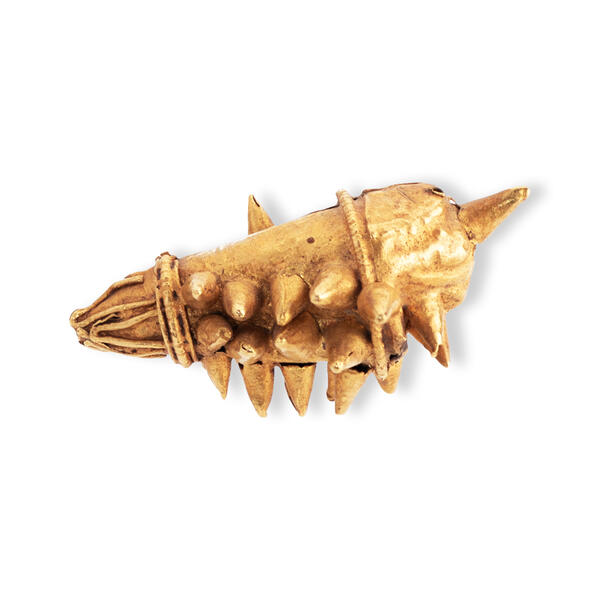
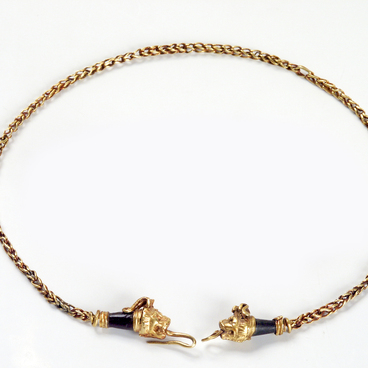
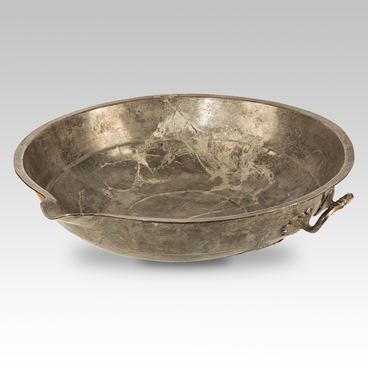
The earrings on display in the museum were found during excavations at a burial site in the Tanais Necropolis in 1960.
Tanais is an archaeological site located near the present-day village of Nedvigovka, in the Myasnikovsky District of the Rostov Region.
According to the ancient Greek historian and geographer Strabo, in the 3rd century BCE, this city, as “the largest barbarian settlement after Panticapaeum, ” began playing an important role in facilitating trade between the Greeks and local populations. In addition, it served as a major center for craft production and agriculture. For many centuries, Tanais remained the sole and principal trade center in the region.
The city enjoyed the greatest prosperity in the period from the 1st century to the first half of the 3rd century CE, until it was defeated by the Goths. Luxury goods and household items “typical of a civilized lifestyle, ” as Strabo described, spread from there throughout Asian and European Sarmatia. Tanais was a vital economic, cultural, and political center that facilitated communication between the cities of the Bosporan Kingdom and the northern Black Sea region with the tribes inhabiting the steppes surrounding the city.
The earrings from the collection are made from two thin gold plates shaped like a stylized hedgehog figure. The body of the hedgehog, which is hollow and cone-shaped, serves as the base. Cone-shaped projections are soldered onto the base to resemble needles. The conical head features a cone-shaped nose, and a notched wire is soldered around the head, twisting around the body.
In the tail part, there is a rectangular plate that resembles three wires. The central wire is also adorned with notches. Attached to the tail section is an oval-shaped bow, which is constructed from three wires that are soldered together. They are decorated with notches, imitating braids. At the end of the tail, a gold zigzag wire is used for decoration.
Symbolism played a significant role in ancient cultures. Symbols were integral elements of various aspects of life, including rituals, ceremonies, material production, and daily activities. One popular symbol was the hedgehog. It was used by different cultures and carried its own meaning. For most peoples, the hedgehog represented wisdom, alertness, and caution.