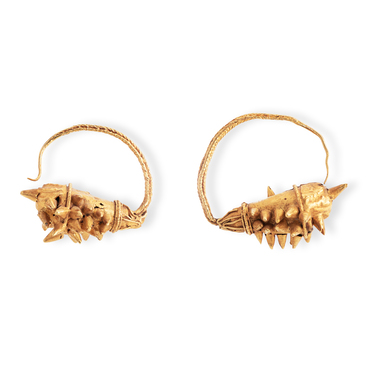
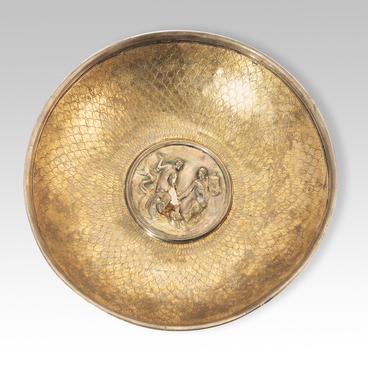
The kurgan “Sadovy”, located on the site of the modern city of Novocherkassk, was discovered in 1962. It was part of the larger burial site known as the “Khokhlach” complex. During excavations, a burial chamber was discovered beneath the mound that had been looted a very long time ago. However, several items have survived. These include a silver louterion — a vessel for ablutions, as well as parts of horse harnesses, gold plaques, and silver bowls. In addition, archaeologists also found a bronze cauldron, a situla (a vessel similar to a bucket), as well as a bronze basin.
The large, wide open vessel on display in the museum is called a louterion. It features fasteners in the form of embossed handles. The basin is fitted with a shallow circular tray, which has three handles and a drain spout. Louteria were used for washing one’s hands and face before eating, as well as for various ritual ablutions.
In her article, Zemfira Vladimirovna Dzarasuyeva, a researcher at the Institute of History and Archaeology of Vladikavkaz, describes the routine of Ancient Greeks as follows, “The toilette of the Greeks involved washing the face and anointing the body with plant-based aromatic oils, such as rose and myrtle, as well as other fragrant substances. For this purpose, the Hellenic people utilized wide, flat-bottomed bowls — louteria. These large, thick-walled containers were typically made of ceramic; some washbasins were made of metal or stone. Only a few examples are known to be fitted with a drain spout and side handles.”
Such artifacts are characteristic of late Hellenistic art and may have been produced in the Mediterranean region. Sicily was an important center of silverware production. Researchers also note works of artisans from Alexandria and Asia Minor.
Scientists have proposed several hypotheses
regarding how such luxury items may have reached the nomadic populations.
According to one theory, the Romans had a tradition
of sending barbarian leaders precious dishes, expensive weapons and other
gifts. With such offerings, they attempted to bribe and placate the
nomads in order to avoid raids and live in peace. Therefore, the bowls found at
the “Sadovy” site may have entered the Don–Azov area as diplomatic gifts for
Sarmatian leaders. Alternatively, these items could have been seized by the
nomads during battles as prizes of war. It is also plausible that the nomads
would simply buy these luxury objects from the Romans.