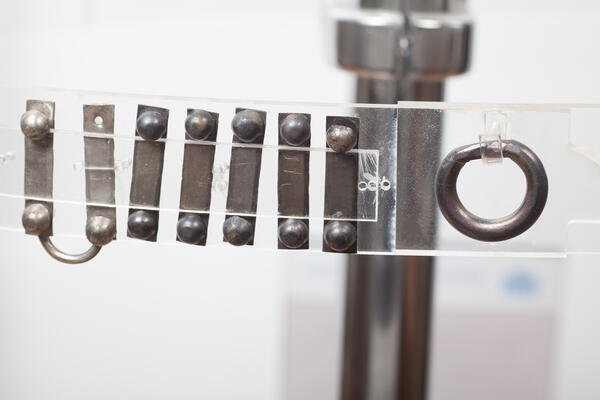
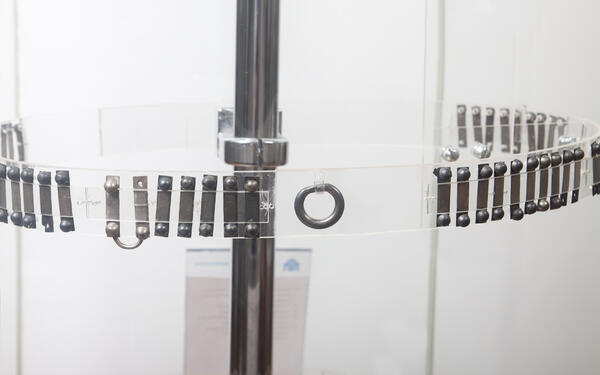
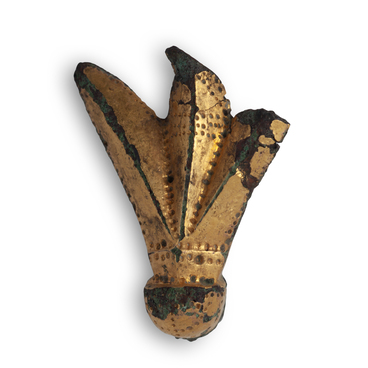
Another artifact from the collection was handed over by law enforcement to the Kursk State Regional Museum of Archaeology. From the “silver” sword belt set, fittings have been preserved that are similar in shape to the gilded ones but slightly larger, up to three centimeters wide. This set also includes fittings connected by loops, which likely served as eyelets. A ribbed fitting, judging by similar items found on late Roman belts, may have been a belt stop. The frame from the buckle, which was probably part of the silver belt, is simple, without a shield (or it hasn’t survived), oval-shaped, and round in cross-section, measuring 23 by 24 millimeters.
Additionally, two silver rivets with rounded heads and in the shape of a “Maltese” cross were found. The simple set also included two small copper frames, possibly from hanging items. Analogs of belts with such fittings, both silver and copper alloy, come from the Eastern Aral Sea region, in the territory of modern Kazakhstan. Several burials with complete belts decorated with plates and inlaid buckles were found in the mounds of the Dzhetyasar area. These belts contain up to a hundred fittings.
Similar belts, combining fittings with hemispherical rivet heads and polychrome-style decorative elements, are found in warrior graves with weapons from Fyodorovka in the Samara region, the Kubey burial mound in the Odessa region, and in Hunnic antiquities discovered near the town of Tolna in Hungary. In Western Europe, similar silver belts decorated with plates, sometimes made with niello decorative patterns, are known from Lyon in France and from Scotland (the Traprain Law hoard). This hoard is well-dated and, according to current understanding, was buried between 410 and 425 AD.
In 2013, a treasure trove of money and clothing was
found in the Poseimye region, containing belts with similar fittings and one
and a half hundred denarii. Most of the items belong to the so-called
polychrome style, characterized by a combination of gold and predominantly
blood-red inserts of precious stones and glass.