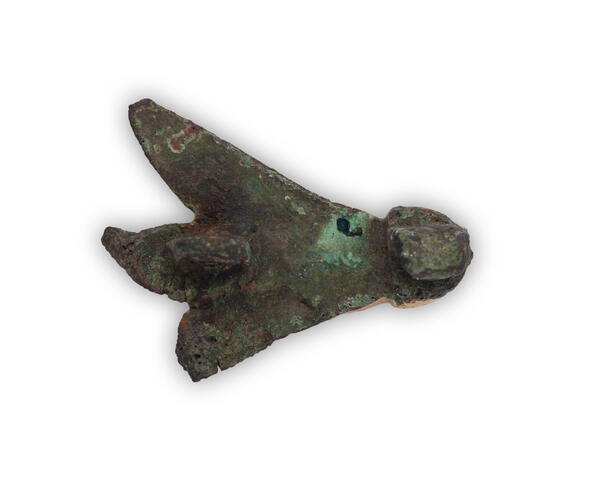
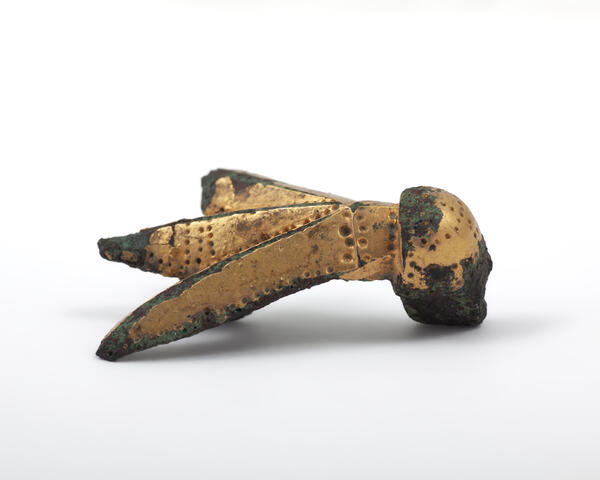
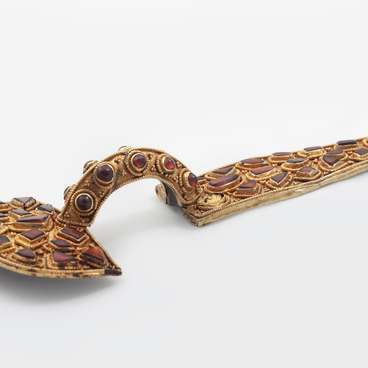
The cicada fibula was discovered in the Kursk region during the work of the Middle Seym Expedition of the Institute of Archaeology of the Russian Academy of Sciences, led by archaeologist Oleg Alexandrovich Radyush. The expedition took place in 2008–2009, and in 2010, the artifact was transferred to the collections of the Kursk Museum of Archaeology. A fibula is a metal clasp, which, unlike most modern brooches, serves both as a decoration and performs a practical function. A pin with a “lock” for the pointed end allows the fastening of clothing.
The decoration is cast from bronze and covered with gilding. It features a relief ending in the shape of a trefoil. A stamped pattern is applied to the outer surface. On the reverse side of the product there is a plate and a vertical post for attaching a spring, cast together with the body. The spring and pin were likely made of iron. The upper part is designed in the form of three wings, separated from the hemispherical end by a thick “neck, ” which transitions into a semicircular shield. Besides bronze, silver could also have been used to cast such decorative objects.
Prototypes of such pins exist among the enamel brooches of the Roman period. From the late 4th to the 5th century, various types of such brooches spread among the settled populations along the Roman limes from Gaul and Britain to the Northern Black Sea region. Cicada fibulae are a specific adornment of the Migration Period. They became widely distributed in the 5th–6th centuries. They are found in Western Europe, in the Danube region, the Balkans, the Northern Black Sea region, Crimea, and the North Caucasus.
Noteworthy is the observation of the French
archaeologist Mikhail Mikhailovich Kazansky that this category of jewelry is
characteristic of the women’s costumes in the contact zones between barbarian
tribes, primarily Germanic federates, and the population of the Roman Empire.
In the North Caucasus, cicada fibulae appeared under the influence of the
Bosporan culture and the settlement areas of the Goth Tetraxites. Cicada pins
are much less common than fibulae. A small series of them comes from the Middle
Danube region.