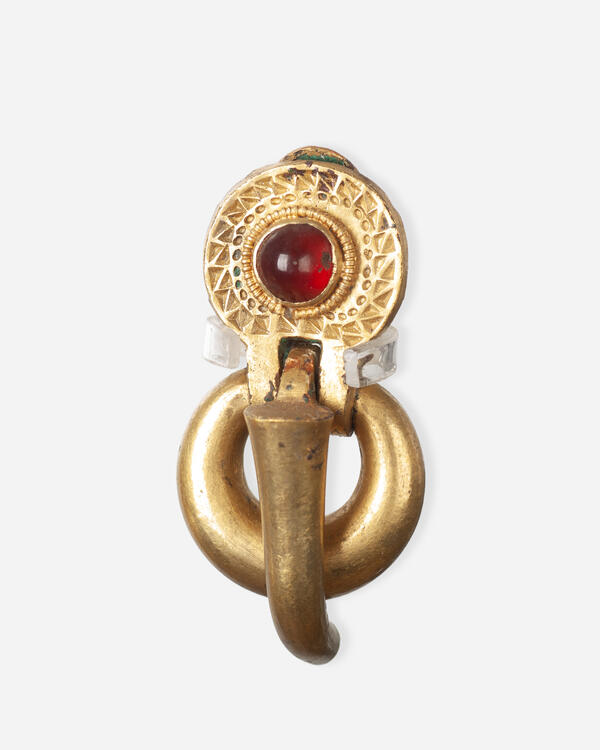
In July 2010, Russian security forces prevented the illegal export of unique items from an ancient burial site that had been looted by treasure hunters. The items were handed over to the Kursk State Regional Museum of Archaeology by law enforcement agencies. One of the most intriguing sets of artifacts is the “golden” sword belt set. The “golden” sword belt set includes metal objects and components that, at first glance, appear to be made of gold and are decorated with cloisonné enamel.
This set in the “hoard” includes elements of a ceremonial belt — a buckle with a rectangular frame and numerous fittings (at least 70 pieces), which fit well on a belt 2.5 centimeters wide. Attached to it were small rings on round shields for hanging various items, as well as, on additional straps, a long sword with a golden hilt in ceremonial scabbards. It is possible that the original condition (before the set was damaged) of the gilded belt was very good, as evidenced by a piece of leather with a rivet found during washing.
Laboratory studies revealed that the belt buckle, numerous fittings, and rings for hanging various items needed by a rider were made of copper and subjected to fire gilding — amalgamation. However, the sword belt buckles were entirely gold, including the scabbard coverings, sword hilt, and pommel, except for the parts that bore specific loads. Even the small nails used to attach the scabbard coverings to the wooden base were made of high-purity gold.
Most of the items belong to the so-called
polychrome style, characterized by a combination of gold and mostly blood-red
inserts of precious stones and glass. This style became widespread in barbarian
Europe at the beginning of the Migration Period in the 5th century CE.
Therefore, the Volnikovka find can be confidently dated to the last quarter of
the 4th century to the first half of the 5th century CE, when polychrome
decorations became a symbol of power for the barbarian “aristocracy” of Europe.