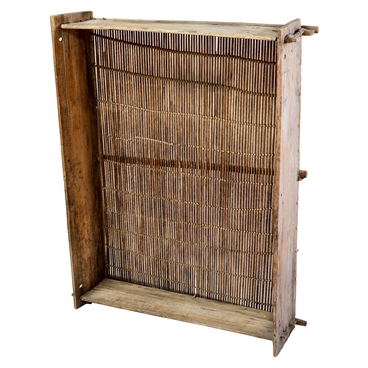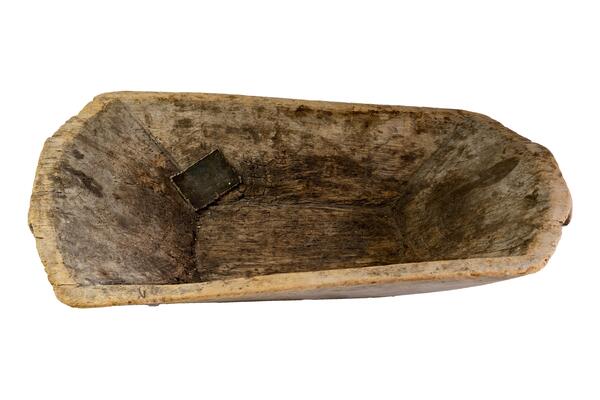
The words “selnitsa”, “seyalnitsa” and “sochelnitsa” were used to name a type of kitchenware, exactly an oval, rectangular or square bowl with high sides. According to the dictionary created by Vladimir Ivanovich Dal, there is one more word for it — “seinitsa”. The length of a bowl was about 30–80 cm, its width was about 30– 50 cm. Selnitsa was used to put under a sieve while sifting flour for baking. It was also used for kneading or washing husks out of cereals.
Such containers were made of different materials, depending on the most affordable ones in a particular area. These bowls were made out of a solid wooden block, or thin bars, woven from birch bark, straw, flexible willow, or bird cherry twigs. Wooden bowls were the firmest and most durable. They, as well as the other kitchen utensils, were often inherited from mother to daughter. Linden was considered the best material for these purposes. It did not crack over time, did not have any extraneous smell, did not emit resin, like conifers. It was also easy to clean and wash.
Flour had to be sieved before kneading. In the old days, peasants grinded grain in village mills. They also used hand millstones, but less often and only when it was required to make small quantity of flour. There were many husks, specks, crumbs from the millstone, and large particles of grain after this process. Therefore, they could spoil the finished bread. They were removed with the help of a sieve. Moreover, baked foods, which were made of sifted flour, were tastier and softer.
If a housewife planned to cook yeast dough for bread or pies, she had to put flour from a selnitsa into a kneading trough, a type of wooden tub. The pancake batter was sometimes kneaded right in a selnitsa. All ingredients were also mixed there.
A selnitsa was kept with the rest of the kitchen utensils in the so-called woman’s wide bench that was an analog of a modern kitchen in a peasant’s hut. It was located in front of a woodstove. It was that very place where a housewife cooked food, baked bread, gave tasks to her daughters and daughters-in-law for a day. In Siberia, such a housewife was called “bolshukha” (consonant with Russian “great woman”).
A selnitsa, as well as many other types of kitchen utensils, had a ritual purpose. It was customary to make a bride sit on it before the wedding. That had to help her give birth to many healthy children.
Such containers were made of different materials, depending on the most affordable ones in a particular area. These bowls were made out of a solid wooden block, or thin bars, woven from birch bark, straw, flexible willow, or bird cherry twigs. Wooden bowls were the firmest and most durable. They, as well as the other kitchen utensils, were often inherited from mother to daughter. Linden was considered the best material for these purposes. It did not crack over time, did not have any extraneous smell, did not emit resin, like conifers. It was also easy to clean and wash.
Flour had to be sieved before kneading. In the old days, peasants grinded grain in village mills. They also used hand millstones, but less often and only when it was required to make small quantity of flour. There were many husks, specks, crumbs from the millstone, and large particles of grain after this process. Therefore, they could spoil the finished bread. They were removed with the help of a sieve. Moreover, baked foods, which were made of sifted flour, were tastier and softer.
If a housewife planned to cook yeast dough for bread or pies, she had to put flour from a selnitsa into a kneading trough, a type of wooden tub. The pancake batter was sometimes kneaded right in a selnitsa. All ingredients were also mixed there.
A selnitsa was kept with the rest of the kitchen utensils in the so-called woman’s wide bench that was an analog of a modern kitchen in a peasant’s hut. It was located in front of a woodstove. It was that very place where a housewife cooked food, baked bread, gave tasks to her daughters and daughters-in-law for a day. In Siberia, such a housewife was called “bolshukha” (consonant with Russian “great woman”).
A selnitsa, as well as many other types of kitchen utensils, had a ritual purpose. It was customary to make a bride sit on it before the wedding. That had to help her give birth to many healthy children.