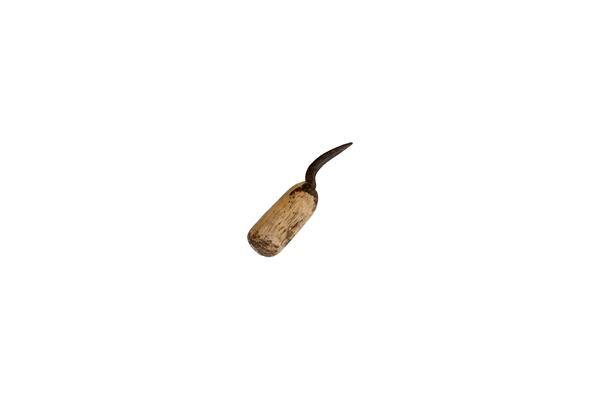
The terms “svayka” and “kochedyk” were used to denote a flat arcuated awl used to weave bast shoes in the old days. It consisted of a rounded wooden handle and a working part curved in a form of a mini sickle. It could be made of metal, wood, or bone, depending on the more available material of any concrete location.
Bast, also known as fibers that were taken from underneath the upper layer of the bark of deciduous trees, was the main material for bast shoes. Sometimes, it was replaced with birch bark. However, it was shorter and more fragile. The length of one strip was not more than the girth of a tree trunk, which it was removed from.
To make a pair of bast shoes, the master needed about 14 meters of bast. Its width was approximately equal to the width of a man’s toe. As a rule, the peasant prepared bast in summer, but made bast shoes in winter, when there was not any fieldwork. It was mainly man’s work. Boys were taught to make bast shoes from early childhood.
The kochedyk was used to hook the loops from the already woven row and pull a new bast strip into them. Thanks to this method, bast shoes were thick and durable. They didn’t leak and feet did not freeze in them. The men added a double bast layer, willow twigs, or ropes to make soles more durable. Sometimes they hemmed bast shoes with leather. To fix bast shoes on feet, special frills were used — bast laces that were wrapped around the ankles.
Svaika was also used to repair worn-out shoes. To do it, men pulled new bark strips in places of the old ones. That process was called “podkovyrka”. This tool was also used to remove bast from tree trunks. Sometimes a steel kochedyk was used instead of steel to make a fire.
Bast shoes were rarely worn on the territory of the modern Tyumen Region. Such shoes were not suitable for swampy soils and cold climates. Svaika from the collection of Nizhnevartovsk Museum of Local History was made in the Kursk Governorate in the 1870s. This instrument belonged to the Rodionov family, who lived in Grachevka village. According to the custom, in many peasant houses, svaikas, as well as the other tools, were inherited from father to son.
Bast, also known as fibers that were taken from underneath the upper layer of the bark of deciduous trees, was the main material for bast shoes. Sometimes, it was replaced with birch bark. However, it was shorter and more fragile. The length of one strip was not more than the girth of a tree trunk, which it was removed from.
To make a pair of bast shoes, the master needed about 14 meters of bast. Its width was approximately equal to the width of a man’s toe. As a rule, the peasant prepared bast in summer, but made bast shoes in winter, when there was not any fieldwork. It was mainly man’s work. Boys were taught to make bast shoes from early childhood.
The kochedyk was used to hook the loops from the already woven row and pull a new bast strip into them. Thanks to this method, bast shoes were thick and durable. They didn’t leak and feet did not freeze in them. The men added a double bast layer, willow twigs, or ropes to make soles more durable. Sometimes they hemmed bast shoes with leather. To fix bast shoes on feet, special frills were used — bast laces that were wrapped around the ankles.
Svaika was also used to repair worn-out shoes. To do it, men pulled new bark strips in places of the old ones. That process was called “podkovyrka”. This tool was also used to remove bast from tree trunks. Sometimes a steel kochedyk was used instead of steel to make a fire.
Bast shoes were rarely worn on the territory of the modern Tyumen Region. Such shoes were not suitable for swampy soils and cold climates. Svaika from the collection of Nizhnevartovsk Museum of Local History was made in the Kursk Governorate in the 1870s. This instrument belonged to the Rodionov family, who lived in Grachevka village. According to the custom, in many peasant houses, svaikas, as well as the other tools, were inherited from father to son.