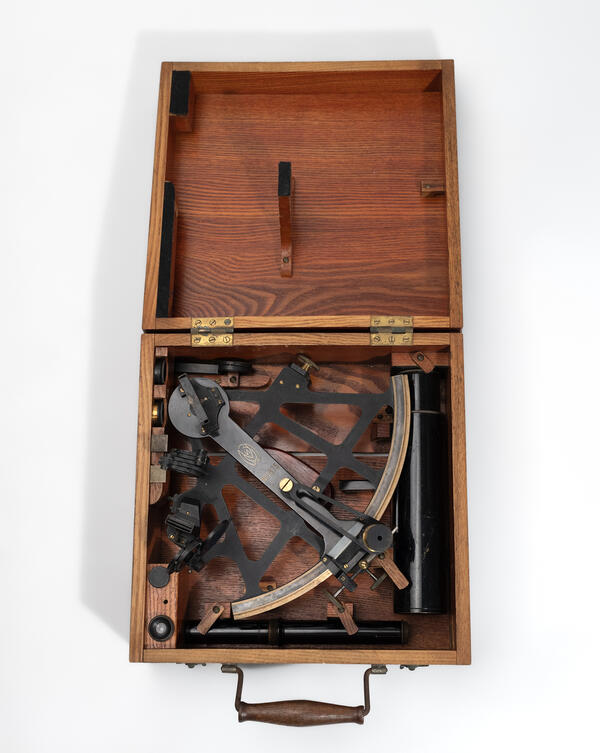
The term “sextant” originated from the Latin word meaning “the sixth” or “one-sixth”. This is a navigation instrument used by sailors to measure the angle between the horizon and astronomical objects, such as the Sun. This information was used to estimate the geographical position of the ship.
By measuring the altitude of the Sun at noon on a specific date, sailors could estimate latitude. Basically, the sextant was used to measure the angular distance between two visible objects. Based on the known height of a lighthouse, one could calculate the exact distance between the ship and the lighthouse by measuring the angle between its base and top.
The frame of a sextant is in the shape of 1/6 of a circle, or 60°, hence its name. It uses the principle of double reflection to combine images of two objects. This principle was first discovered by the English physicist, mathematician, and astronomer Isaac Newton in 1699. However, his writings remained unpublished.
Several decades later, the octant was invented, which became the predecessor of the sextant. It was designed by two scientists who worked independently. The instrument constructed by the American inventor Thomas Godfrey was considered inferior to that developed by the English mathematician John Hadley. Later, the octant and astrolabe were replaced by the sextant which became the main navigation instrument.
The main advantage of the sextant was that it measured the angle of the astronomical object relative to the horizon, rather than to the instrument itself. This ensured greater accuracy of measurement.
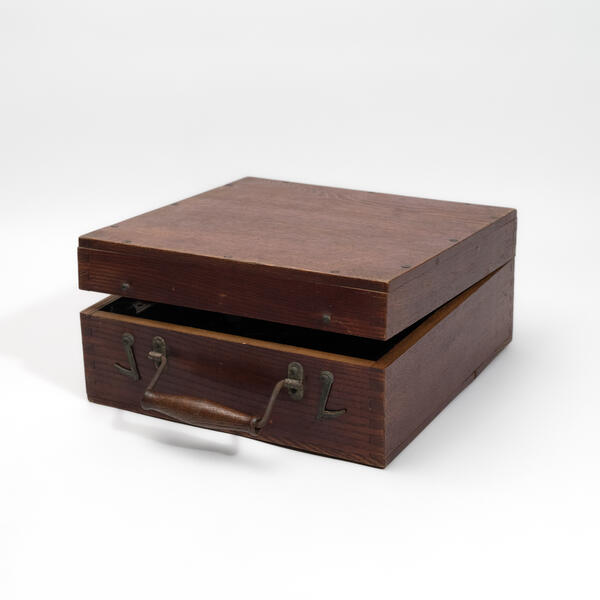
The displayed marine sextant was manufactured in the Soviet Union in the first half of the 20th century. Similar instruments were produced at several Soviet factories. One of these was the Nautical Instrument Factory, which was renamed the Navigation Instrument Factory in 1938. In 1941, a part of the factory was evacuated from Leningrad to Katav-Ivanovsk in Chelyabinsk Oblast. Another such factory was the Yaroslavl Shipbuilding Plant, founded in 1920.