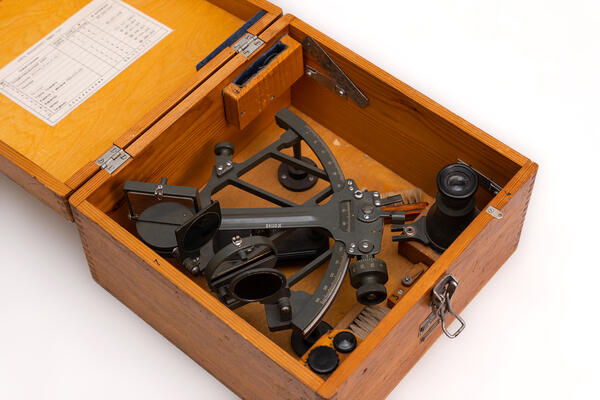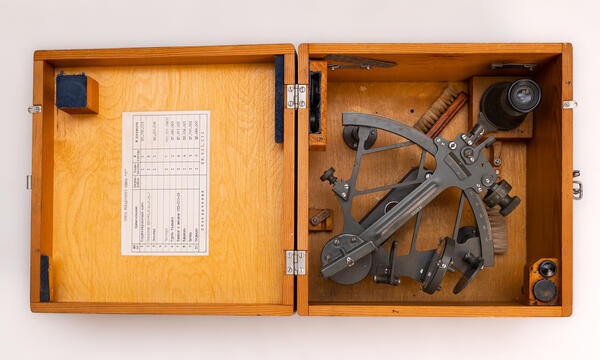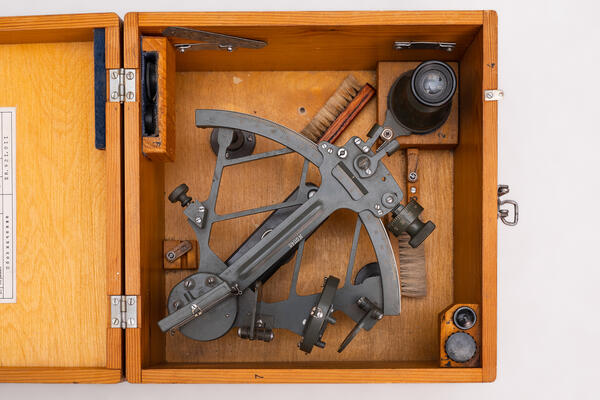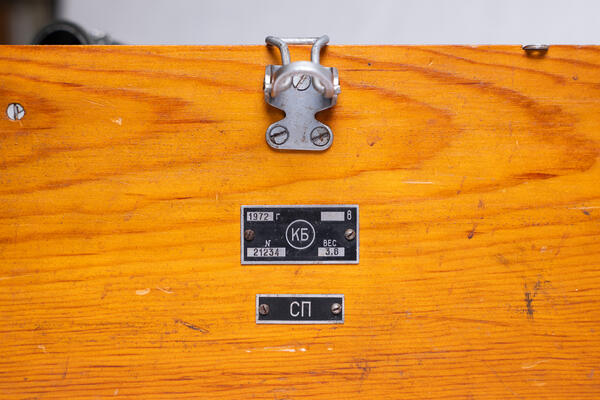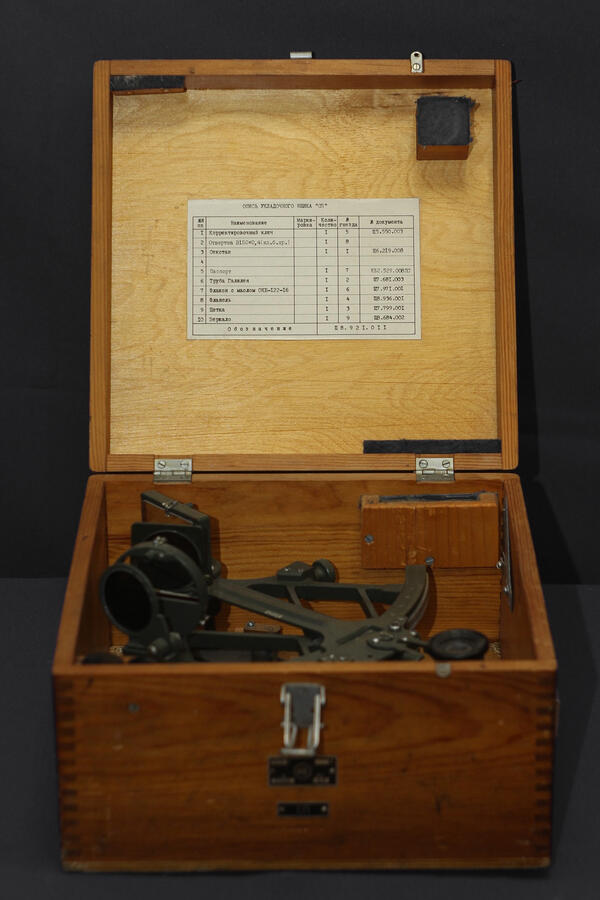
A sextant is a navigational instrument that is used to measure the altitude of the Sun and celestial objects above the horizon. It allows users to determine geographic coordinates in a specific location. The horizon, in this case, is understood as the apparent boundary between the sky and sea, while the measurement point is the ship. By measuring the altitude of the Sun at astronomical noon using a sextant, one can, if the date of measurement is known, calculate the latitude of the area. Alternatively, if the altitude of a lighthouse is known, measuring the angle between its base and top, one can determine the distance to the lighthouse using a simple calculation.
The principle behind measuring the altitude of the Sun using paired mirrors and double reflection was first described by Isaac Newton in 1699. A few decades later, in 1730, both the English mathematician John Hadley and the American inventor Thomas Godfrey independently developed a device that operates using this principle — the sextant. The success of their invention led to its continued use until the present day, with little change in the design.
Prior to the invention of the sextant, the astrolabe was the primary navigation device. However, its accuracy could not compare to that of the sextant. When using the sextant to observe the horizon and a celestial object, both are visible within the same field of view and remain stationary even when the observer is in motion on a ship.
The name of this instrument derives from the Latin word “sextans” (sextantis), meaning “sixth”, as it represents one-sixth of a complete circle. The frame of a sextant is in the shape of a sector which is approximately 1/6 of a circle, or 60 degrees in total. Although the sextant can still be found on modern naval ships, it is rarely used, mainly for preserving the proficiency of navigators.
The quadrant can be regarded as an early predecessor to the sextant. These instruments were vital observational tools before visible-light astronomy developed. They consisted of a graded arc covering a quarter of a complete circle (90 degrees) for measuring angles, and a rod attached to one end of the arc that fixed the measured angle. Portable quadrants were carried by traveling astronomers, while wall-mounted quadrants were installed in observatories. These instruments remained in use until the beginning of the 18th century, when they were largely replaced by the sextant and other more advanced instruments.