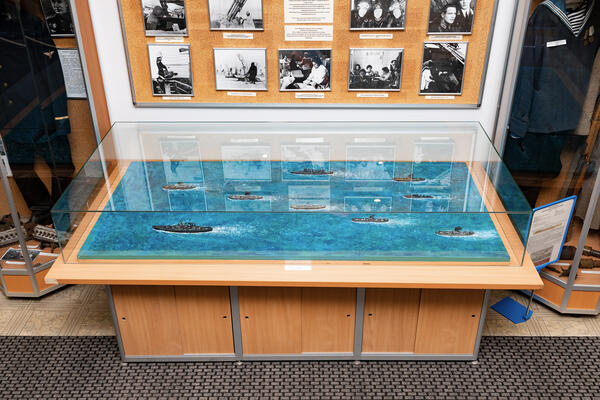
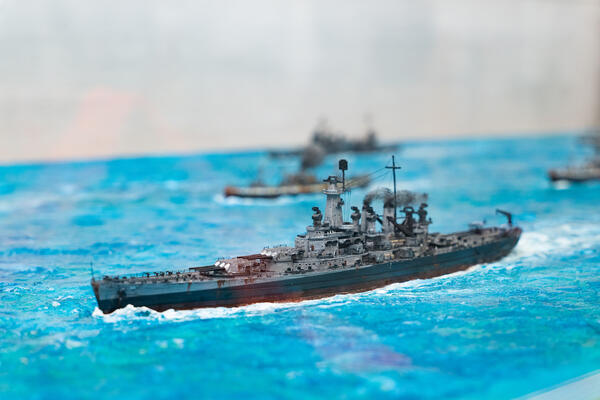
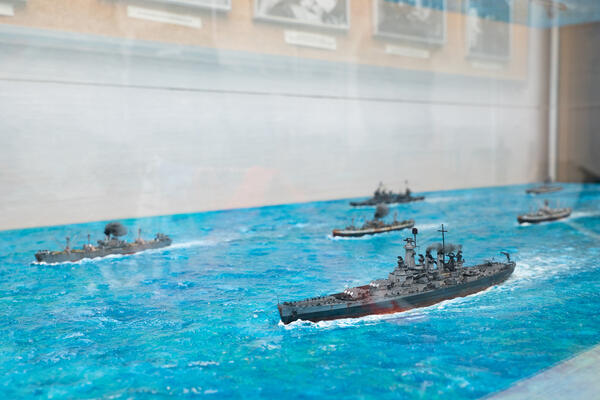
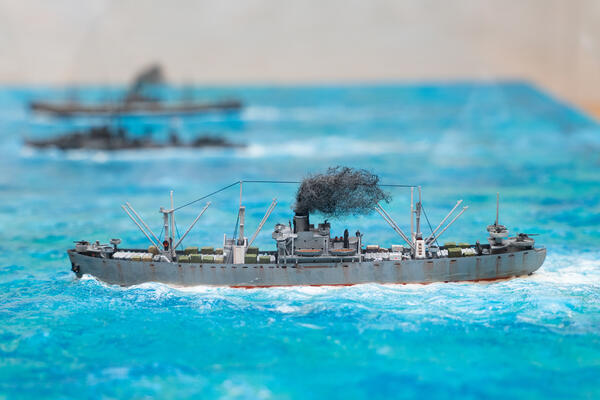
Arctic sea convoys played an important role during the Great Patriotic War. Thanks to them, equipment, machinery, food and weapons were delivered to the USSR under the Lend-lease agreement. All these convoys were designated by the letters PQ — after the English officer Peter Quelyn Edwards, who was involved in operational planning. Homebound convoys were designated with the letters QP. They sailed from the ports of England, Scotland and Iceland via several seas of the Atlantic and Arctic oceans to Arkhangelsk, Molotovsk and Murmansk.
At the beginning of the war, the Germans did not attack them. Hitler believed that the defeat of the USSR was inevitable, and therefore the Arctic convoys did not matter. Hitler changed his mind in early 1942, when it became clear that the Blitzkrieg had failed. Under the new conditions, he could not ignore the convoys, since supplies to the northern Soviet ports, according to Hitler, “feed the resilience of the Russians” and “therefore must be stopped.”
Convoy PQ-17 sailed from Hvalfjörður in northwestern Iceland on June 27, 1942. It was a string of 35 merchant and cargo ships, 3 rescue and 2 tanker ships.
In early July 1942, the Finnish radio interception outpost in Sortavala intercepted an encrypted telegram transmitted in Morse code from a Soviet airbase near Murmansk. Decrypted by the Finns, the text of the telegram contained a full description of the large convoy PQ-17 with military supplies heading from Iceland to the USSR. The Finns handed over these materials to the Nazis. At first, they planned to use surface ships to attack the convoy. However, British submarines detected an attempt to put the battleship Tirpitz to sea, and the German surface ships were recalled back to base. The attack on PQ-17 was carried out by aircraft and submarines.
As a result, 22 merchant ships and two auxiliary
vessels from the convoy were sunk. 210 aircraft, 430 tanks, as well as 3,350
vehicles and 99,316 tons of general cargo ended up on the bottom of the sea.
153 merchant seamen died. The destruction of Convoy PQ-17 became one of the
most tragic events in the Arctic during the Second World War. The writer
Valentin Pikul described this tragedy in his novel “Requiem for Convoy PQ-17”.