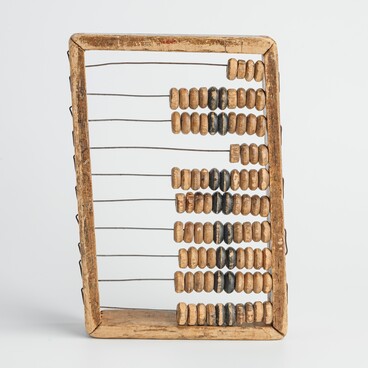
The Museum of Intelligence Officer Nikolai Kuznetsov in the village of Zyryanka houses a vertical desktop abacus from the 1950s, used to teach arithmetic to preschool and school-age children.
An abacus is a mechanical calculating device designed to perform basic arithmetic operations. Its origins trace back to ancient China, from where it spread to many parts of the world and remained the primary tool for computation for centuries. Abacuses became especially widespread in the Russian Empire and later in the USSR, where they were actively used in trade, accounting, and education until electronic calculators became widely available in the 1970s.
Despite its apparent simplicity, the abacus is a highly effective tool for fast and accurate calculations — even with large numbers. The device consists of a wooden frame with parallel metal rods, each typically strung with ten beads (with one notable exception).
There were several types of abacuses. Many can still be found in Russian homes — often worn but fully functional. This durability is no surprise: the frames of office and school abacuses were commonly made from strong, long-lasting hardwoods such as oak, ash, or maple. The rods were crafted from polished steel wire, resistant to wear and bending.
The arrangement of beads followed a strict system: most rods held ten beads, but one of the lower rods — typically the fourth from the bottom — had only four. This design reflected the pre-revolutionary Russian monetary system, which included fractional units like the quarter-kopeck (¼ kopeck). The four-bead row allowed users to work comfortably with these fractional values.
For ease, the middle bead in each row — and, where present, the second bead in the eighth and eleventh rows — was painted in a contrasting color. These colored beads served as markers to separate numerical classes (thousands, millions), making it easier to read and interpret large numbers.
Abacuses were manufactured in five standard sizes, differing in the number of rods and overall length. The most compact model — featuring 10 rods and 94 beads — was traditionally called a “warehouse” abacus in trading circles. This name, dating back to pre-revolutionary times, reflected the device’s common use in warehouses and commercial establishments.