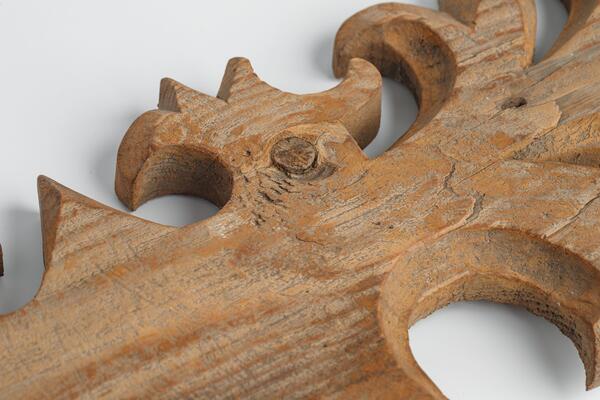
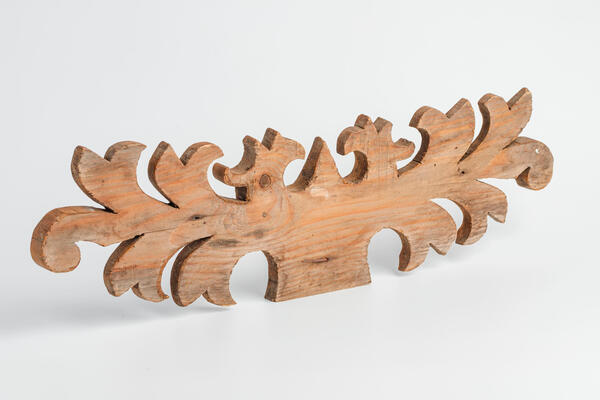
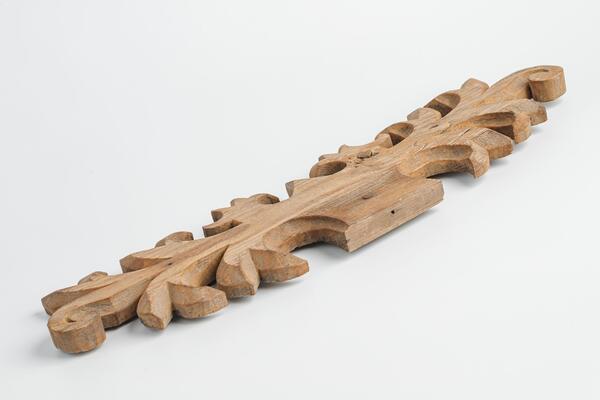
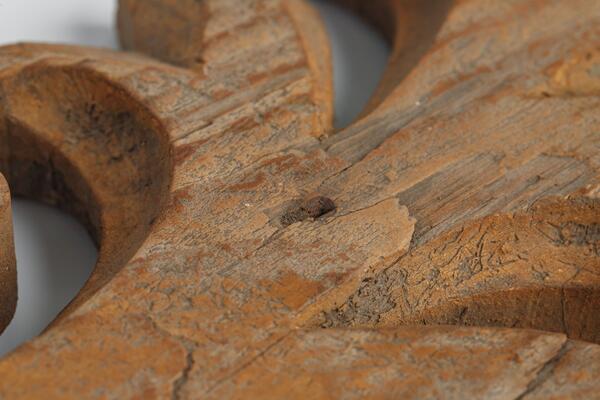
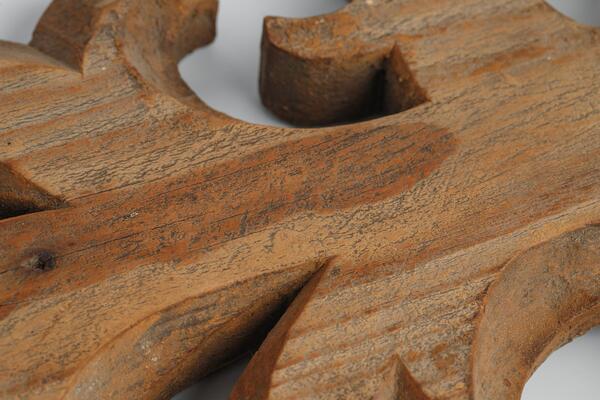
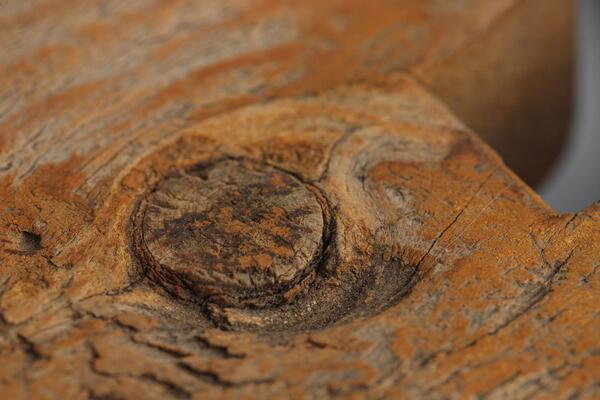
The Museum of Intelligence Officer Nikolai Kuznetsov in the village of Zyryanka displays a fragment of a carved wooden window trim. The artifact entered the museum’s collection in 1978.
A trim — a platband or architrave — is an architectural detail: a profiled frame surrounding a window or doorway. The Russian word for trim (nalichnik) derives from the expression “on the face”, meaning “on the face of the house” — its façade. In popular belief, the façade was the house’s “face” turned toward the world. Like a person’s face, it had to be well-groomed and beautiful — not merely ornamental, but a family’s calling card, embodying its pride, identity, and values.
Originally, window platbands served a practical purpose: they concealed gaps between the window frame and the log walls, shielding the interior from drafts and noise. But their role soon expanded far beyond utility, evolving into powerful expressions of the people’s symbolic worldview.
A traditional Russian platband consists of four main elements: two vertical side posts and two horizontal boards — the windowsill (lower) and the frieze (upper). Often, a kokoshnik — a gracefully curved element resembling a rooster’s comb — rose above the frieze. This motif symbolized rebirth, light, and divinity.
The symbolism of the trim reflected ancient Slavic conceptions of cosmic order. The upper section — the frieze and kokoshnik — represented the heavenly realm: bright, daytime, and divine. The windowsill embodied the earthly sphere: dark, nocturnal, and mortal. The vertical sides served as the connecting axis between these worlds — the sacred threshold through which all living beings passed.
It was the village wooden houses, with their intricately carved trim, kokoshniks, and gateposts, that became the true guardians of authentic Russian folk culture. Every element of the façade — from the roofline to the windowsill — conveyed information about the household: its lineage, beliefs, fears, and hopes. But window frames were most meticulously decorated. In folk consciousness, a window was far more than an opening for light; it was regarded as the eye of the house — the dwelling’s primary sensory organ, through which its soul gazed upon the world. The carved trim thus served not only as ornament but as a protective amulet, shielding the hearth from evil forces.
In this light, the carved window frame is not merely an architectural detail — it is an amulet, a philosophical statement, and a historical document that captures the soul of the Russian village.