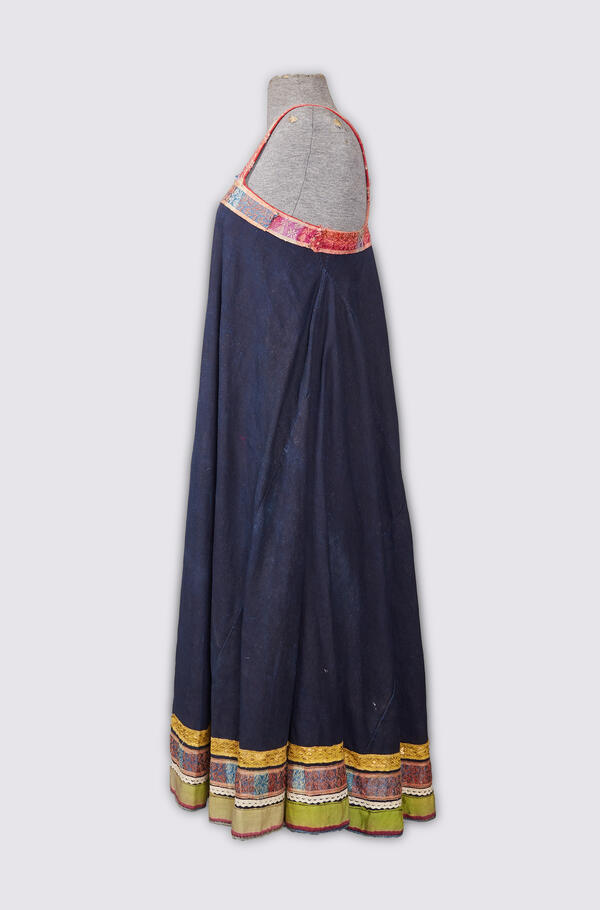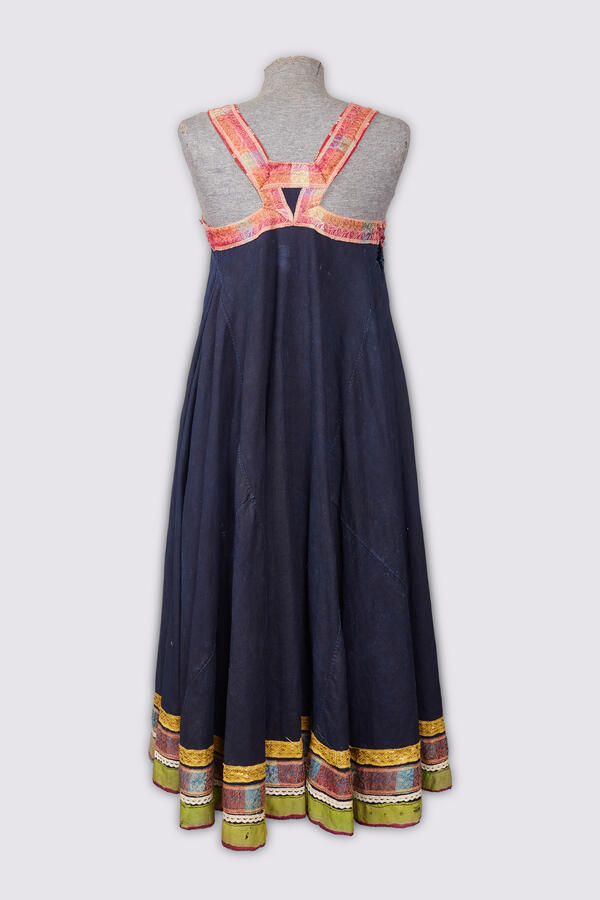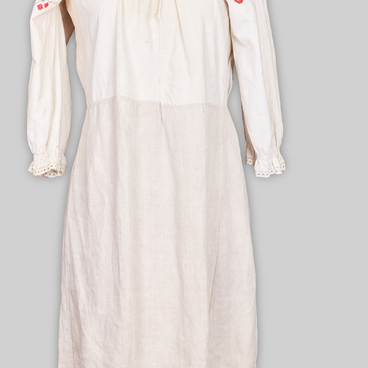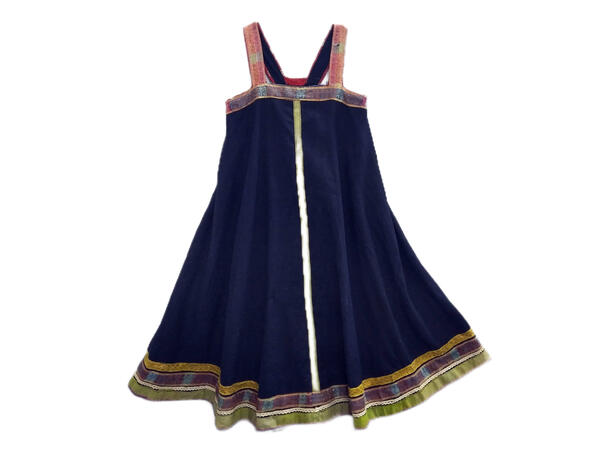
The Zheleznodorozhny Local Lore Museum presents a dark blue sarafan sundress made of rough cotton. The lower hem of the sarafan is trimmed with a wide strip of pistachio-colored chintz. The hem is also decorated with a wide ribbon with a floral pattern, golden trimming and a strip of narrow white lace. For a kosoklinnyi sarafan (which means that it is sewn of oblique wedges of fabric), navy blue cotton, sometimes blackened with sandalwood, was used, as well as woolen fabric of natural colors or dyed black or red. For festive sarafans, navy blue nankeen, less often silk, was used instead of navy blue cotton, and woolen fabric was replaced by broadcloth.
For the first time, the term “sarafan” was recorded in the Nikon Chronicle in 1376. Its compiler coined it to describe prince’s clothes without specifying the type of cut or materials used. Researchers believe that the term “sarafan”, which was probably of Iranian origin, was derived from the words sarapa or sarapai (“dressed from head to toe”) and was originally used to describe long man’s topwear with sleeves. Until the early 17th century, this word was rarely found in written sources and was always used in connection with men’s clothes. The sarafan joined the ranks of women’s clothes only in the 17th century. Most likely, the term began to be used in the 17th century to describe women’s clothes that had existed since the middle or end of the 14th century, and, possibly, some new types of clothing that were first designed in towns and then spread to the countryside due to the influence of urban fashion. Before Peter the Great signed the decrees on the mandatory wearing of European clothing in cities, sarafans were worn by noblewomen, boyars, townswomen and peasants. With the advent of Westernization in Russian clothes, sarafans were considered indecent for noblewomen to wear and continued to be worn only by the bourgeoisie, merchants and peasants.
Catherine II tried to change the situation. The Empress obliged the ladies of the court to wear Russian traditional dresses. A new version of a sarafan was developed especially for this, which was, of course, not entirely authentic and had a touch of the French fashion of that time but was still recognizable as a traditional Russian sarafan.
In the 18th –19th centuries,
sarafans became widespread in the north of European Russia, the central
governorates, the Volga and Siberia regions. Both married and unmarried women
wore sarafans. Everyday sarafans were simpler in appearance, while festive ones
were decorated with colorful ribbons sewn along the hem and stripes of
embroidery on a contrasting background. Known since the end of the 19th century, the Russian romance “Do not sew me, mother, a red sarafan…” was once
perceived literally, since wedding sarafans were usually red.