The samovar is one of the symbols of Russian culture. It was customary to polish this household item to a shine and hang baranki (ring-shaped bread) around it; it could be found in almost every house, regardless of the status of the owners.
This kitchen utensil was an indispensable attribute of a palace and a merchant’s mansion, an inn and a tavern. Not a single family gathering was complete without a samovar, where news was shared, commercial deals, creative ideas, travel itineraries and much more were discussed over a cup of tea.
However, not every family could afford this water-heating device, especially from famous manufacturers. The presence of a samovar was a sign of wealth and hospitality, and it was usually placed in a prominent place in the house.
The heyday of samovars was in the second half of the 19th century. They were made by famous Tula manufacturers: the Lisitsyns, Batashyovs, Kapyrzins, Teile and others. The city of Tula became the center of samovar production for several reasons at once — due to rich ore deposits, proximity to the capital and because of the abundance of highly skilled craftsmen — metal carvers.
Samovars were made of copper and alloys based on it — brass, tombac and melchior. Wealthy buyers were offered products with nickel or silver coating, while especially expensive samples were made of pure silver.
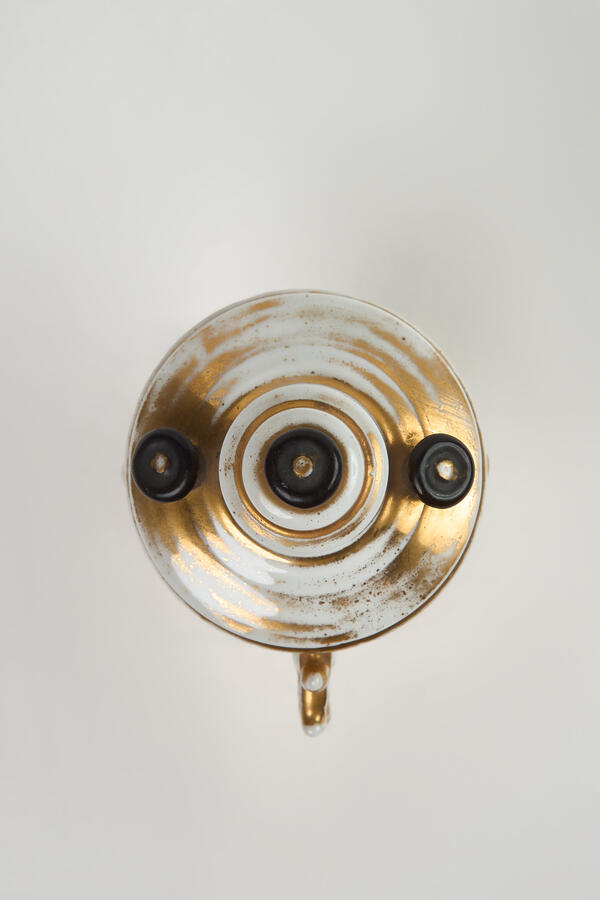
The samovar from the museum collection is made of porcelain coated with gilding. It was intended not for boiling water, but for drinking — it is a cup with a removable lid.
Few such items have survived: they are characterized by their small size and thin, fragile walls. The museum samovar cup has minor rubbing marks.
This porcelain samovar is almost an exact copy of a real thing. Above the neck of the body there are slots like a real air vent, and the burner with a knob and two grab handles on the sides crowns the lid. The cup handle is stylized as a samovar faucet.
The museum’s samovar was made at the Partnership
for the production of porcelain, faience and majolica products of M. S.
Kuznetsov. The blue overglaze mark on the bottom of the samovar testifies to
the place of its production.