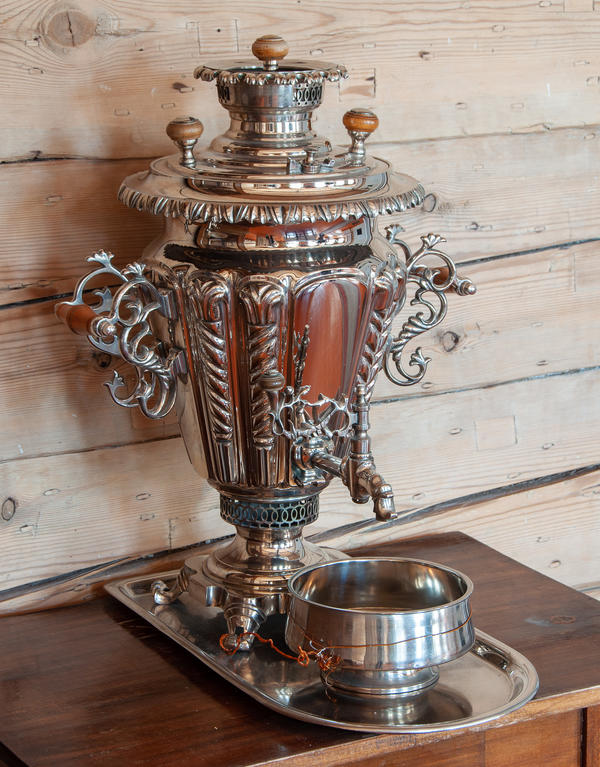
A samovar is a metal vessel for boiling water and making tea. The classic principle of operation of the device was that at first the water was heated by an internal furnace in the form of a high tube, which was filled with charcoal. Then heated water was poured through a tap into a vessel. Later, kerosene, electric and other types of samovars appeared.
The nickel samovar with a volume of five liters was presented to the elder sister of Vladimir Ilyich Lenin, Anna Ilyinichna Ulyanova, by her adopted son Georgy Yakovlevich Lozgachev-Elizarov, as he recalled during his visit to the Apartment-Museum of Vladimir Lenin in the 1920s.
This exhibit was made in the city of Tula. The samovar has the shape of a truncated cone with the base facing up. The outer surface is embossed, decorated with a complex ornament. The side handles and the faucet are made in the technique of metal weaving. On the top cover there is a brand name — “ТПЗ”, Tula Cartridge Plant, where samovars were produced during the period of economic growth starting in 1919.
The plant was founded in 1880. In addition to cartridges, civilian products were manufactured there, including parts for samovars. After the revolution and nationalization, the production facilities of the family enterprise of Vasily Stepanovich Batashev, where samovars were also produced from 1840, were transferred there.
It is probably for this reason that the water heaters of the Tula Cartridge Plant are very similar to those created by the masters of the Batashev family factory before the revolution. At that time, the manufacturer had an impeccable reputation and had the right to feature the coat of arms of the Russian Empire on its products. The Batashev factory also made bespoke samovars for the royal family. Because of this the devices made during the era of the New Economic Policy, or NEP, began to be equated with antique royal samovars.
In 1937, the Tula Cartridge Plant was reorganized,
and samovar production became a separate enterprise. In 1943, it received the
name “Stamp”. As the name implies, the company used stamping, which allowed to
increase productivity and at the same time reduce the cost of a unit of
production.