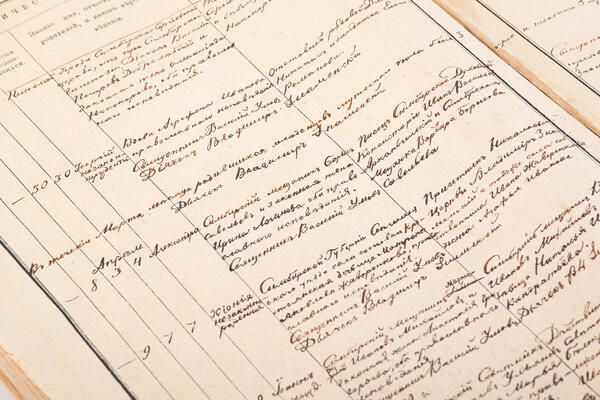
The parish register is a list of official records of civil status acts. Such registers were kept in Russia from the beginning of the 18th century until 1918.
The records in the parish register were maintained for a year and consisted of three parts: information “about the born”, “about the married”, “about the dead”. The parish registers were kept by trusted clerics in two copies. As a rule, the original was stored in the church. The second one, a duplicate, was certified by the responsible representative from the clergy and sent to the archive of the consistory — to the institution for church affairs under the bishop.
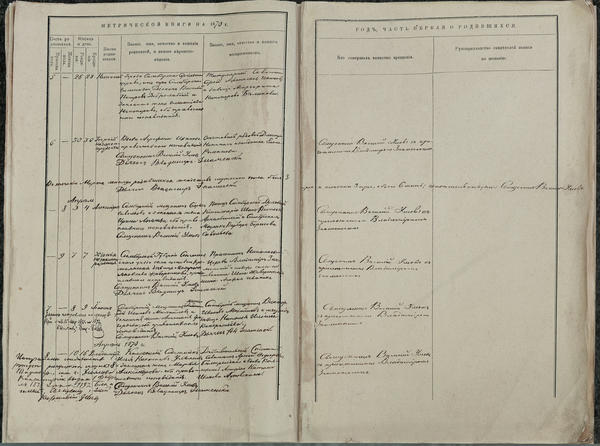
The register presented in the collection is opened on the page with data on those who were born on April 10, 1870 (according to the new style on April 22) in the city of Simbirsk, modern Ulyanovsk. Entry No. 8 at the bottom of the page includes information about the baptism of Vladimir Ulyanov, the future Lenin, as well as about his parents, godparents and those who performed the rite of baptism. He became the first Simbiryan in his family after they moved from Nizhny Novgorod.
The sacrament was conducted by priest Vasily Umnov and deacon Vladimir Znamensky. The boy’s godparents were family friends: the widow of a collegiate assessor (or a major in the modern system of ranks) Natalia Ivanovna Aunovskaya and the actual state councilor, the manager of the principality, or property office Arseny Fedorovich Belokrysenko. Arseny Fedorovich was also the godfather of Lenin’s younger sister, Maria Ilyinichna Ulyanova.
Vladimir Ilyich was baptized in St. Nicholas Church, which has not survived to the present day. Its history began in the middle of the 17th century, when a wooden single-altar Kazan church was built in Streletskaya Sloboda. In the early 1700s, St. Nicholas Church was built on the east side of it, originally also made of wood. The stone version was created in 1768.
In 1792–1796, the Kazan Church was rebuilt into a
warm one, that is, it began to be heated. Over the next five years, St.
Nicholas church, also a cold one, was rebuilt. The churches were separate and
did not have a single entrance. Despite this, the complex was given a common
name in honor of St. Nicholas of Myra, or Nicholas the Wonderworker. In 1864,
the buildings were severely damaged during a fire in Simbirsk, but two years
later they were restored again. In 1931, St. Nicholas Church was closed and
dismantled the following year.