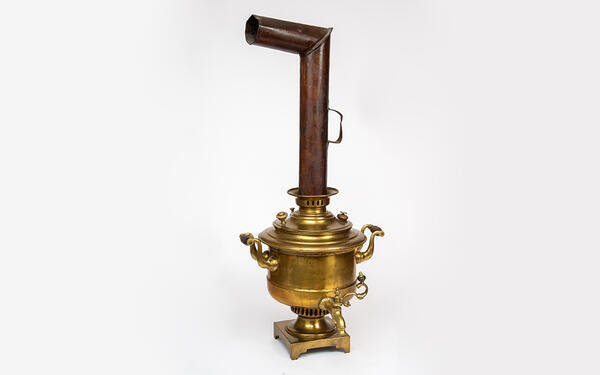
The samovar from the Verkhnyaya Pyshma museum was made in 1872. The water in it was heated by hot coals. An L-shaped pipe was attached to the brass body, it served as a chimney. In the lower part, there was a faucet, which was used to pour tea.
In Russia, the samovar became a symbol of peasant life — it could be found in almost every home. However, this device for heating water was not invented in Russia. It was used in other cultures since ancient times.
Ancient Romans used an authepsa — a tall vessel, which looked like a samovar. Inside was a tube for hot coals, which heated the water. In the summer, authepsas were used to cool — in this case, ice was used instead of coals.
A vessel similar to the samovar also existed in China and was called hot pot. It was a deep bowl with a built-in pipe and an air intake. The device was made of metal or porcelain. The dish was usually used to serve soup or boiling broth. According to one of the versions, the hot pot was brought in the 16th century to Russia, where it was improved and turned into a samovar.
Some scientists believe that the device appeared in Russia in the 18th century, during the reign of Peter the Great. The emperor traveled to European countries and brought interesting objects, including a vessel resembling a samovar. Other researchers believe that the samovar appeared in Russia after the death of Peter.
The first Russian-made samovar was assembled in the Urals in 1740, and six years later, the production of samovars started in Tula. The samovar was made of copper; it had two handles on the sides, so that it was easier to carry it when hot from the stove to the table. Later samovars were made from cupronickel and brass. There were also souvenir items made of precious metals — gold, silver –and even pure quartz.
Samovars ranged in volume from 2 to 15 liters. Their shapes were also different: more than 150 different models were produced in Tula alone. Egg-shaped samovars were popular, as well as models resembling the authepsa — an ancient Greek vessel. Moreover, portable models with removable legs were in great demand. Samovars in the form of cubes or polyhedrons could be taken on a picnic, a hike or a long journey.
In Russia, the samovar became a symbol of peasant life — it could be found in almost every home. However, this device for heating water was not invented in Russia. It was used in other cultures since ancient times.
Ancient Romans used an authepsa — a tall vessel, which looked like a samovar. Inside was a tube for hot coals, which heated the water. In the summer, authepsas were used to cool — in this case, ice was used instead of coals.
A vessel similar to the samovar also existed in China and was called hot pot. It was a deep bowl with a built-in pipe and an air intake. The device was made of metal or porcelain. The dish was usually used to serve soup or boiling broth. According to one of the versions, the hot pot was brought in the 16th century to Russia, where it was improved and turned into a samovar.
Some scientists believe that the device appeared in Russia in the 18th century, during the reign of Peter the Great. The emperor traveled to European countries and brought interesting objects, including a vessel resembling a samovar. Other researchers believe that the samovar appeared in Russia after the death of Peter.
The first Russian-made samovar was assembled in the Urals in 1740, and six years later, the production of samovars started in Tula. The samovar was made of copper; it had two handles on the sides, so that it was easier to carry it when hot from the stove to the table. Later samovars were made from cupronickel and brass. There were also souvenir items made of precious metals — gold, silver –and even pure quartz.
Samovars ranged in volume from 2 to 15 liters. Their shapes were also different: more than 150 different models were produced in Tula alone. Egg-shaped samovars were popular, as well as models resembling the authepsa — an ancient Greek vessel. Moreover, portable models with removable legs were in great demand. Samovars in the form of cubes or polyhedrons could be taken on a picnic, a hike or a long journey.