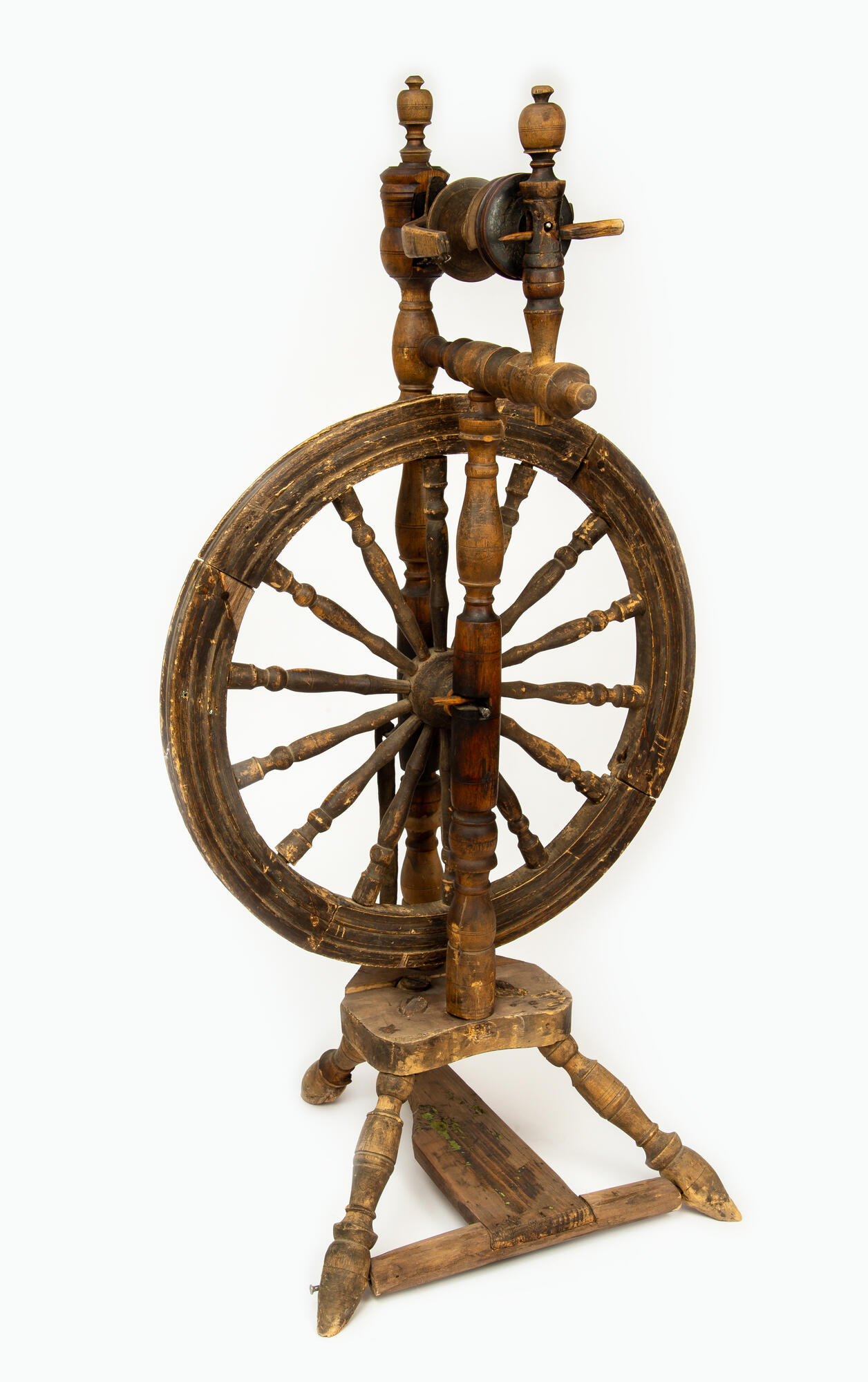


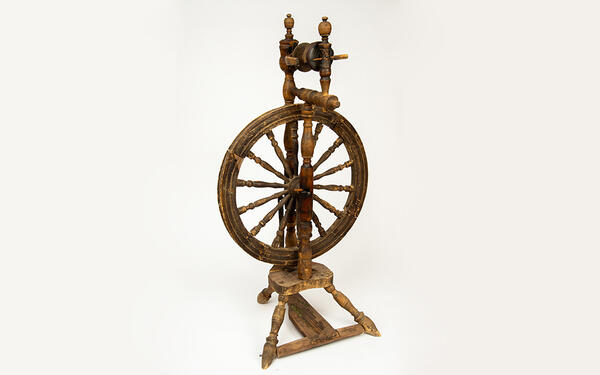
The spinning wheel was made by Mordovian craftsmen in the early 20th century. The device was used to spin threads from linen and cotton fibers.
The spinning wheel consists of a wooden board into which fiber or wool was inserted, and a wheel, which quickly fed the thread to the bobbin and increased the speed of work.
Spinning wheels appeared in Ancient Rome, but in Russia the device was not only a practical instrument, but also had a symbolic meaning — it was an expensive and special gift. For example, the groom often gave the bride a distaff, which he had made himself as a wedding present. He decorated it with various images such as birds, flowers and geometric patterns.
The first devices for spinning were hand-held distaffs. The work began with the spinner sitting on the ‘dontse’ — the lower horizontal part of the device — attaching the fiber to the flat vertical piece from above and manually drawing a short thread. Then she attached it to a spindle — a smooth, pointed wooden stick. The spinner held it in her right hand, rotated and, at the same time, pulled out the fiber with her left hand, moving it in the direction of the spindle.
Depending on the vertical part, there were two types of distaffs: oar-shaped — with a rectangular board, which was crowned with a row of vertical ridges, and forked, which looked more like a wooden hair comb. They were popular in different regions.
In the Urals and in the North of Russia, oar-shaped distaffs were more common, while the forked carved distaffs were more popular in the south. The type of decoration also depended on the region. In some villages, some distaffs even had a mirror attached.
The semi-mechanical spinning wheel appeared in the 15th century, it was equipped with a wheel, and some models had a foot pedal that controlled the speed.
The spinning wheels were made of wood. Often, different timber types were used for different elements. For example, the spindle was carved from birch, the ‘dontse’ (bottom part) — from aspen or linden, and the combs — from hard wood, like maple or ash.
Spinning and weaving was done solely by girls. They sat down to spin in the fall and winter once the harvest season was over. The process was difficult and complex, so girls mastered the art of spinning from childhood.
The work on the spinning wheels was slow, and to pass the time, the spinners came together. Such evenings, when the girls were singing songs, talking and spinning, were called ‘zapryady’.
The spinning wheel consists of a wooden board into which fiber or wool was inserted, and a wheel, which quickly fed the thread to the bobbin and increased the speed of work.
Spinning wheels appeared in Ancient Rome, but in Russia the device was not only a practical instrument, but also had a symbolic meaning — it was an expensive and special gift. For example, the groom often gave the bride a distaff, which he had made himself as a wedding present. He decorated it with various images such as birds, flowers and geometric patterns.
The first devices for spinning were hand-held distaffs. The work began with the spinner sitting on the ‘dontse’ — the lower horizontal part of the device — attaching the fiber to the flat vertical piece from above and manually drawing a short thread. Then she attached it to a spindle — a smooth, pointed wooden stick. The spinner held it in her right hand, rotated and, at the same time, pulled out the fiber with her left hand, moving it in the direction of the spindle.
Depending on the vertical part, there were two types of distaffs: oar-shaped — with a rectangular board, which was crowned with a row of vertical ridges, and forked, which looked more like a wooden hair comb. They were popular in different regions.
In the Urals and in the North of Russia, oar-shaped distaffs were more common, while the forked carved distaffs were more popular in the south. The type of decoration also depended on the region. In some villages, some distaffs even had a mirror attached.
The semi-mechanical spinning wheel appeared in the 15th century, it was equipped with a wheel, and some models had a foot pedal that controlled the speed.
The spinning wheels were made of wood. Often, different timber types were used for different elements. For example, the spindle was carved from birch, the ‘dontse’ (bottom part) — from aspen or linden, and the combs — from hard wood, like maple or ash.
Spinning and weaving was done solely by girls. They sat down to spin in the fall and winter once the harvest season was over. The process was difficult and complex, so girls mastered the art of spinning from childhood.
The work on the spinning wheels was slow, and to pass the time, the spinners came together. Such evenings, when the girls were singing songs, talking and spinning, were called ‘zapryady’.