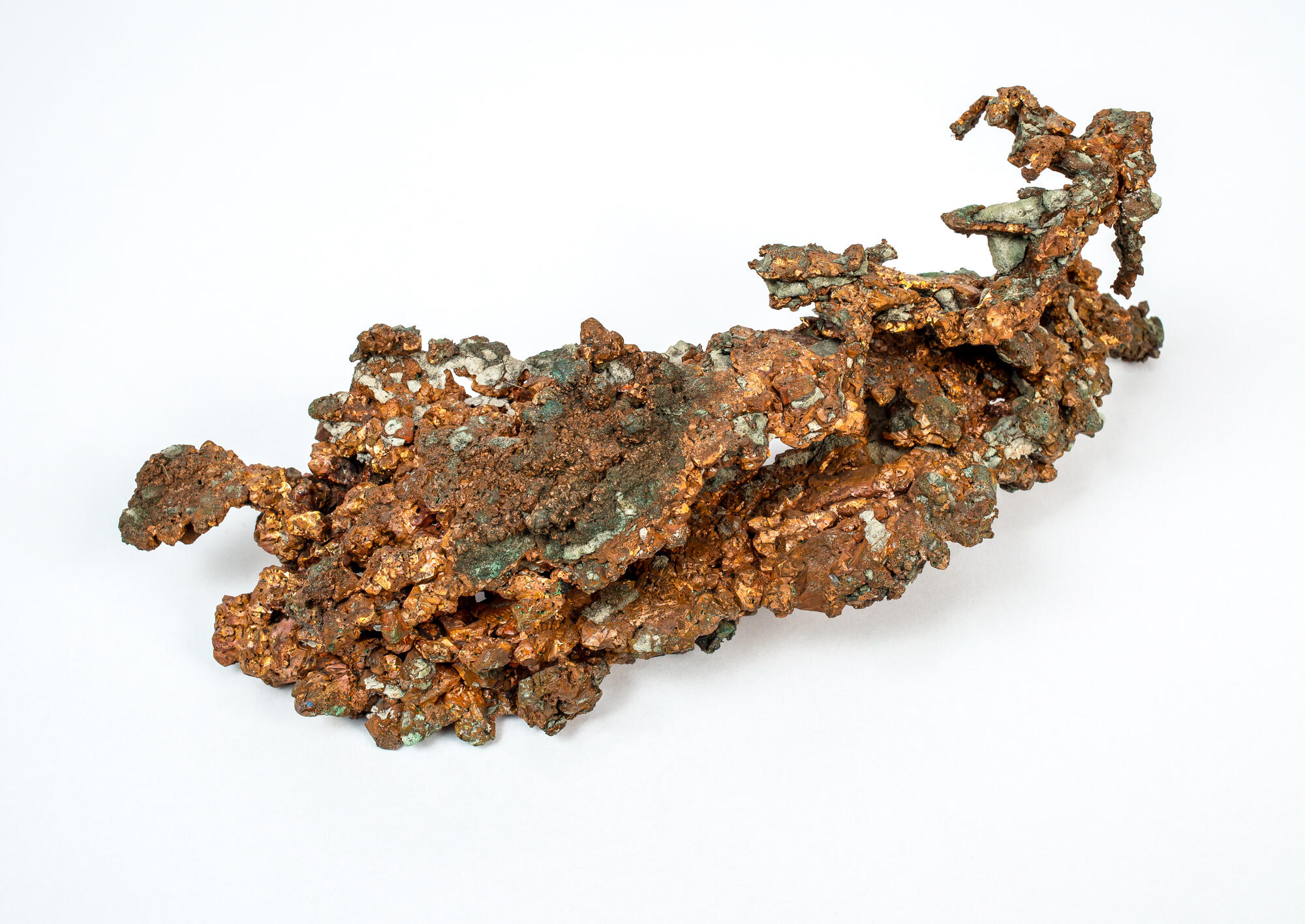


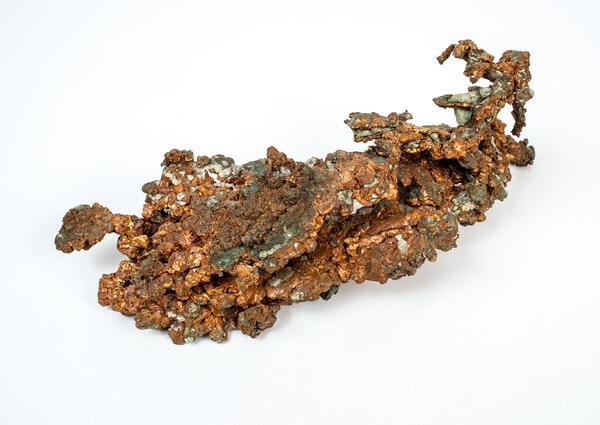
Native copper from the museum collection is a rare mineral, in which the proportion of pure copper is up to 99%. There are several varieties of this mineral. Gold copper contains up to 3% of gold, silver copper — up to 4% of silver, and ferrous copper — up to 2.5% of iron.
Ore extraction can be carried out in an open pit or underground. The rock is crushed into large pieces, the weight of which can reach several tons, which are then brought to the surface. After that, it is refined — the maximum possible number of impurities is removed by firing, use of acids and other methods. The result is native copper, which is a multi-faceted pink-orange crystal.
Man learned to mine and use copper about 10 thousand years ago. Archaeologists claim that ancient people discovered the metal by accident, when they were collecting stones in order to make tools. In those times, copper could be found on the riverbanks and in rocky cliffs, in the form of gray-green and red-green fragments of rock.
Most likely, the metal was used initially in the same way as ordinary stones, and there was not much processing involved. Then people noticed that cutting copper with a stone hammer makes it harder. This is how the cold forging method appeared, which led to the production of primitive tools.
Several centuries later, people learned to melt copper: the material was put into a fire and the resulting liquid metal was poured into simple home-made molds. People began to use copper to make weapons, tools and jewelry.
Later, they learned to add other minerals to liquid metal and obtain alloy. Bronze became the most widespread one — copper with the addition of tin. It was stronger, more pliable and did not oxidize in water or humid air. Bronze was used to make knives, jewelry, figurines of animals and people, and later coins.
In its pure form, copper continued to be used for industrial purposes. When electricity appeared in the 19th century, the metal proved to be an ideal material for wires and cables: it was flexible and had high electrical and thermal conductivity. Now more than 70% of all copper that is produced in the world is used for the production of electrical products: light bulbs, air conditioners, radiators and so on.
Ore extraction can be carried out in an open pit or underground. The rock is crushed into large pieces, the weight of which can reach several tons, which are then brought to the surface. After that, it is refined — the maximum possible number of impurities is removed by firing, use of acids and other methods. The result is native copper, which is a multi-faceted pink-orange crystal.
Man learned to mine and use copper about 10 thousand years ago. Archaeologists claim that ancient people discovered the metal by accident, when they were collecting stones in order to make tools. In those times, copper could be found on the riverbanks and in rocky cliffs, in the form of gray-green and red-green fragments of rock.
Most likely, the metal was used initially in the same way as ordinary stones, and there was not much processing involved. Then people noticed that cutting copper with a stone hammer makes it harder. This is how the cold forging method appeared, which led to the production of primitive tools.
Several centuries later, people learned to melt copper: the material was put into a fire and the resulting liquid metal was poured into simple home-made molds. People began to use copper to make weapons, tools and jewelry.
Later, they learned to add other minerals to liquid metal and obtain alloy. Bronze became the most widespread one — copper with the addition of tin. It was stronger, more pliable and did not oxidize in water or humid air. Bronze was used to make knives, jewelry, figurines of animals and people, and later coins.
In its pure form, copper continued to be used for industrial purposes. When electricity appeared in the 19th century, the metal proved to be an ideal material for wires and cables: it was flexible and had high electrical and thermal conductivity. Now more than 70% of all copper that is produced in the world is used for the production of electrical products: light bulbs, air conditioners, radiators and so on.