Font
Color
Graphics
Изображение точки

To see AR mode in action:

1. Install ARTEFACT app for iOS or Android;

2. Find the exhibition «Visiting Merchant Serebryakov»

3. Push the «Augmented reality» button and point your phone's camera at the exhibit;

Скрыть точки интересаПоказать точки интереса
Показать в высоком качестве

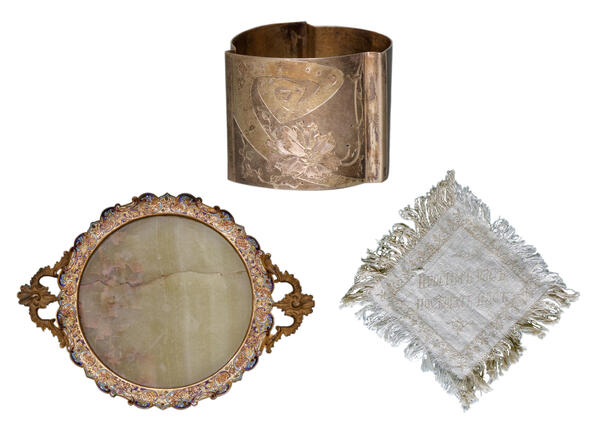
Napkin holder, Trivet for hot dishes, Napkin

0
Open in app
#1
Napkin holder, Trivet for hot dishes, Napkin
#8
Napkin holder
#3
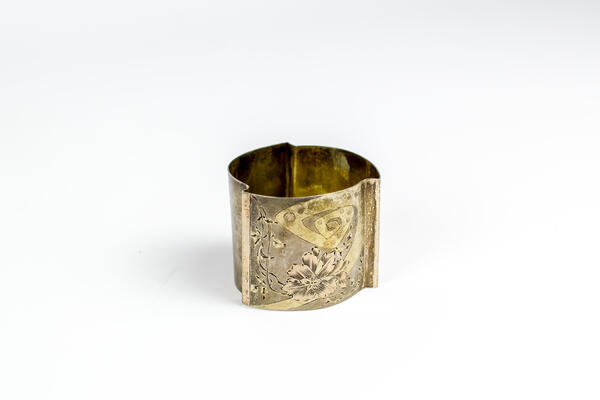
This ring has an irregularly shaped bevelled cylinder shape and is made of silver. The ring’s entire surface is decorated with a floral design.

A napkin ring is a dinner-table serving piece and is put on a rolled-up napkin. Besides circular rings, there are also oval, rectangular, triangular, hexagonal, and ornately-shaped rings.

In England in the 18th century, the rings were used to indicate clean napkins. Thus, it was possible to specify which napkin could be used at lunch, and which required washing. Later, the rings were used to indicate which napkin belonged to which member of the family. Each person had their own napkin and their own ring decorated with the owner’s monogram.

Such napkin holders appeared in France at the beginning of the 19th century. At that point in time, silver rings had lost their actual use and by the forties of the 19th century in Europe, they became very popular as a serving piece and table decor. In order to get a fashionable table requisite, some citizens gave for smelting down silver coins, from which rings were made.

The rings could be closed or split, and with flat, convex, or edge surfaces. Some napkin rings had small legs with balls or widenings at the ends in the form of animal or bird paws.

The napkin ring diameter usually made up 35-45 millimeters, the width was 30-40 millimeters, and the item’s weight was about 40-50 grams. Aside from silver, the rings were made of cupronickel, brass, copper, nickel-silver, organic glass, wood, porcelain, nacreshell, bone, and horn.

The napkin ring monograms and markings were carved out or engraved depending on the material. The metal napkin rings, were made traceried and solid, the latter were decorated with chasing work, engraving, niello, enamel and filigree. Brass, copper and nickel-silver rings were plated with silver and nickel. The wooden items were decorated with colored pictures.
#9
Полное наименование: Napkin ring
Дата создания: the 19th century
Техника: silver, engraving, gilding
Место создания: Saint Petersburg, Russian Empire
Размеры: 4.3×5.4 cm
Коллекция: Decorative and applied arts, household and ethnographic items
Правообладатель изображений: MBI “Tetyushi Region History Museum”
#10
Trivet for hot dishes
#5
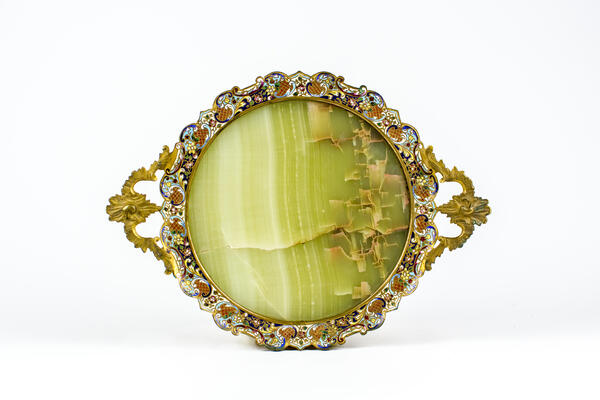
The trivet for hot dishes presented in the exhibition was made in France in the 19th century.

This history of this item is connected with the culture of drinking. Germany is considered to be the birthplace of the very first mat for the bowl. In German, this accessory was called “birdekel”, which literally translates into Russian as “beer lid”. In the 19th century, it was customary in German pubs to cover the mugs with felt napkins to protect the drink from flies and other insects. Later the same napkins were put under the mugs so that they would not slide on the table. Birdekels in those days were reusable: after the feast they were washed, dried, and used again.

A few years later, coasters made of thick, moisture-absorbing cardboard were invented, but such an accessory had a very short service life. Therefore, over time, they began to be made of more durable materials that are resistant to moisture and high temperature. Later, they began to be made not only for mugs, but also for dishes.

The base of this trivet is made of onyx. In ancient times, this stone was used to make seals, cups, caskets and other things. Moreover, onyx was used in the decoration of temples and cathedrals. For example, in the Middle Ages, the thinnest plates of this mineral replaced the glass in the stained-glass windows of cathedrals. Only rich families could afford onyx products.

Onyx is a chalcedony variety of quartz. The color of the mineral can be brown, greenish-brown, honey, white, yellowish-brown. Onyx is opaque by its nature.

The frame of the trivet is made of bronze in the technique of cloisonne enamel. To create objects using this technique, the outline of a future image is scratched, engraved or cut through on a thin metal plate made of copper, gold, more rarely silver, melchior or stainless steel. The thickness of the strips depends on the author’s idea, but rarely exceeds 1 millimeter. The strips create both closed and open cells of various shapes and sizes. Each cell is filled with enamel and then fired. After that, the enamel is sanded and finally polished in such a way that the enamel and the top of the partitions are in the same plane. The resulting multi-colored enamel image resembles an inlay with precious stones.
#11
Полное наименование: Trivet for hot dishes
Дата создания: the end of the 19th century
Техника: onyx, bronze, enamel, forging
Размеры: 32.5×24×3.5 cm
Коллекция: Decorative and applied arts items, household and ethnographic items
Правообладатель изображений: MBI “Tetyushi Region History Museum”
№ Госкаталога: 6015261
Место создания: France
#12
Napkin
#7
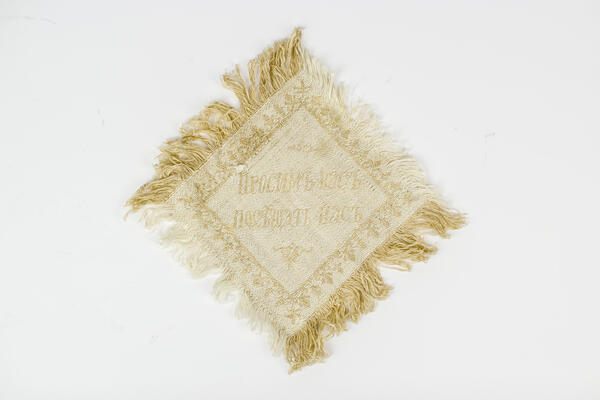
The napkin was kept in the family of Trofim Vasilchenkov, the great-grandson of the Tetyushi merchants Nikolai Polosukhin and G. Terekhov (his name has not been preserved). The children from the Tetyushi orphanage bestowed it upon the merchants in gratitude for their guardianship. Vasilchenkov’s relatives donated the napkin to the museum.

The square napkin with fringed edges is woven from beige and milky linen threads. It has floriated edges with the beige threads.

The inscription: “Please visit us” is woven in two lines with the same threads diagonally inside the frame formed by the weave.

The first napkins had been in use already in ancient Rome, and were known as “sudaria” and “mappae”. They represented a piece of fabric used to blot the lips after a meal or wipe the sweat from the forehead. Each guest brought his own napkin to the feast. They were used to wrap the leftover food. The napkins would often be personalized, decorated with embroidered monograms with the owner’s initials.

The use of the napkin in Europe began in the 15th century, at first they were used only by royalty. At that time, not everyone used forks and knives. The commonalty mainly ate with fingers, so the napkins were large-sized so that it was comfortable to wipe oneself.

In the 17th century, the first etiquette instructions on napkin usage at the table appeared in France. A French treatise dating from 1729 stated, “It is ungentlemanly to use a napkin for wiping the face or scraping the teeth, and a most vulgar error to wipe one’s nose with it.” Another rule of decorum sated as follows: “The person of highest rank in the company should unfold his napkin first, all others waiting till he has done so before they unfold theirs. When all of those present are social equals, all unfold together, with no ceremony.”

In Russia, the sleeves of clothes or tablecloth ends were used instead of napkins. This lasted until the beginning of Peter the Great reign. By his Decree, the emperor introduced the mandatory everyday use of the table napkins for the Russian nobility. In 1729, an etiquette book gave instructions on how and what table napkins should be used for: “For wiping lips, mouth, and fingers if they are greasy, for wiping the knife before cutting bread, for cleaning the spoon and fork after they are used. Should the fingers be too dirty, wipe them with bread first, so as not to use too many napkins. ”
#13
Полное наименование: Tavern napkin with the inscription “Please visit us”
Дата создания: the end of the 19th century
Техника: flax, weaving
Место создания: the Russian Empire
Размеры: 17×19.5 cm
Коллекция: Decorative and applied arts, household and ethnographic items
Правообладатель изображений: MBI “Tetyushi Region History Museum”
№ Госкаталога: 15150383
#14
read morehide
00:00
00:00
1x

Napkin holder, Trivet for hot dishes, Napkin

0
Point your smartphone camera to open in the app
Share
VkontakteOdnoklassnikiTelegram
Share on my website
Copy linkCopied
Copy
Open in app
To see AR mode in action:
  1. Install ARTEFACT app for 
  2. iOS or Android;
  3. Find and download the «Paintings in Details» exhibition
  4. Push the «Augmented reality» button and point your phone's camera at the painting;
  5. Watch what happens on your phone screen whilst you flip through the pictures.
 
We use Cookies
Cookies on the Artefact Website. We use cookies to ensure that we give you the best experience on our website. If you continue without changing your settings, we'll assume that you are happy to receive all cookies on the Artefact website. However, if you would like to, you can change your cookie settings at any time.
Learn more about cookie useHide
Content is available only in Russian

X

Нашли опечатку?...

%title%%type%