#1
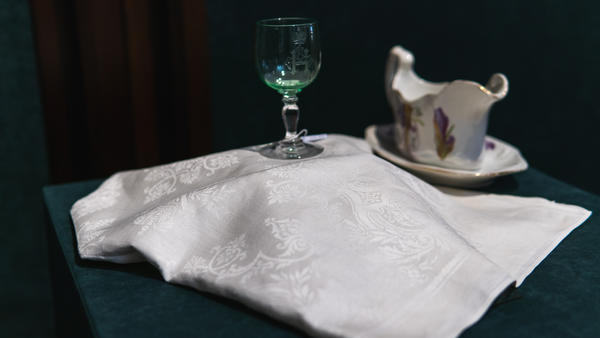
Napkin with Monogram of Emperor Nicholas II, Green shot glass, Gravy boat
#2
#5
#14
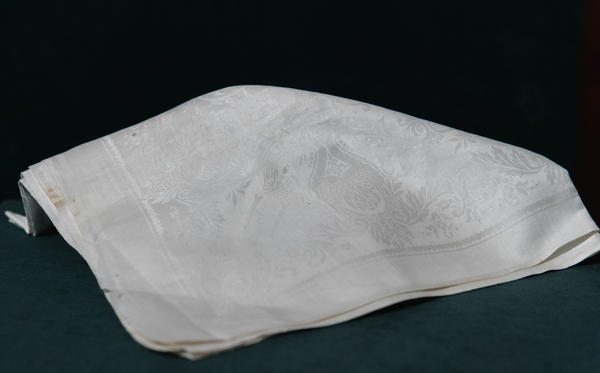
When Nicholas II and his family set off to Tobolsk exile, most of dishes and kitchen wares were sent there from Tsarskoe Selo. Among them there were tablecloths and table napkins. One of them is now stored in Tobolsk Historical and Architectural Museum — Reserve.
Entire surface of napkin is adorned by tracery that was manually woven at the factory. In the middle of background there is the Russian Empire emblem and in corners — the monogram of Nicholas II: the crown, under which there is letter N and Latin number II. These elements show that table linen was produced by special order for the family of the last Russian Emperor. The rest of the pattern was made in the form of interwoven stems and leaves.
The rectangular napkin was manufactured from poplin — dense and soft fabric, which appeared as far back as the 14th century at the court of the Pope of Rome. This is how its name descended from: in some foreign languages, this word meant papal.
Poplin were woven from threads of different thicknesses: the base was softer and thinner, the weft was dense. Such kind of weave formed a small scar on the surface of canvas. In Russia, such fabric appeared only in the 18th century, but became popular quickly. Ladies' gowns, men’s shirts, bed-clothes, tablecloths were made of it. This fabric most often consisted from silk fibers. However, the imperial family napkins were made from thin flax.
Colonel Evgeny Kobylinsky donated the table napkin, which is kept in the Museum of the Family of Emperor Nicholas II, to Tobolsk Historical and Architectural Museum — Reserve. Since March 1917, he was serving the head of the Tsar’s security. There, he made friends with the Romanovs and earned a trust of Nicholas II. Tsarevich Alexei’s tutor, Pierre Gilliard, reminisced about Kobylinsky as the “best friend” of the disgraced emperor.
After the Tsar’s family departure to Ekaterinburg, Evgeny Kobylinsky remained in Tobolsk. Provincial commissar Vasily Pignatti, who served as the custodian of the Tobolsk Museum at that time, helped him donate objects from the collection that belonged to the Imperial Family.
Entire surface of napkin is adorned by tracery that was manually woven at the factory. In the middle of background there is the Russian Empire emblem and in corners — the monogram of Nicholas II: the crown, under which there is letter N and Latin number II. These elements show that table linen was produced by special order for the family of the last Russian Emperor. The rest of the pattern was made in the form of interwoven stems and leaves.
The rectangular napkin was manufactured from poplin — dense and soft fabric, which appeared as far back as the 14th century at the court of the Pope of Rome. This is how its name descended from: in some foreign languages, this word meant papal.
Poplin were woven from threads of different thicknesses: the base was softer and thinner, the weft was dense. Such kind of weave formed a small scar on the surface of canvas. In Russia, such fabric appeared only in the 18th century, but became popular quickly. Ladies' gowns, men’s shirts, bed-clothes, tablecloths were made of it. This fabric most often consisted from silk fibers. However, the imperial family napkins were made from thin flax.
Colonel Evgeny Kobylinsky donated the table napkin, which is kept in the Museum of the Family of Emperor Nicholas II, to Tobolsk Historical and Architectural Museum — Reserve. Since March 1917, he was serving the head of the Tsar’s security. There, he made friends with the Romanovs and earned a trust of Nicholas II. Tsarevich Alexei’s tutor, Pierre Gilliard, reminisced about Kobylinsky as the “best friend” of the disgraced emperor.
After the Tsar’s family departure to Ekaterinburg, Evgeny Kobylinsky remained in Tobolsk. Provincial commissar Vasily Pignatti, who served as the custodian of the Tobolsk Museum at that time, helped him donate objects from the collection that belonged to the Imperial Family.
#13
Full name: Table Napkin with Monogram of Emperor Nicholas II
Author: unknown
Date: turn of the 20th century
Technique: poplin; machine-made
Dimensions: 86×71 cm
Collection: Textiles
Copyright: Tobolsk Historical and Architectural Museum — Reserve
Restorers: O.A. Mamina
Goskatalog Number: 003495091
Author: unknown
Date: turn of the 20th century
Technique: poplin; machine-made
Dimensions: 86×71 cm
Collection: Textiles
Copyright: Tobolsk Historical and Architectural Museum — Reserve
Restorers: O.A. Mamina
Goskatalog Number: 003495091
#3
Green shot glass
#7
#9
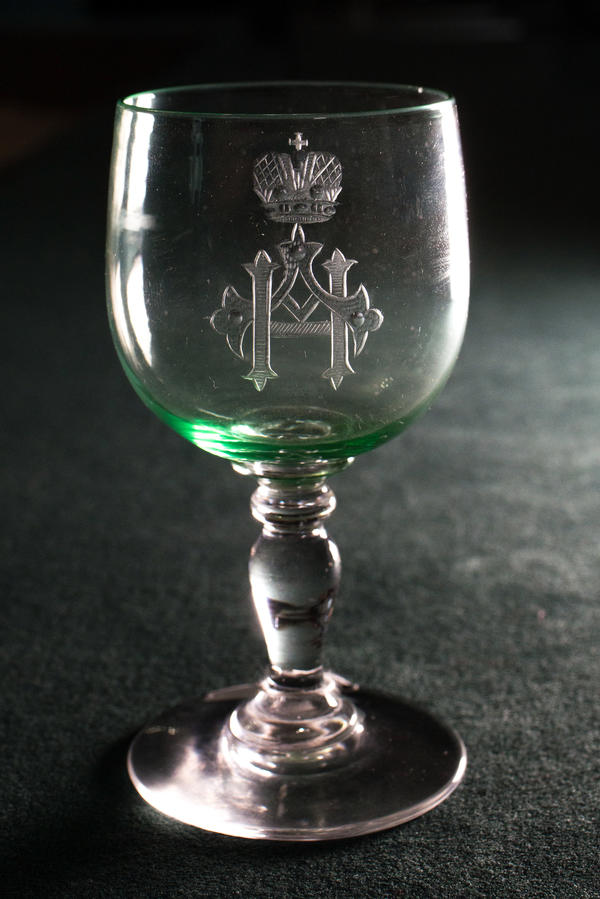
The shot glass from the collection of the Romanovs Museum is a small hemispherical bowl on a carved leg. It is made of transparent glass; the bottom is tinted green so that the vessel and the drink in it play brighter in the light.
The wall of the glass is decorated with engraving — the imperial crown and the personal monogram of Tsesarevich Nikolai Alexandrovich, which consists of the intertwined initials of the heir.
Monogrammed tableware was made specifically for members of the imperial family. For guests and courtiers, they manufactured sets with other designs, without monograms.
This glass was made at the Imperial Porcelain Factory. That enterprise was established in 1744 by order of Empress Elizabeth Petrovna. By the 19th century, the factory had become one of the largest in Europe.
For several centuries, the Imperial Porcelain Factory produced not only porcelain and earthenware sets for the royal house but glassware as well. The tableware was transferred to the Marshal of the Court Section of the Court Administration. That service ensured that it was properly stored in the pantries, always intact and clean, served in accordance with the ceremonial.
In addition, employees of the Marshal of the Court Section made sure that the ‘current loss’ was timely filled up and they created new sketches of glasses and cups for the imperial factory. The designs were approved by the Imperial Committee of the Court Administration. Then they were passed to glass and porcelain masters.
In the 18th-19th centuries, crystal and thin glass products in Russia were considered expensive and valuable goods. They were most often used by noble families and at the imperial court. If a set was not made for the royal family, then those items that were intended for the head of the family were decorated with a monogram. Crystal shot and wine glasses were often complemented by decanters made in the same style. Crystal products were decorated with carvings or cut to make light play brighter on them.
Ordinary citizens bought shot and drinking glasses of thicker cheap glass, copper or tin. In the countryside, people typically made do with wood or clay tableware.
The wall of the glass is decorated with engraving — the imperial crown and the personal monogram of Tsesarevich Nikolai Alexandrovich, which consists of the intertwined initials of the heir.
Monogrammed tableware was made specifically for members of the imperial family. For guests and courtiers, they manufactured sets with other designs, without monograms.
This glass was made at the Imperial Porcelain Factory. That enterprise was established in 1744 by order of Empress Elizabeth Petrovna. By the 19th century, the factory had become one of the largest in Europe.
For several centuries, the Imperial Porcelain Factory produced not only porcelain and earthenware sets for the royal house but glassware as well. The tableware was transferred to the Marshal of the Court Section of the Court Administration. That service ensured that it was properly stored in the pantries, always intact and clean, served in accordance with the ceremonial.
In addition, employees of the Marshal of the Court Section made sure that the ‘current loss’ was timely filled up and they created new sketches of glasses and cups for the imperial factory. The designs were approved by the Imperial Committee of the Court Administration. Then they were passed to glass and porcelain masters.
In the 18th-19th centuries, crystal and thin glass products in Russia were considered expensive and valuable goods. They were most often used by noble families and at the imperial court. If a set was not made for the royal family, then those items that were intended for the head of the family were decorated with a monogram. Crystal shot and wine glasses were often complemented by decanters made in the same style. Crystal products were decorated with carvings or cut to make light play brighter on them.
Ordinary citizens bought shot and drinking glasses of thicker cheap glass, copper or tin. In the countryside, people typically made do with wood or clay tableware.
#12
Full name: Green shot glass with monogram of Tsesarevich Nikolai Alexandrovich
Author: Imperial Porcelain Factory
Date: second half of the 19th century
Technique: glass; carving
Dimensions: 12×5,5 cm
Collection: Glass
Copyright: Tobolsk Historical and Architectural Museum – Reserve
Goskatalog Number: 13971010
Author: Imperial Porcelain Factory
Date: second half of the 19th century
Technique: glass; carving
Dimensions: 12×5,5 cm
Collection: Glass
Copyright: Tobolsk Historical and Architectural Museum – Reserve
Goskatalog Number: 13971010
#4
Gravy boat
#8
#10
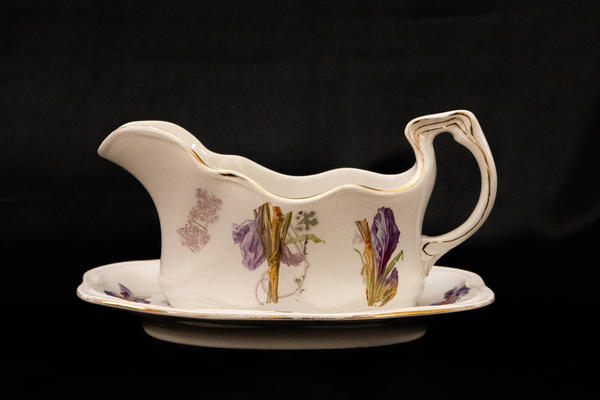
The earthenware gravy boat with painting was presented to the Museum of the Romanov family by resident of Tobolsk Larisa Raevskaya. She, in turn, received it from her acquaintance - Irina Pozdnyakova. The old gravy boat belonged to Pozdnyakova’s mother and was passed on to her from her mother-in-law, Maria Loginova. According to researchers, Loginova could serve the Romanov family when they were in Tobolsk exile.
#15
The gravy boat was part of a large set of tableware from the governor’s house, where the disgraced emperor and his family were housed. The gravy boat also included a small saucer: it has also been preserved to this day, and is presented in the exhibition of the Tobolsk Museum.
#16
The white earthenware gravy boat is painted with colored glaze. Its sides, as well as the saucer boards have images of lilac irises. Parts of the gravy boat are decorated with gilding.
Matvey Kuznetsov founded the Partnership for production of porcelain, earthenware and majolica articles in 1889. He produced tableware and decor items for different categories of buyers: inexpensive practical products with simple decor were designed for peasants, townspeople preferred options with painting similar to sets for noble families. Tableware with exquisite artwork and a gilded inner surface was offered by Kuznetsov to aristocrats.
By the beginning of the 20th century, the Partnership was the largest producer of porcelain and earthenware articles in Europe. It consisted of seven factories, each of which specialized in certain products. The Dulyovo factory produced church utensils, figurines and services painted with large color spots. Single pieces were made in Tver. They included dishes, mugs, bread and caviar bowls. The range of the Budyansk factory included even doll tableware sets.
In 1902, Kuznetsov became the official supplier of the imperial court. His enterprise supplied the Romanov family with tableware till the revolution.
Matvey Kuznetsov’s factories applied a special method of processing clay that then was used to produce earthenware. It was kept for a year in basements with a certain humidity and temperature, after which the material became plastic and did not crack during operation processes. Peat that was extracted no later than in July, was used for roasting. Such fuel had time to dry properly, so it gave an even hot flame and did not produce smoke.
Matvey Kuznetsov founded the Partnership for production of porcelain, earthenware and majolica articles in 1889. He produced tableware and decor items for different categories of buyers: inexpensive practical products with simple decor were designed for peasants, townspeople preferred options with painting similar to sets for noble families. Tableware with exquisite artwork and a gilded inner surface was offered by Kuznetsov to aristocrats.
By the beginning of the 20th century, the Partnership was the largest producer of porcelain and earthenware articles in Europe. It consisted of seven factories, each of which specialized in certain products. The Dulyovo factory produced church utensils, figurines and services painted with large color spots. Single pieces were made in Tver. They included dishes, mugs, bread and caviar bowls. The range of the Budyansk factory included even doll tableware sets.
In 1902, Kuznetsov became the official supplier of the imperial court. His enterprise supplied the Romanov family with tableware till the revolution.
Matvey Kuznetsov’s factories applied a special method of processing clay that then was used to produce earthenware. It was kept for a year in basements with a certain humidity and temperature, after which the material became plastic and did not crack during operation processes. Peat that was extracted no later than in July, was used for roasting. Such fuel had time to dry properly, so it gave an even hot flame and did not produce smoke.
#11
Full name: Gravy boat
Author: Partnership for production of porcelain, earthenware and majolica articles
Date: late 19th century — early 20th century
Technique: earthenware; glaze, colored glaze, gilding
Dimensions: 11.5×21×12.5 cm
Collection: Porcelain, Ceramics
Copyright: Tobolsk Historical and Architectural Museum — Reserve
Goskatalog Number: 8997854
Author: Partnership for production of porcelain, earthenware and majolica articles
Date: late 19th century — early 20th century
Technique: earthenware; glaze, colored glaze, gilding
Dimensions: 11.5×21×12.5 cm
Collection: Porcelain, Ceramics
Copyright: Tobolsk Historical and Architectural Museum — Reserve
Goskatalog Number: 8997854
read morehide
00:00
00:00
1x
Napkin with Monogram, Shot glass, Gravy boat
0
 Point your smartphone camera to open in the app
Open in app
Share