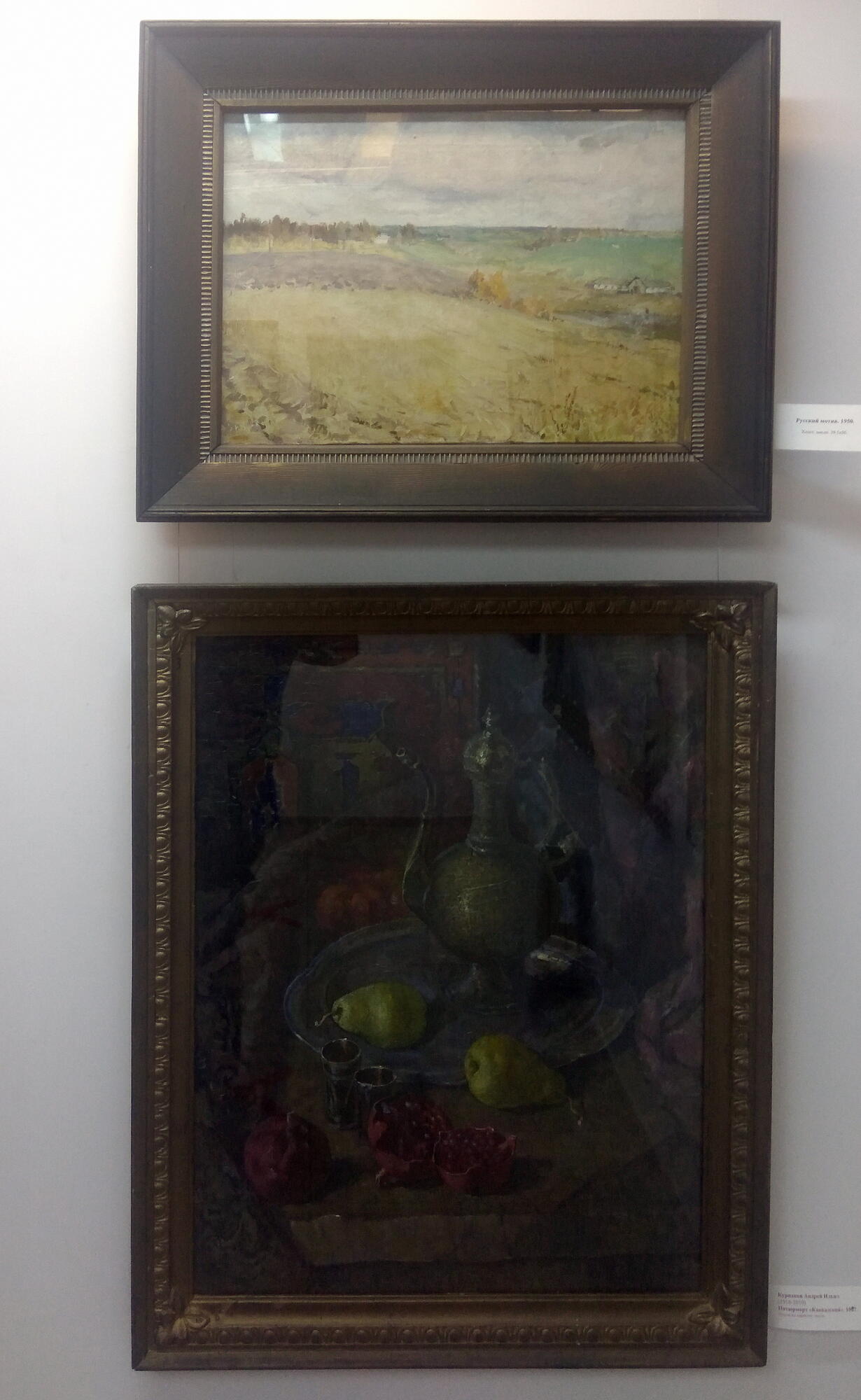


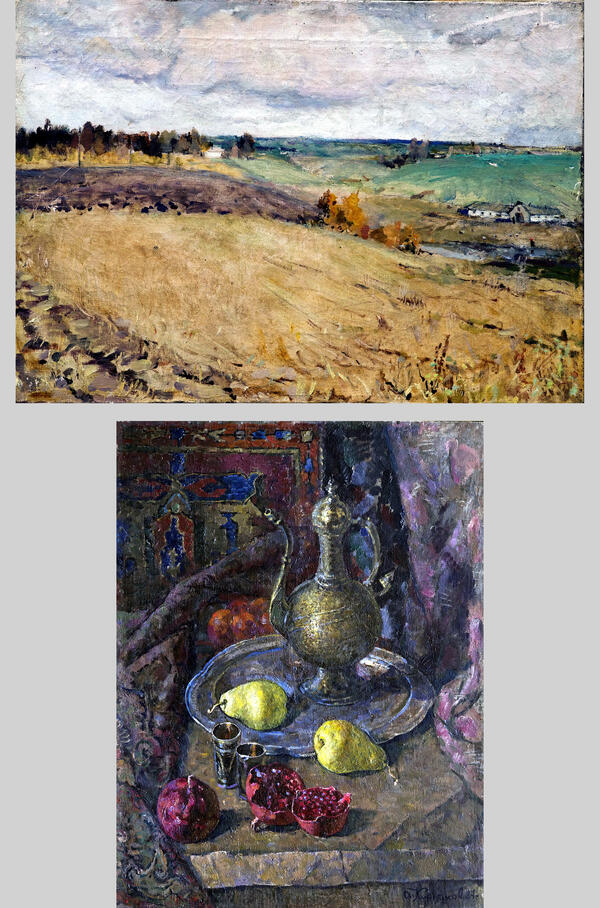
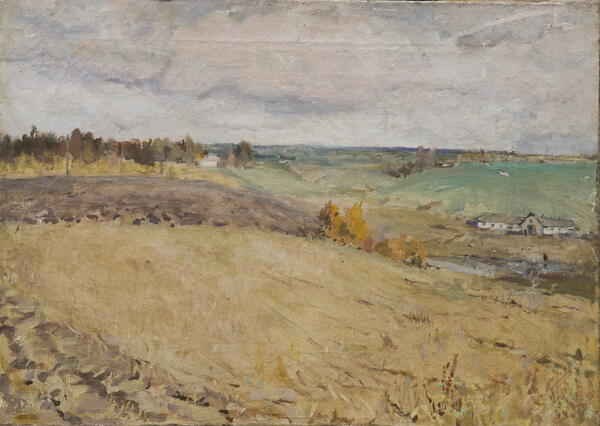
The motive of his native land was very close to Andrei Ilyich Kurnakov in the 1950s, since only recently he defended it in the Great Patriotic War. After the end of the war, he continued his education at the Kharkov Art Institute. The landscape ‘Russian Motif’ was painted at the time when he was a student, but as a professional artist he was already a member of the Union of Artists of Russia.
The painting depicts a rural landscape, mid-autumn, October. A panorama of the Central Russian valley is in front of us. For the composition, an artist chose a viewpoint from above, standing on a hillock. In the foreground is a harvested field of warm, light ocher color with the remains of cut straw. On the right, at the edge of the picture, the brown panicles of yellow dock rise, the seeds of which will serve as food for wintering birds in the cold and hungry winter, when snow covers the ground. In the lower left corner there are traces of a plow that has screwed out layers of soil.
Further, in the background, plowed brown soil contrasts with the light ocher of the field and straw. In the composition’s center, a bush with bright red foliage flames, smoothly going down the slope to the right, directing our gaze to a small river flowing below. Its leaden water reflects a gray sky with cumulus. On the opposite bank, a fisherman in a red hat is barely visible.
Behind the river is a low-lying valley with gentle slopes and buildings standing below. This is a farm with white one-story houses with a common entrance under a gable roof. Behind it, the still greening meadow smoothly rises to the hill, on which in some places there are literally strokes depicting groups of grazing cows. Further in the background, in the center, there is a shallow ravine with green grass - a place of war games for village boys. On the right, the houses of the village are marked in dark brown spots, behind which a dark strip of forest runs along the horizon. On the left, starting from the background, power lines stretch, pulling wires to a village with white one-story houses.
Light brown haystacks stand along the road and near the forest prepared for winterfeed. A forest with already darkened deep brown foliage begins behind the haystacks. The upper part of the picture’s composition is occupied by a light gray sky with dark gray cumulus. The artist, conveying the depth and airiness of space, brightens the sky on the horizon almost to white, smoothly transitioning to lead-gray clouds at the upper edge of the picture.
The landscape was painted in oil, with almost watercolor strokes. Transparent colors convey the feeling of cool autumn air, smelling of smoke from campfires in the village gardens. The artist managed to convey through the composition a warm greenish-ocher color, a light-air perspective and a wide space, peculiar for the central part of the Russian land.