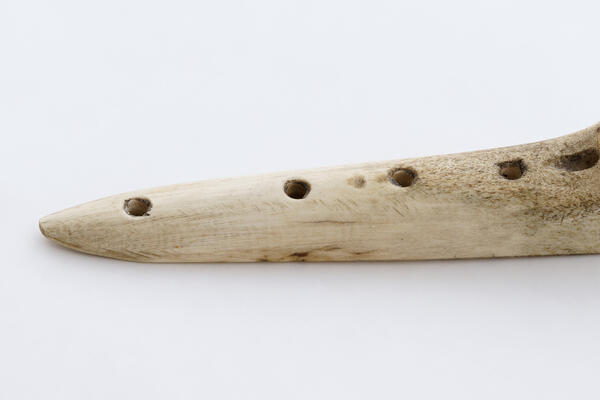
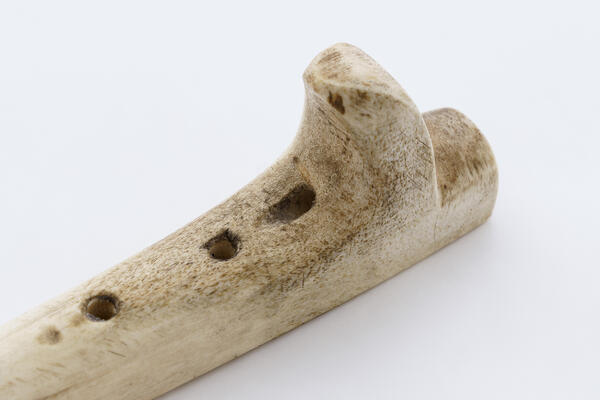
The hall “Rus and Horde: 14th Century Warfare” at the State Museum-Reserve “Kulikovo Field” features a replica of a lash handle. Like the original, this replica is made of bone as a U-shaped bar, with one side of the loop pointed and the other made as a massive hook. Four holes were drilled on the pointed side of the handle to attach the leather part of the lash.
A lash was an essential part of a horseman’s equipment and a device used to control a horse. It consisted of a handle, which could be made of wood, metal, or bone, and a leather-braided whip.
There were three main types of lashes: the whip (“khlyst”) was a flexible but sturdy rod that thinned towards the end and had the handle at the thicker end; the switch (“stek”) was an inflexible rod that was of the same thickness throughout its length and was often braided or coated; and the bullwhip (“knut”) was a single-tailed braided whip attached to a fixed handle.
For many hundreds of years, lashes underwent no significant changes. During the era of the Battle of Kulikovo, one of the distinctive features of lashes was the beak-shaped end of the handle. This could be made from wood, carved from bone, or cast of non-ferrous metal.
Bone-carving was common in the Middle Ages; traces of bone-carving production are constantly found during archaeological surveys in both ancient Russian and Golden Horde towns. Bone-carving workshops of the Golden Horde were known on Tsarevskoe, Selitrennoe and Bolgarskoe town sites. In two estates of Tsarevskoye site, bone and horn blanks, trimmings, as well as semi-finished products were found. Knife handles, heads and linings were also made there. On Bolgarskoe town site, waste products, blanks, rejects, and numerous products of bone carvers and their tools (cutters, drills, and specialized knives) were found.
Details of bows as well as ornamental decorative
linings of quivers, rings for bowstrings, knife handles, muffs and backplates,
buckles, overlays, sewn-on badges, handles of lashes, awls, saddle covers,
“whistling” attachments on tangs of iron arrowheads, and other items were made
from bone.