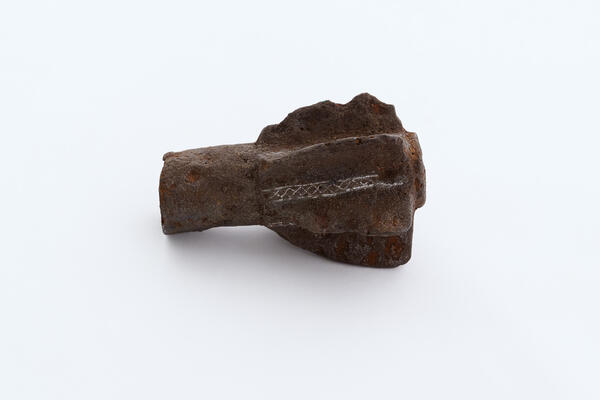
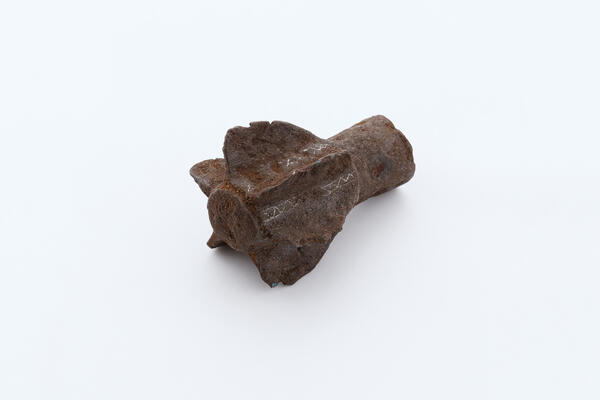
The exhibition at the State Museum-Reserve “Kulikovo Field” features a flanged mace displayed in its main hall “Rus and Horde: 14th Century Warfare”. It was part of the offensive weapons used by warriors in the 14th–15th centuries. The original artifact, which served as the basis for the replica on display, is classified as a type of mace. In the terminology of Russian weapons experts, the flanged mace is known as a shestoper and also has an authentic Old Russian name — pernat or pernach, derived from its design. “Pero” means “a feather” in Russian, and the mace consists of a cylindrical sleeve with feather-shaped impact elements, attached to it vertically using welding or copper soldering.
A flanged mace is a type of cold impact weapon. It takes the form of a staff with a head made up of six metal flanges.
Flanged maces, as an independent type of weapon, emerged at the turn of the 14th century and became widespread in the 1330s. During the time of the Battle of Kulikovo, this type of mace became dominant in the Golden Horde, almost completely replacing all other types of bludgeoning weapons. Earlier maces, typically in the form of a steel ball or polyhedron and sometimes equipped with spikes, were replaced with this six-flange design. The stunning effect of this weapon was as powerful as that of traditional maces, but it was better at penetrating armor.
Moreover, within the military aristocracy of the Golden Horde, the flanged mace played a symbolic role. In the Golden Horde legend — “The Last of the Sart Family, ” which recounts events that occurred 11 years after the Battle of Kulikovo during Tamerlane’s invasion in the summer of 1391 — the character states, “I had my own pernach (flanged mace) and tamga. I was both an elder and a bey (chieftain).“
The displayed mace belongs to the pernach type, specifically the six-flanged variant. During the era of the Battle of Kulikovo, this type of mace was not merely a weapon but also a symbol of feudal lordship. In Horde and Iranian miniature paintings, members of the nobility are often depicted wielding flanged maces. Furthermore, these are relatively common finds within the historical territory of the Golden Horde. At the same time, seven flanged maces have already been discovered in Tula Oblast.