Font
Color
Graphics
Изображение точки

To see AR mode in action:

1. Install ARTEFACT app for iOS or Android;

2. Find the exhibition «Russians. Late 19th — Early 20th Century»

3. Push the «Augmented reality» button and point your phone's camera at the exhibit;

Скрыть точки интересаПоказать точки интереса
Показать в высоком качестве

Rubel

Creation period
the second half of the 19th century
Place of сreation
Eastern Europe
Dimensions
63x8,5 cm
Technique
wood; relief carving
3
Open in app
#1

The first irons in Russia came into use in the 17th century and did not immediately become widely available. Meanwhile, tablecloths, towels and other homespun items made of linen and hemp after washing and drying became rough, creased and needed to be made smooth again.

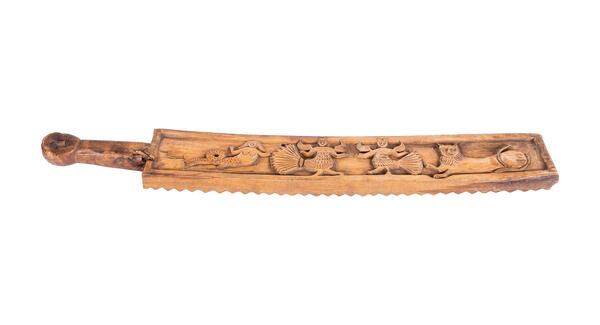
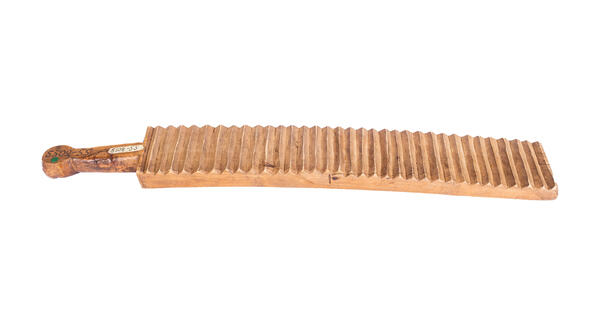
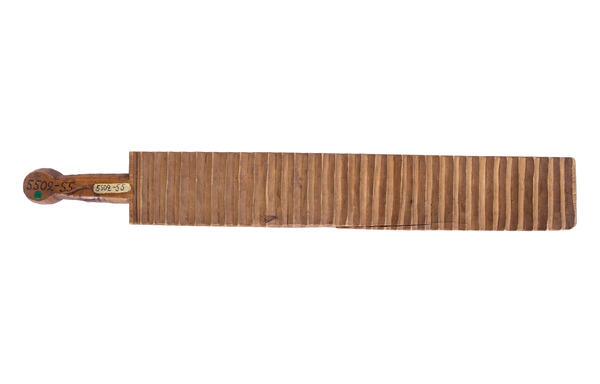
A rubel was used for this purpose. It was a long rectangular bar with a handle at the end. The lower working surface had rounded cross grooves, and the upper front surface could be decorated with carving or painting.

A rubel did not smooth out the cloth but rolled it out and kneaded it thoroughly. To do this, the laundry was tightly wrapped on a cylindrical roller and rolled over several times with the ribbed side of the rubel while applying pressure. The washed item became smooth and soft, at the same time the remaining water and dirt were squeezed out of it along with small pieces of trash. The proverb “not by washing, but by rolling” which meant “to get what one wants (cleanliness) in one way or another” is associated with the rubel.

Rubels were made of hardwood: beech, oak, rowan, and birch. In the Russian North, the tool had a hollow in the handle, where dried peas were put. While working, such a rubel would make a sound like a rattle.

Like other household items, the rubel played an important role in rituals. In Southern Russian provinces, the bridesmaids or younger brother tapped the rubel on the table and haggled with the groom’s side for a “maiden’s plait” or the groom’s place at the feast:
#2

Here we have a rolling pin and a rubel, give me a hundred rubles for my sister!

#3

Beautifully decorated with paintings or carvings, this tool was a common gift of the groom to the bride.

The tradition of decorating homes and household utensils with carved images of fantastic creatures dates back to Volga ship carving. The exhibit is decorated with figures of female pharaohs, Alkonosts and a lion. The image of the Alkonost is taken from the popular prints. This bird of paradise with female hands and head, wearing a crown, mesmerized people with its singing. Male and female pharaohs were brought into the decor from apocryphal legends of the Exodus of the Jews from Egypt. Novgorod peasants told that the Egyptians who drowned in the Red Sea turned into fish with human heads and hands, and in clear weather they would surface with the cry “King Pharaoh drowned in the water”. The lion for the peasants was the personification of military valor, nobility and the proud king of beasts. In the Russian legend of the Deluge, the Devil sent mice to Noah’s ark to gnaw holes and sink it:
#4

The lion-beast saw it and sneezed so hard that a cat came out. The cat ate the mouse, and the ark did not perish.

#5

For this service, it was believed, cats were allowed into the church, and the lion was made king over all the beasts.

#7
Rubel
#6
read morehide
00:00
00:00
1x

Rubel

Creation period
the second half of the 19th century
Place of сreation
Eastern Europe
Dimensions
63x8,5 cm
Technique
wood; relief carving
3
Point your smartphone camera to open in the app
Share
VkontakteOdnoklassnikiTelegram
Share on my website
Copy linkCopied
Copy
Open in app
To see AR mode in action:
  1. Install ARTEFACT app for 
  2. iOS or Android;
  3. Find and download the «Paintings in Details» exhibition
  4. Push the «Augmented reality» button and point your phone's camera at the painting;
  5. Watch what happens on your phone screen whilst you flip through the pictures.
 
We use Cookies
Cookies on the Artefact Website. We use cookies to ensure that we give you the best experience on our website. If you continue without changing your settings, we'll assume that you are happy to receive all cookies on the Artefact website. However, if you would like to, you can change your cookie settings at any time.
Learn more about useHide
Content is available only in Russian

X

Нашли опечатку?...

%title%%type%