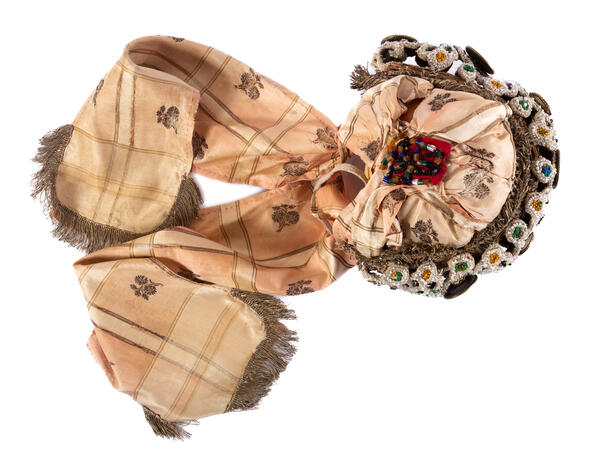
A konura, or koruna, was a special kind of headdress that existed in the Arkhangelsk and Vologda governorates. It was intended exclusively for betrothed girls and was no longer worn after the wedding.
A konura was put on a bride while she was still at her parents’ house for a pre-wedding bridal’s party or right on the day of the wedding. The ceremony of putting it on was accompanied by lamentations — a farewell to the girl’s freedom, paternal home and friends. In the new husband’s house before the “princely feast” or immediately after the wedding service, near the church, the konura was replaced with a married woman’s close-fitting headdress.
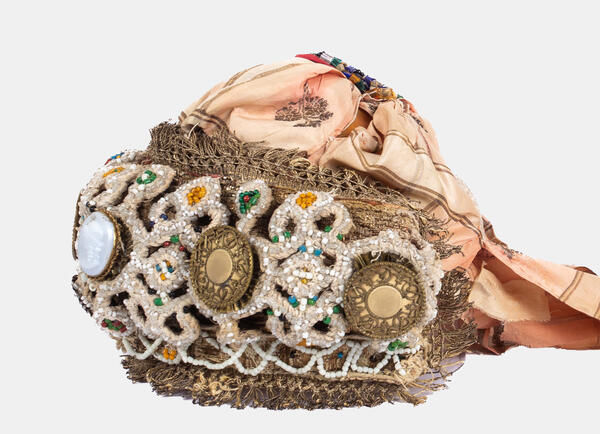
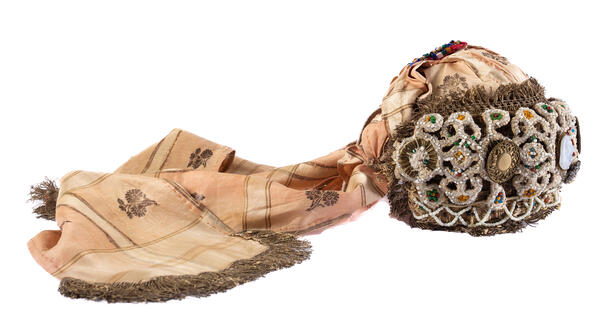
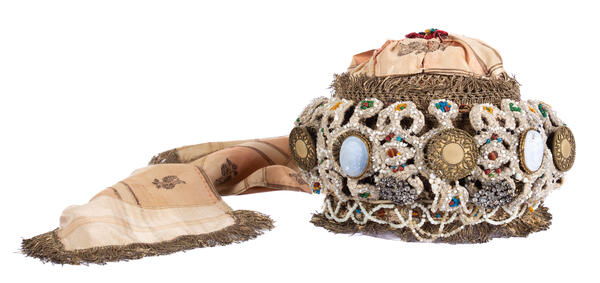
A konura was an open, maiden’s headdress designed as a loose headband with a relief openwork decorative element attached to it on the outside. The base, made of birch bark or glued cardboard strips, was covered with canvas or chintz and decorated on the outside with a braid. At the bottom, the konura was embroidered with chopped mother-of-pearl, gold or colored beads, and oblique crosses of white bugles.
The upper part of the headband rose 5–7 centimeters above the base. This elegant construction was made of glued layers of canvas, twisted into a roll. A pattern was cut into it, and the remaining part was decorated in the technique of string pearl embroidery: pearls, mother-of-pearl or beads were strung on a linen thread and fastened with a cross stitch along the cord. The image in the form of scrolls and heart-shaped figures was texturized.
The openwork band was also decorated with rosettes made of pressed foil or thin sheet metal bent in frequent assemblages, flat metal leaves and buttons, cannetille, faceted glass chatons, multicolored beads, and even cameos.
A fringe of gold threads was often sewn to the upper and lower edges of the base. At the back, at the junction of the ends of the headband, long flaps of silk fabric, such as multicolored brocade, were sometimes sewn to the middle of the back and embroidered with gold thread on the bottom edge.
A konura was put on top of the usual maiden’s headband, so the whole headdress looked rather tall. In the church during the wedding ceremony, the open maiden’s headpiece was supplemented with a headscarf or silk bow. Three or four loops of the bow were folded into a kind of rosette to cover the open part of the head.