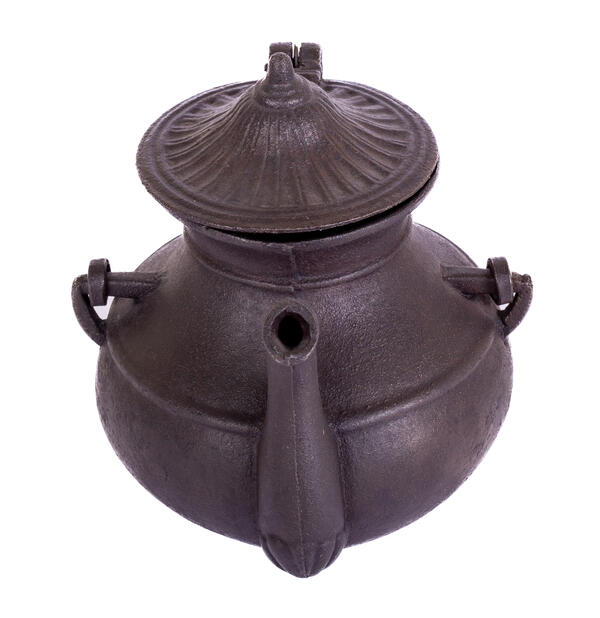
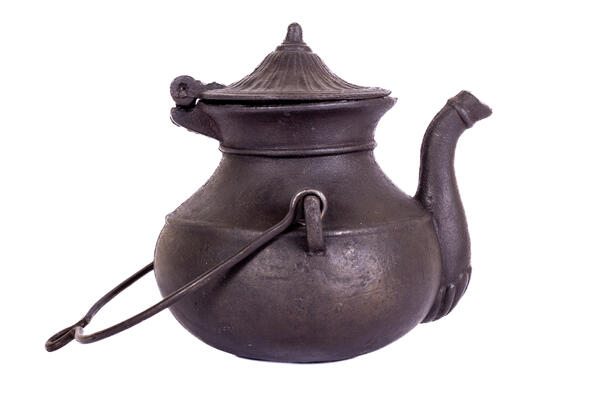
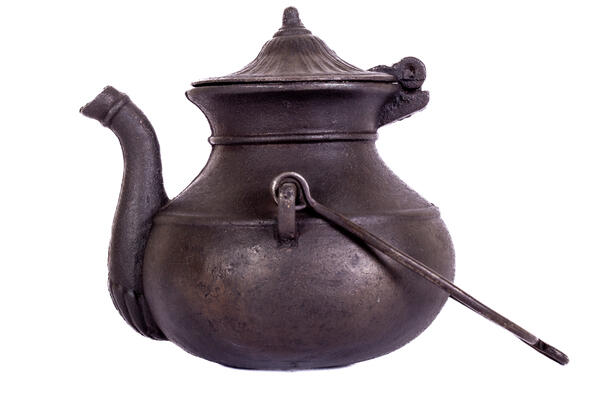
“Hanging, dangling, everyone bows to him, ” — this is how Russian peasants used to describe a hand-washing pot, emphasizing the important role of this utensil in the household.
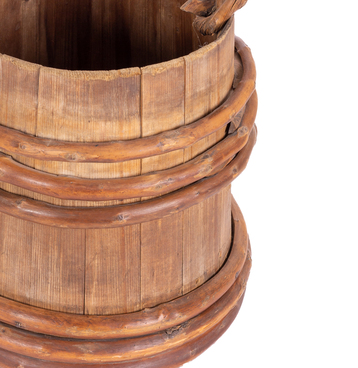
Hand-washing pots were made of clay, metal or wood in the form of a rounded or slightly elongated vessel (“baran”) with a wide opening where water was poured. There were two spouts on opposite sides or an opening with a metal rod that was raised for draining. A three-legged basin was placed under the hand-washing pot. A “rukotyorka” — a piece of rough homespun linen for wiping hands was placed next to it. In a peasant house the hand-washing pot usually hung next to the oven. Hands were washed before and after meals.
Hand washing was an important ritual. The concept of cleanliness, both physical and mental, was of great importance in the traditional culture. To designate supernatural beings, words with the meaning of uncleanness were used: “nemytik”, “neumyty”, “unclean force”.
It was considered obligatory to wash hands and face not only in the morning and before each meal (it was thought that if one did not wash their hands before eating, then the devil would sit at the table and help them eat), but also before an important event, and sometimes after it. Thus, hands and face were washed before and after a long journey, before visiting an apiary, when returning from a visit or cemetery, as well as after a funeral repast.
In transitional ceremonies involving a change of status (childbirth, wedding and funeral), ritual washing was a prerequisite. A woman in labor and a midwife, a bride, a groom and all their kin washed; the deceased was washed and those who came into contact with the dead body washed too.
The hand-washing pot was also a symbol of the house and its mistress. During the viewing of the bride the matchmaker was obliged to look into the oven and the hand-washing pot. On the second day after the wedding, the new wife stood at the hand-washing pot with a towel and a piece of soap, inviting all the new relatives to wash their hands and faces. Thus, she introduced herself as a new rightful member of the family. The “family” terminology also appears in a folklore riddle about a hand-washing pot and a towel: “At the sea a daughter-in-law is swaying, in the sky her brothers-in-law are wondering, how the hell she will not break off”.
The neck of an old hand-washing pot could serve as a substitute for the “chicken god”: it was hung under the henroost as a protection against Kikimora.