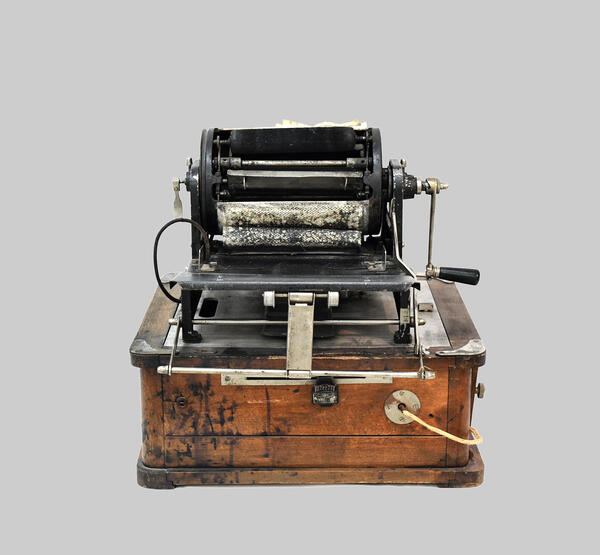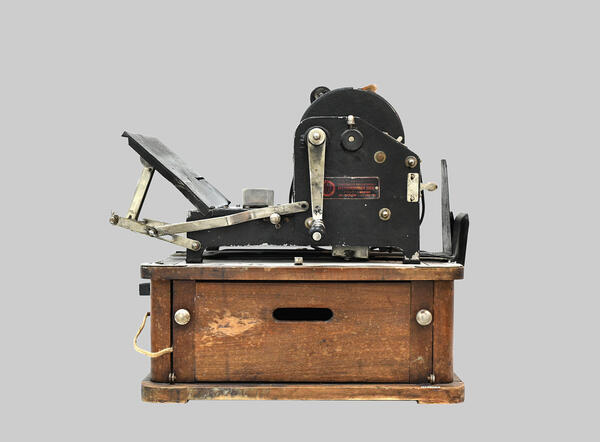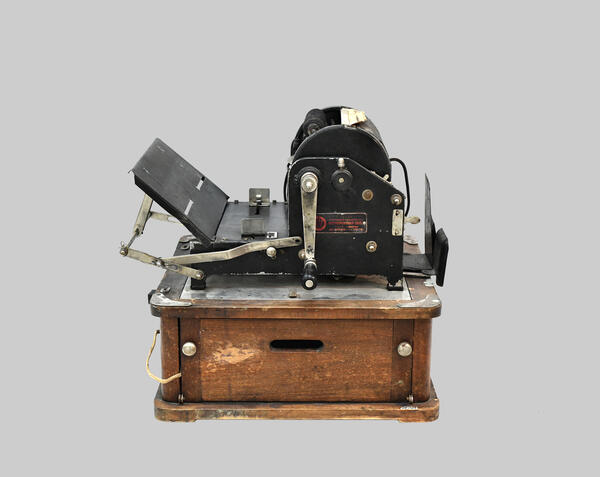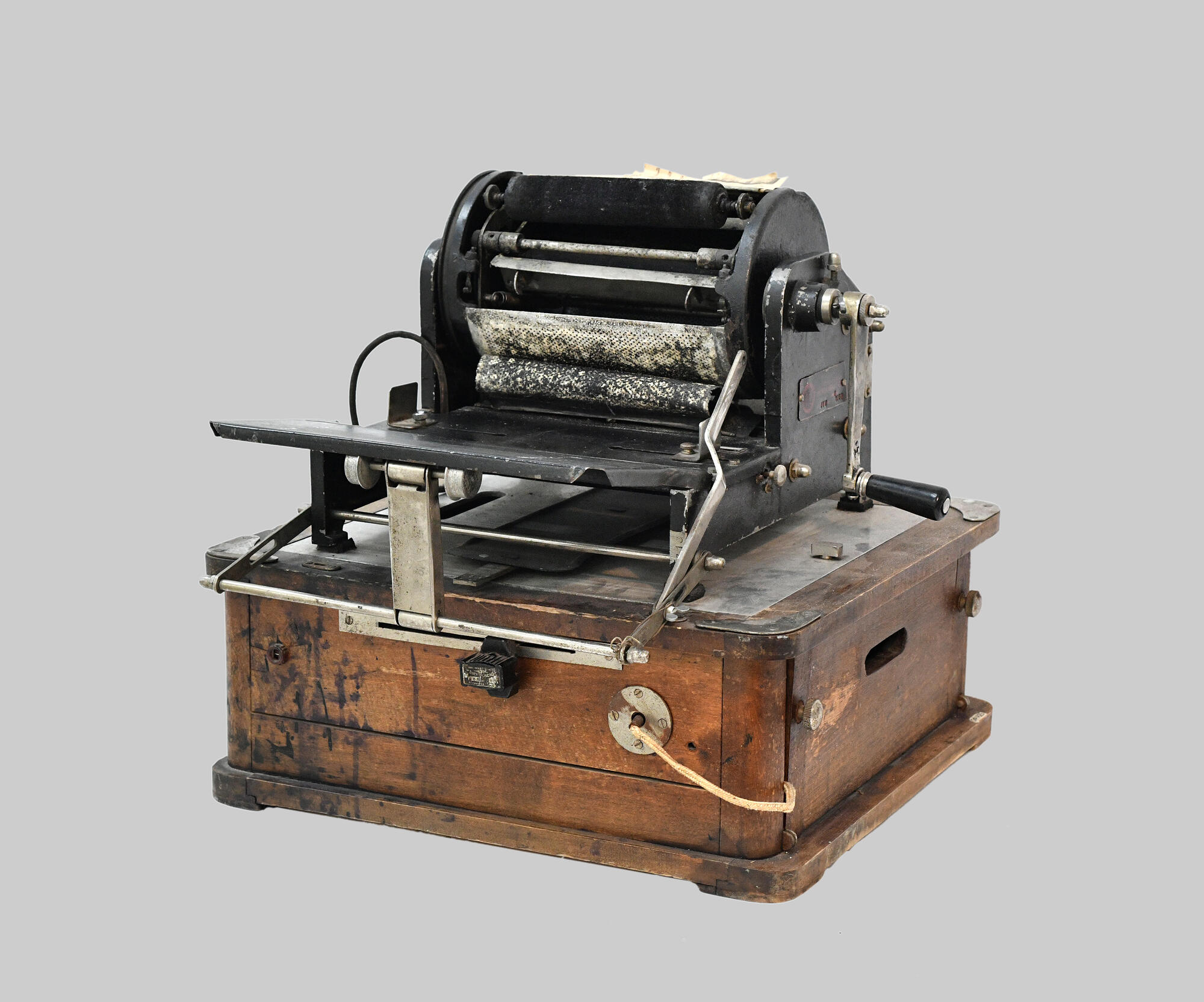


The offset printing machine is used for offset printing of typewritten text. The ink is not transferred from the printing plate to the printing surface directly, but by means of an intermediate offset cylinder, so that the final image on the printing plate is straight and not mirrored.
In the first half of the 20th century, such a small offset press could produce up to 4,000 copies per hour. It was operated either manually or electrically. The work of the machine is based on one important property of the printing ink: it is retained on the rough surface of the printing plate and at the same time does not stick to its smooth areas.
The ink from the printing plate is transferred to the rubber plate, and from that to the paper. The printing plate (cliché) is made of metal or metal-coated cardboard. The original is fixed on the plate by photocopying. After the plate is treated with acid, it leaves the image of the original as a thin rough layer that holds the ink. The resulting printing plate is mounted on a drum and when it rotates, it is coated with ink, which is then transferred to the rubber plate. This is then printed on to paper.
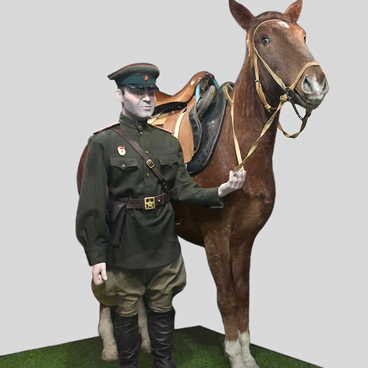
The offset printing machine presented at the exhibition is of great interest to the museum’s visitors. During the Great Patriotic War, a similar machine was used in the 112th Bashkir (16th Guards) Cavalry Division to print its own front-line newspaper “Kyzyl atlylar” (“Red Cavalrymen”).
In the first half of the 20th century, such a small offset press could produce up to 4,000 copies per hour. It was operated either manually or electrically. The work of the machine is based on one important property of the printing ink: it is retained on the rough surface of the printing plate and at the same time does not stick to its smooth areas.
The ink from the printing plate is transferred to the rubber plate, and from that to the paper. The printing plate (cliché) is made of metal or metal-coated cardboard. The original is fixed on the plate by photocopying. After the plate is treated with acid, it leaves the image of the original as a thin rough layer that holds the ink. The resulting printing plate is mounted on a drum and when it rotates, it is coated with ink, which is then transferred to the rubber plate. This is then printed on to paper.
The offset printing machine presented at the exhibition is of great interest to the museum’s visitors. During the Great Patriotic War, a similar machine was used in the 112th Bashkir (16th Guards) Cavalry Division to print its own front-line newspaper “Kyzyl atlylar” (“Red Cavalrymen”).