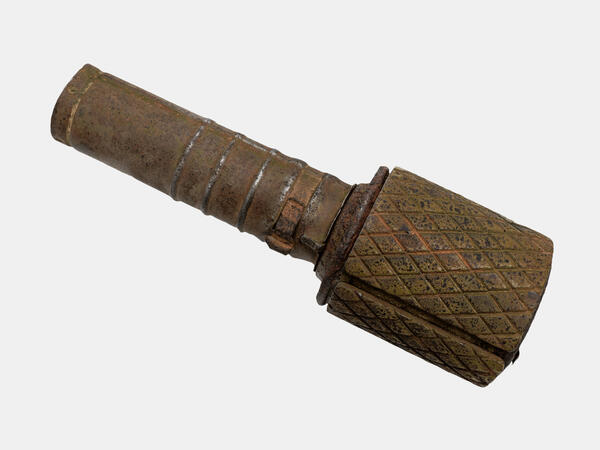
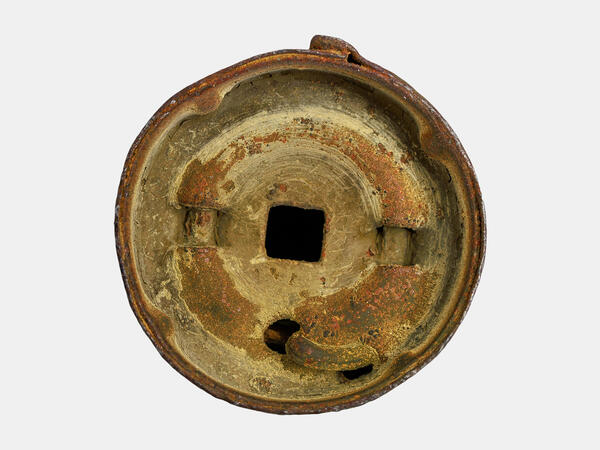
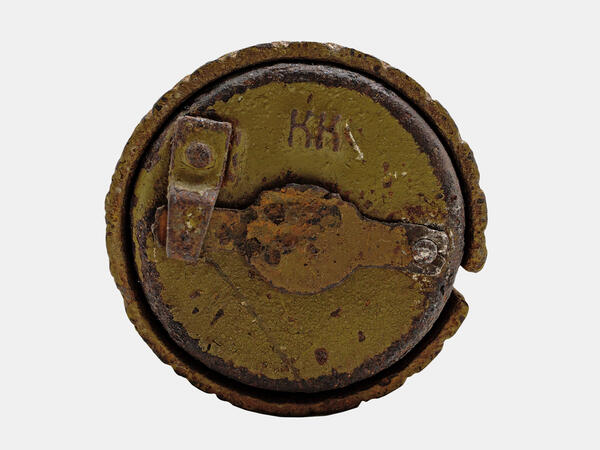
The RGD-33 hand grenade is an anti-personnel fragmentation grenade, which was widely used by Soviet troops in the early years of the Great Patriotic War. Upon explosion, it bursts into several small, lethal fragments.
The RGD-33 grenade was used both for offense and defense. It had a special fragmentation sleeve with notches: with this jacket, the grenade was said to be in “defensive” mode. It was easy to put the jacket on the grenade and when it was detonated, it produced a large number of fragments.
The RGD-33 grenade was developed by the Russian engineer Mikhail Grigoryevich Dyakonov, who began his career as a weapons designer during the First World War.
In 1925, it was decided to modernize the Rdultovsky grenade, which had been in service from 1914. This task was entrusted to Dyakonov. In 1929, he presented a modified version which was adopted by the Red Army under the designation RG-1914/30.
However, in 1933, Dyakonov developed a new grenade based on the RG-1914/30, which then became known as the RGD-33. This grenade had a thicker body, which produced more fragments upon explosion. The grenade also received another characteristic feature — a special metal band underneath the grenade body. This metal band, cut into small squares and laid in four layers, was placed immediately under the outer shell of the grenade and after the explosion burst into a large number of fragments. Also, some other changes were made to the design, and this model entered service with the Red Army.
During the Second World War, the RGD-33 fragmentation grenades were used in bundles against tanks. A soldier would take five assembled grenades and release their locking catches. Then, he would tie them tightly with twine or wire: four grenades had to point with their handles in one direction, and the fifth handle — in the opposite direction. It was necessary to hold the bundle by the handle of the fifth grenade and move its safety pin to the left so that a red dot would appear. The bundle was then thrown under the tank tracks. The fifth grenade exploded, blowing up the others.
The RGD-33 grenades were produced at the
“Krasnoznamenets” factories, the Leningrad “Pyatiletka” Factory, the Leningrad
Soap Factory, the Nevsky Soap Factory, the Nevsky Chemical Plant, Plant No. 6,
the Murmansk Ship Repair Plant, the Abram-Mys workshops, the “Apatit” Plant,
Sevastopol Plant No. 1, “Krasny Metallist” Plant and others.