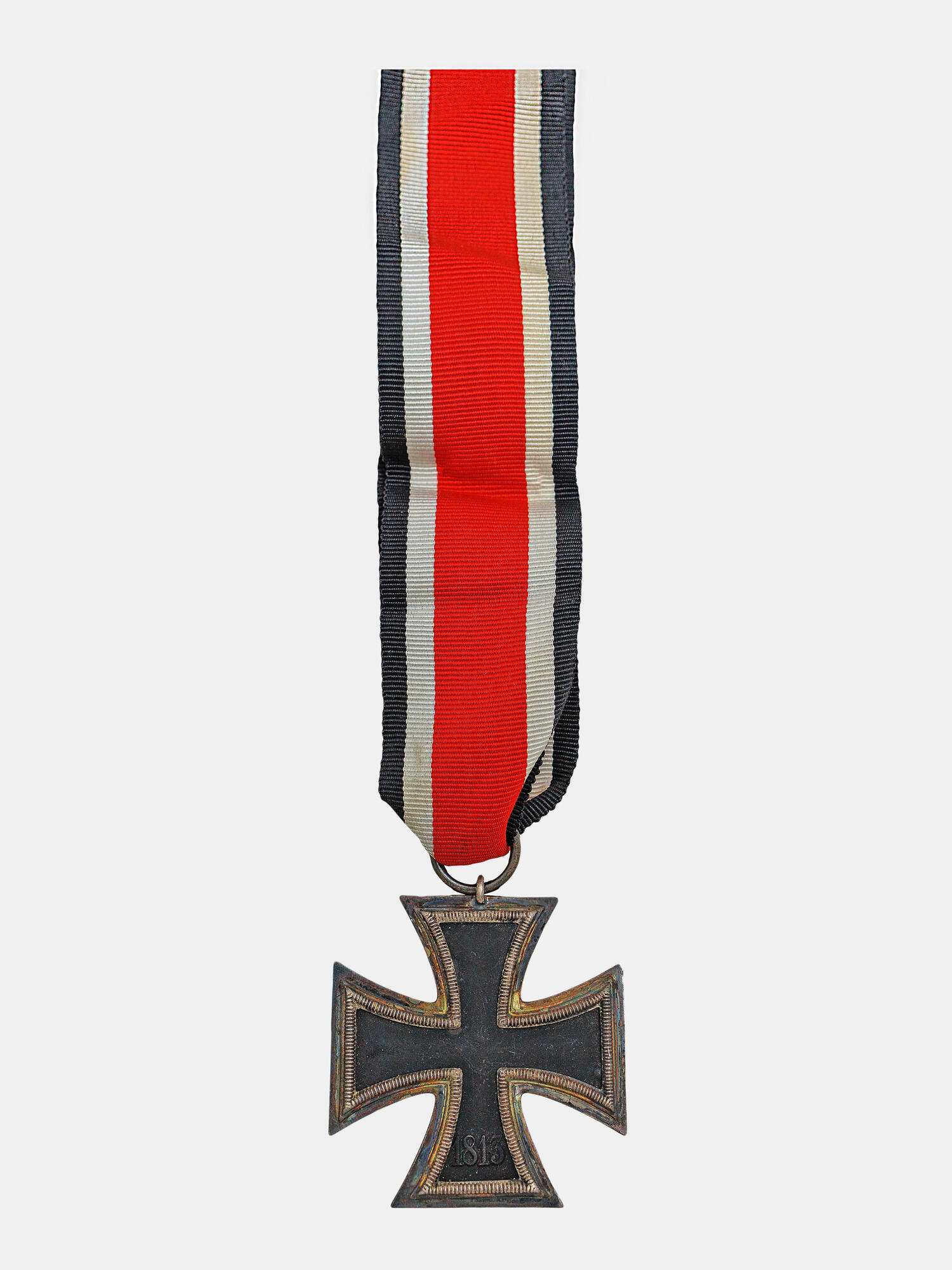


On the first day of World War II, Adolf Hitler restored an order introduced by Frederick William III — the Iron Cross. It was the only medal that the Third Reich inherited from the German Empire (or rather, from Prussia).
Originally, the Iron Cross 2nd Class — the lowest degree — was to be awarded for distinction in battle. However, pretty soon, it was given for a certain number of days the soldier spent participating in combat operations. It was done informally, for example, if the soldier showed outstanding bravery.
The cross consisted of a central iron part and two halves of a silver frame soldered together. The centerpiece was made of solid iron, which was either chemically processed or simply painted black. As to the frame, the qualifier “silver” is rather arbitrary, basically it refers to the color. An eyelet (also “silver”) was soldered to the upper beam of the cross, into which a round ring for the ribbon was inserted. The manufacturer’s stamp was usually (but not always) placed on the eyelet.
The Iron Cross 2nd Class was awarded in a blue envelope, less often — in a case covered with black faux leather. The 150-mm-long ribbon was also presented with the medal. The recipient was given a corresponding certificate that featured an image of the Iron Cross without an eyelet in the upper part, that is, the Iron Cross 1st Class, and began with the following words: “On behalf of the Fuhrer and the Supreme Commander of the Wehrmacht” (Adolf Hitler held both these positions), followed by the name of the recipient and his rank. Usually, the division commander signed the certificate. The signature was accompanied by the appropriate round seal.
However, often the certificate was simply printed
on a typewriter, and the cross at the top was drawn by hand. This usually
happened during military operations, when there were no necessary forms at
hand. The number of recipients of the Iron Cross 2nd Class has not
yet been precisely determined. It is believed that a total of 2,500,000 crosses
of the 2nd class were produced, of which about 2,300,000 were
awarded.