#1
Reproductions and photos in the bedroom
#3
#5
#7
The director spent two years filming BEzhin Meadow (from 1935 to 1937) and had two versions of the movie. However, both were censored and banned as ‘ideologically faulty as well as infected with mysticism and formalism’ and subsequently destroyed.
The movie is based on a true story involving PAvlik MorOzov, a teenager who died in 1932. Pavlik’s father, who had supposedly been helping the kulAks (wealthy peasants), was charged in his death. Shortly before he died, the boy had snitched on his father to the authorities. The Soviet propaganda used this fact to try and fabricate a myth about a selfless young Pioneer (a member of the Soviet youth organization) who put the interests of the state before his family bonds. But Eisenstein set about directing the movie because he saw this incident as a historical tragedy: rapid social changes led to a breakdown of family relationships.
The screenplay was created by playwright Alexander Rzhevsky. He changed the protagonist’s name from Pavlik to Stepok and transferred the events from Northern Urals to Bezhin Meadow mentioned in Sketches from a Hunter’s Album by Ivan Turgenev. In doing so, he wanted to highlight the contrast between the upright children of state farmers, members of the Soviet Youth Organization, and the superstitious children of the 19th-century peasant serfs. In Eisenstein’s movie, the father resembles the pagan god Pan from Mikhail Vrubel’s painting. He is not an affluent peasant but rather a poor man with a mindset typical for the patriarchal community-based society of Russian villages. His son, on the contrary, personifies youth Bartholomew (who will later become St. Sergius of Radonezh) from the Vision to the Youth Bartholomew, a painting by Mikhail Nesterov. The son quells violence as if he traveled back in time from some ideal future. And both, the father and the son, end up dying in the class warfare of the era. In the 1930s, such a tragic interpretation was bound to be banned. Eisenstein himself narrowly avoided being arrested.
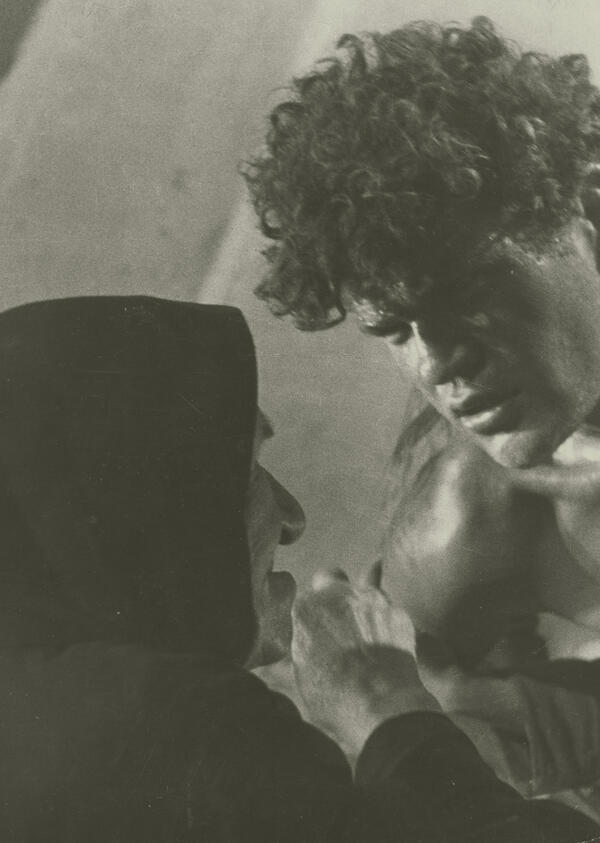
This photo was on the wall of Eisenstein’s bedroom, in his apartment on Potylikha Street where he lived from 1935 to 1948. The picture shows a young podkulAchnik (a political label used in the Soviet Union in the 1920s and 1930s to brand people considered traitors to the Soviet government). He is being led onto the porch of a church where three opponents of collectivization (a policy of forced consolidation of individual peasant households into collective farms), who had attempted to set fire to the collective farm fields, had been hiding. And the severe-looking old woman, named StyOpka, is making the sign of the cross over him. This episode was shot in a church in the village of Troitse-Golenishchevo, not far from the Mosfilm movie studio. The photo was taken by Mikhail Gomorov, who used to play in the productions staged by Eisenstein at the Proletkult theater, and had been his assistant ever since the Strike.
The movie is based on a true story involving PAvlik MorOzov, a teenager who died in 1932. Pavlik’s father, who had supposedly been helping the kulAks (wealthy peasants), was charged in his death. Shortly before he died, the boy had snitched on his father to the authorities. The Soviet propaganda used this fact to try and fabricate a myth about a selfless young Pioneer (a member of the Soviet youth organization) who put the interests of the state before his family bonds. But Eisenstein set about directing the movie because he saw this incident as a historical tragedy: rapid social changes led to a breakdown of family relationships.
The screenplay was created by playwright Alexander Rzhevsky. He changed the protagonist’s name from Pavlik to Stepok and transferred the events from Northern Urals to Bezhin Meadow mentioned in Sketches from a Hunter’s Album by Ivan Turgenev. In doing so, he wanted to highlight the contrast between the upright children of state farmers, members of the Soviet Youth Organization, and the superstitious children of the 19th-century peasant serfs. In Eisenstein’s movie, the father resembles the pagan god Pan from Mikhail Vrubel’s painting. He is not an affluent peasant but rather a poor man with a mindset typical for the patriarchal community-based society of Russian villages. His son, on the contrary, personifies youth Bartholomew (who will later become St. Sergius of Radonezh) from the Vision to the Youth Bartholomew, a painting by Mikhail Nesterov. The son quells violence as if he traveled back in time from some ideal future. And both, the father and the son, end up dying in the class warfare of the era. In the 1930s, such a tragic interpretation was bound to be banned. Eisenstein himself narrowly avoided being arrested.
This photo was on the wall of Eisenstein’s bedroom, in his apartment on Potylikha Street where he lived from 1935 to 1948. The picture shows a young podkulAchnik (a political label used in the Soviet Union in the 1920s and 1930s to brand people considered traitors to the Soviet government). He is being led onto the porch of a church where three opponents of collectivization (a policy of forced consolidation of individual peasant households into collective farms), who had attempted to set fire to the collective farm fields, had been hiding. And the severe-looking old woman, named StyOpka, is making the sign of the cross over him. This episode was shot in a church in the village of Troitse-Golenishchevo, not far from the Mosfilm movie studio. The photo was taken by Mikhail Gomorov, who used to play in the productions staged by Eisenstein at the Proletkult theater, and had been his assistant ever since the Strike.
#6
Full name: An old woman making the sign of the cross over a podkulachnik who has been arrested Scene showing the Arrest of Arsonists from Bezhin Meadow
Author: Mikhail Gomorov
Date: 1935
Technique: photographic paper, photo printing
Place: Moscow
Dimensions: 23×16.2 cm (photo); 30×19.5 cm (paper back)
Collection: Bedroom
Copyright: Cinema museum
Goskatalog Number: 10085661
Author: Mikhail Gomorov
Date: 1935
Technique: photographic paper, photo printing
Place: Moscow
Dimensions: 23×16.2 cm (photo); 30×19.5 cm (paper back)
Collection: Bedroom
Copyright: Cinema museum
Goskatalog Number: 10085661
#8
The Warrior’s Tomb
#9
#11
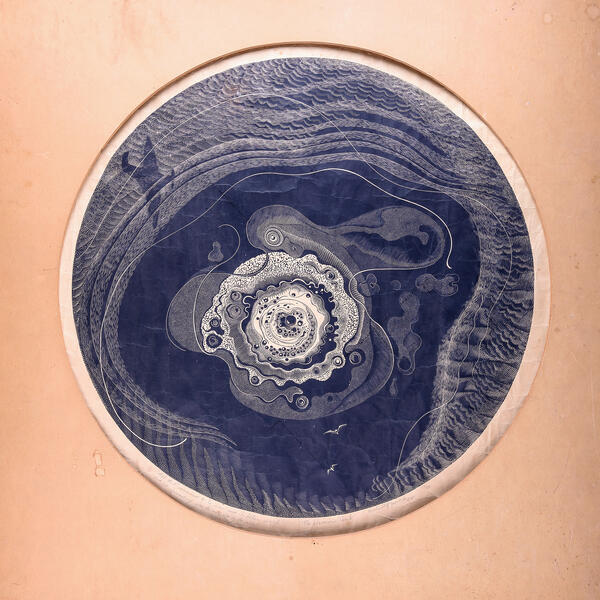
On the door of his bedroom, Sergei Eisenstein hung a wood engraving by British artist and sculptor Gertrude Hermes (1901–1983), one of the first women to master the art of wood engraving in the 1930s when this was considered a purely men’s craft. During the war, she worked in Montreal and New York. The Warrior’s Tomb was her only major work of this period. After the war was over, she returned to London. There she became famous and was elected a member of the Royal Academy of Arts.
Gertrude Hermes' parents moved to England from Germany back in the 19th century, and although Gertrude Hermes was born in London and felt like an English woman, she still deeply felt for the tragedies of the German people who fell under the influence of Nazism, which caused millions of deaths worldwide, including Germany itself.
The plot for The Warrior’s Tomb was inspired by a newspaper article about the wreckage of a German submarine that was bombed by a British fighter plane in the Atlantic Ocean. Yet, the engraving is anything but a news report image of the event. The viewer sees only a shadow of the plane on the water, two gulls, and a giant whirlpool in the ocean—the trace of the explosion that took place in the depths of the ocean. Gertrude Hermes put the image in a circle and inscribed it around with a phrase, which she supposedly took from reports on the enemy bombing: “All that remained to be seen were bubbles rising and oil spreading over the surface of the sea”. “The Warrior”s Tomb”. Gertrude Hermes - 1941. 22/30’ This is the 22nd of 30 prints.
The composition of the engraving is a multi-dimensional metaphor. The circle represents the Earth covered by the war. The whirlpool and the blurring oil stain resemble the protoplasm of a crumbling cell, and the artist often used organic forms.
Experts do not know how Sergey got the engraving. Perhaps it was sent or brought to him by an American cultural figure at the end of the war or in the first years after it ended.
Gertrude Hermes' parents moved to England from Germany back in the 19th century, and although Gertrude Hermes was born in London and felt like an English woman, she still deeply felt for the tragedies of the German people who fell under the influence of Nazism, which caused millions of deaths worldwide, including Germany itself.
The plot for The Warrior’s Tomb was inspired by a newspaper article about the wreckage of a German submarine that was bombed by a British fighter plane in the Atlantic Ocean. Yet, the engraving is anything but a news report image of the event. The viewer sees only a shadow of the plane on the water, two gulls, and a giant whirlpool in the ocean—the trace of the explosion that took place in the depths of the ocean. Gertrude Hermes put the image in a circle and inscribed it around with a phrase, which she supposedly took from reports on the enemy bombing: “All that remained to be seen were bubbles rising and oil spreading over the surface of the sea”. “The Warrior”s Tomb”. Gertrude Hermes - 1941. 22/30’ This is the 22nd of 30 prints.
The composition of the engraving is a multi-dimensional metaphor. The circle represents the Earth covered by the war. The whirlpool and the blurring oil stain resemble the protoplasm of a crumbling cell, and the artist often used organic forms.
Experts do not know how Sergey got the engraving. Perhaps it was sent or brought to him by an American cultural figure at the end of the war or in the first years after it ended.
#10
Full name: Wood Engraving The Warrior’s Tomb
Author: Gertrude Hermes
Date: 1941
Technique: paper, wood engraving
Place: USA
Dimensions: 46.5 cm (mat opening, diameter)
Collection: Bedroom
Copyright: Cinema museum
Author: Gertrude Hermes
Date: 1941
Technique: paper, wood engraving
Place: USA
Dimensions: 46.5 cm (mat opening, diameter)
Collection: Bedroom
Copyright: Cinema museum
#12
The actor Tanimura Torazo as Washizuka Hachiheiji
#13
#14
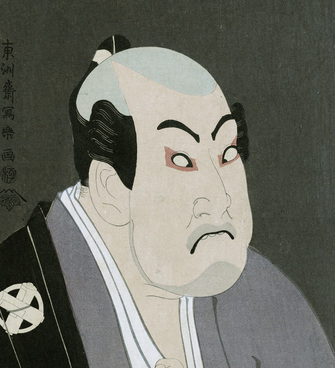
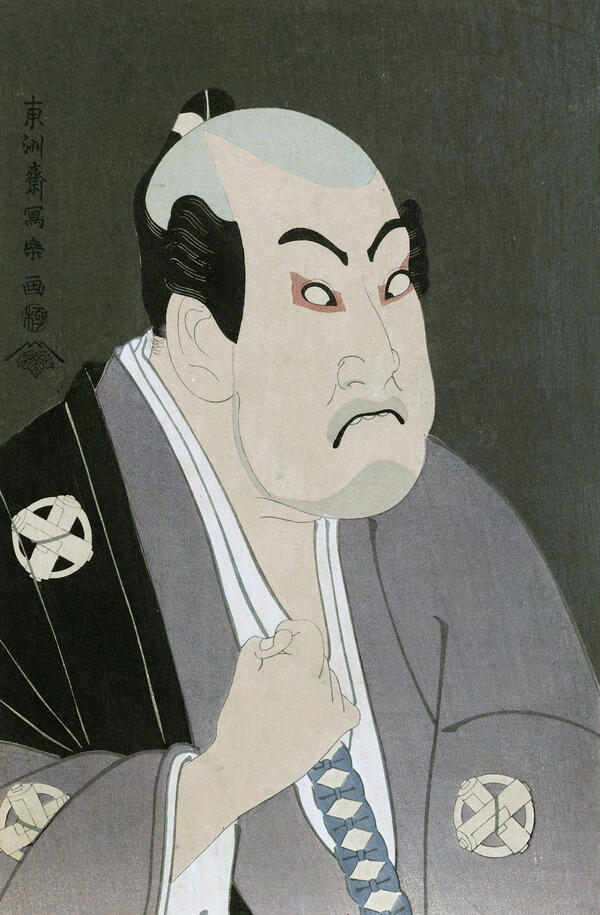
The original color wood engraving The actor Tanimura Torazo as Washizuka Hachiheiji is known since 1794. A copy from Sergei Eisenstein’s collection attributed as a 20th century re-engraving and is now kept in the Pushkin State Museum of Fine Arts.
The figure of ToshusAi SharAku remains a mystery even for the researchers. He appeared out of nowhere in 1794 with his portraits of KabUki actors, became famous at once and disappeared without a trace in 1795. According to a German art historian Julius Kurt, who made Sharaku famous in Europe by comparing him with the Dutch artist REmbrandt, the master was an actor of the Noh Theater, because the faces on the portraits often resemble the masks of this ancient Japanese theater. According to another hypothesis, behind the name of Toshusai Sharaku was used by Katsushika Hokusai, who had created over a hundred portraits of actors just before 1794. Hokusai liked to change names, so he may have taken a new pseudonym to separate grotesque portraits from his work in a different style. Whoever was hiding behind the name of Sharaku, the artist remained in the history of world art, like other great masters of ukiyo-e (Japanese graphics), such as Kitagawa Utamaro, Utagawa Hiroshige, Utagawa Kunisada and Katsusjika Hokusai.
Sharaku was one of the most accurate observers of the Kabuki acting. His engravings show how the characters of classical and new drama were represented on stage in the old days, as well as the costumes, makeup, gestures and facial expressions of the actors, and allow to capture the atmosphere of the early Japanese performances.
Eisenstein was known for his sense of humor, grotesque and parody. He mastered the skill to convey the movement in a drawing with a clean line. He was also observant and had the ability to distinguish the generalizing, typical characteristics in a person’s face. That is why Sergei Eisenstein found Julius Kurt’s book Sharaku (now kept in the Film Museum) and studied it carefully. Portraits by Sharaku became Eisenstein’s favorite example of expression in his theoretical works and lectures at the Stage Management department at the All-Russian State Institute of Cinematograph.
The figure of ToshusAi SharAku remains a mystery even for the researchers. He appeared out of nowhere in 1794 with his portraits of KabUki actors, became famous at once and disappeared without a trace in 1795. According to a German art historian Julius Kurt, who made Sharaku famous in Europe by comparing him with the Dutch artist REmbrandt, the master was an actor of the Noh Theater, because the faces on the portraits often resemble the masks of this ancient Japanese theater. According to another hypothesis, behind the name of Toshusai Sharaku was used by Katsushika Hokusai, who had created over a hundred portraits of actors just before 1794. Hokusai liked to change names, so he may have taken a new pseudonym to separate grotesque portraits from his work in a different style. Whoever was hiding behind the name of Sharaku, the artist remained in the history of world art, like other great masters of ukiyo-e (Japanese graphics), such as Kitagawa Utamaro, Utagawa Hiroshige, Utagawa Kunisada and Katsusjika Hokusai.
Sharaku was one of the most accurate observers of the Kabuki acting. His engravings show how the characters of classical and new drama were represented on stage in the old days, as well as the costumes, makeup, gestures and facial expressions of the actors, and allow to capture the atmosphere of the early Japanese performances.
Eisenstein was known for his sense of humor, grotesque and parody. He mastered the skill to convey the movement in a drawing with a clean line. He was also observant and had the ability to distinguish the generalizing, typical characteristics in a person’s face. That is why Sergei Eisenstein found Julius Kurt’s book Sharaku (now kept in the Film Museum) and studied it carefully. Portraits by Sharaku became Eisenstein’s favorite example of expression in his theoretical works and lectures at the Stage Management department at the All-Russian State Institute of Cinematograph.
#15
Full name: Wood engraving The actor Tanimura Torazo as Washizuka Hachiheiji Facsimile
Author: Toshusai Sharaku
Date: 2018
Technique: paper, laser print
Place: Moscow
Dimensions: 38×25 cm
Collection: Bedroom
Copyright: Cinema museum
Author: Toshusai Sharaku
Date: 2018
Technique: paper, laser print
Place: Moscow
Dimensions: 38×25 cm
Collection: Bedroom
Copyright: Cinema museum
#16
The actor Otani Oniji II as Yakko Edobei
#17
#18
From a young age, Sergei Eisenstein was fond of Japanese culture. He began to learn Japanese with his fellow military construction workers during the Civil War. In 1920, he took discharge to Moscow, the eastern branch of the General Staff Academy, hoping to eventually come to Japan as a translator and see the performances of Noh and Kabuki theaters. However, two months later, Sergei Eisenstein went to work at the theater as a stage designer and director and four years later staged his first film Strike, and a year after he gained worldwide fame with the film Battleship Potemkin.
In 1928, Kabuki Theater came on tour to Moscow, and Eisenstein’s dream came true. He saw the performances of the Japanese theater with his own eyes, made friends with its leading actors and amazed them with his knowledge and understanding of their traditions. Eisenstein studied KabUki with books and engravings by Japanese artists, many of whom were ardent theatergoers. One of those artists was ToshusAi SharAku (mid-to-late 18th century - early 19th century), the author of an impressive portrait gallery of actors and sumo wrestlers of that time. Eisenstein deeply appreciated his skills and called him the “Japanese Daumier” /do’mje/ for his acute characteristics, his caustic humor, and ability to convey movement in statics.
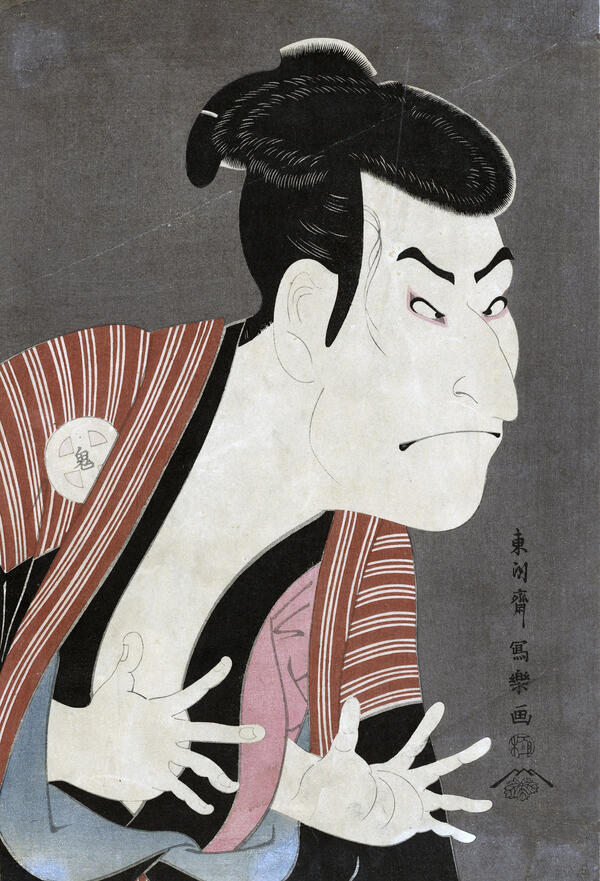
The director managed to buy two portraits by Sharaku. Today they are considered to re-engravings of the 20th century and are kept in the PUshkin State Museum of Fine Arts. The Film Museum displays facsimile (exact) copies of these works. The original color engraving The Actor Otani Oniji as Yakko Edobei is known since 1794 and is one of the most famous works by Sharaku.
Sergei Eisenstein wondered why OtAni’s eyes were crossed that much. The actor wasn’t squint-eyed from birth. It was some kind of convention of play. Kabuki actors were bringing their pupils to the nose bridge in the same way when he saw performances brought to Moscow. This happened at the moments when the actor conveyed a strong emotion, such as anger, with facial gesture. Eisenstein began to study the movement of the eye muscles in various emotions. It turned out that people unknowingly bring the pupils closer when they are fully focused on something or someone, when they are stressed. The Japanese noticed this and put it in the acting rules, so that the audience could see it far away from the stage, and Sharaku focused on this moment in the engraving with grotesque sharpness. This observation helped Eisenstein when he was working with the actors in Ivan the Terrible. He advised the actor Mikhail Kuznetsov to convey the cruelty of oprichniks (life-guardsmen) without growling, but rather just bringing the pupils closer together and the viewer will intuitively understand the character’s state of mind.
In 1928, Kabuki Theater came on tour to Moscow, and Eisenstein’s dream came true. He saw the performances of the Japanese theater with his own eyes, made friends with its leading actors and amazed them with his knowledge and understanding of their traditions. Eisenstein studied KabUki with books and engravings by Japanese artists, many of whom were ardent theatergoers. One of those artists was ToshusAi SharAku (mid-to-late 18th century - early 19th century), the author of an impressive portrait gallery of actors and sumo wrestlers of that time. Eisenstein deeply appreciated his skills and called him the “Japanese Daumier” /do’mje/ for his acute characteristics, his caustic humor, and ability to convey movement in statics.
The director managed to buy two portraits by Sharaku. Today they are considered to re-engravings of the 20th century and are kept in the PUshkin State Museum of Fine Arts. The Film Museum displays facsimile (exact) copies of these works. The original color engraving The Actor Otani Oniji as Yakko Edobei is known since 1794 and is one of the most famous works by Sharaku.
Sergei Eisenstein wondered why OtAni’s eyes were crossed that much. The actor wasn’t squint-eyed from birth. It was some kind of convention of play. Kabuki actors were bringing their pupils to the nose bridge in the same way when he saw performances brought to Moscow. This happened at the moments when the actor conveyed a strong emotion, such as anger, with facial gesture. Eisenstein began to study the movement of the eye muscles in various emotions. It turned out that people unknowingly bring the pupils closer when they are fully focused on something or someone, when they are stressed. The Japanese noticed this and put it in the acting rules, so that the audience could see it far away from the stage, and Sharaku focused on this moment in the engraving with grotesque sharpness. This observation helped Eisenstein when he was working with the actors in Ivan the Terrible. He advised the actor Mikhail Kuznetsov to convey the cruelty of oprichniks (life-guardsmen) without growling, but rather just bringing the pupils closer together and the viewer will intuitively understand the character’s state of mind.
#19
Full name: Wood engraving The actor Otani Oniji II as Yakko Edobei. Facsimile
Author: Toshusai Sharaku
Date: 2018
Technique: paper, laser print
Place: Moscow
Dimensions: 38×25 cm
Collection: Bedroom
Copyright: Cinema museum
Author: Toshusai Sharaku
Date: 2018
Technique: paper, laser print
Place: Moscow
Dimensions: 38×25 cm
Collection: Bedroom
Copyright: Cinema museum
#20
The Matsu Higashiya Teahouse
#21
#2
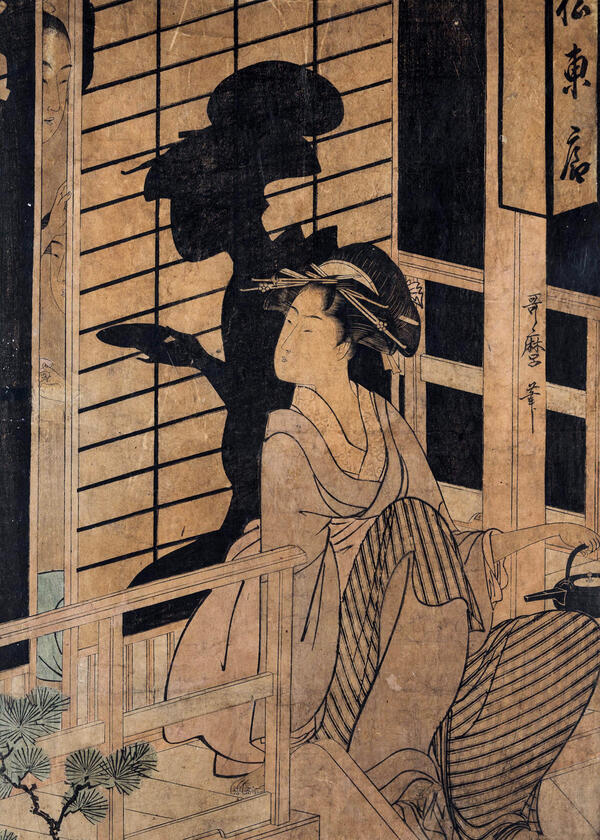
The MAtsu HigashIya Teahouse wood engraving by UtamAro (1753–1806) hung in Eisenstein’s bedroom, on the same wall where he put another work by this artist, a triptych AwAbi Divers.
Sergei Eisenstein studied the works by Utamaro, a master of Japanese ukiyo-e print, very carefully in order to enrich cinematography with the techniques of the artist, who largely determined the features of Japanese classical engraving in its heyday period in the late 18th century.
Utamaro is referred to as an artist of feminine beauty and is widely known for the female characters of his most popular creations: geishas from the entertainment district of Yoshiwara, saleswomen, and tea housemaids. However, he also portrayed the life of ordinary artisans, landscapes, flora, and fauna of Japan. Utamaro was recognized as a classic of not only Japanese but also world culture for his characters' delicate state of mind, the elegance of line, and the extraordinary ingenuity of his compositions.
Kitagawa Utamaro was the first in Japanese xylography to use shoulder-length composition, combining multiple shapes on one sheet and masterfully using the white background of the paper, which played the color and light and shadow effects. These features of Utamaro’s art are visible in his engraving The Matsu Higashiya Tea House, created in 1795–1800. There is another version of this composition with some variations in the character’s clothing (different emblem on the shoulders) and an inscription on the pole saying “The Nakadaya Tea House.” Such a sheet is stored, inter alia, in the British Museum.
On the terrace of the Japanese house, there is a woman (probably a courtesan) with a teapot in her hand. However, a large shadow on the paper wall does not belong to her, as it seems at first glance, but to another courtesan, judging by her sophisticated hair. She sits in the house with a cup in her hand. Part of her face is barely visible behind a sliding screen door, and in the same slit one can see the face of another woman: apparently, a maid calling for the woman with the teapot. The Matsu Higashiya Tea House combines an everyday scene, a portrait and a landscape. The artist managed to fit three figures, part of the house and a branch of bushes into the composition at once, and the space still remains free.
Eisenstein learned the laconic means of expression and skillful use of space from Japanese masters. His scenes combine clear simplicity with dramatic tension. The distinctive feature of this print is that it is not physical figures, but the shadow of a courtesan that prevails in the presented action. In his film Ivan the Terrible, Sergei Eisenstein also played with shadows that sometimes seem to separate from Tsar Ivan and begin to act independently, commanding people.
Sergei Eisenstein studied the works by Utamaro, a master of Japanese ukiyo-e print, very carefully in order to enrich cinematography with the techniques of the artist, who largely determined the features of Japanese classical engraving in its heyday period in the late 18th century.
Utamaro is referred to as an artist of feminine beauty and is widely known for the female characters of his most popular creations: geishas from the entertainment district of Yoshiwara, saleswomen, and tea housemaids. However, he also portrayed the life of ordinary artisans, landscapes, flora, and fauna of Japan. Utamaro was recognized as a classic of not only Japanese but also world culture for his characters' delicate state of mind, the elegance of line, and the extraordinary ingenuity of his compositions.
Kitagawa Utamaro was the first in Japanese xylography to use shoulder-length composition, combining multiple shapes on one sheet and masterfully using the white background of the paper, which played the color and light and shadow effects. These features of Utamaro’s art are visible in his engraving The Matsu Higashiya Tea House, created in 1795–1800. There is another version of this composition with some variations in the character’s clothing (different emblem on the shoulders) and an inscription on the pole saying “The Nakadaya Tea House.” Such a sheet is stored, inter alia, in the British Museum.
On the terrace of the Japanese house, there is a woman (probably a courtesan) with a teapot in her hand. However, a large shadow on the paper wall does not belong to her, as it seems at first glance, but to another courtesan, judging by her sophisticated hair. She sits in the house with a cup in her hand. Part of her face is barely visible behind a sliding screen door, and in the same slit one can see the face of another woman: apparently, a maid calling for the woman with the teapot. The Matsu Higashiya Tea House combines an everyday scene, a portrait and a landscape. The artist managed to fit three figures, part of the house and a branch of bushes into the composition at once, and the space still remains free.
Eisenstein learned the laconic means of expression and skillful use of space from Japanese masters. His scenes combine clear simplicity with dramatic tension. The distinctive feature of this print is that it is not physical figures, but the shadow of a courtesan that prevails in the presented action. In his film Ivan the Terrible, Sergei Eisenstein also played with shadows that sometimes seem to separate from Tsar Ivan and begin to act independently, commanding people.
#22
Full name: Wood engraving The Matsu Higashiya Teahouse
Author: Kitagawa Utamaro
Date: 1795–1800
Technique: paper, wood engraving
Place: Japan
Dimensions: 37×24 cm
Collection: Bedroom
Copyright: Cinema museum
Goskatalog Number: 17962628
Author: Kitagawa Utamaro
Date: 1795–1800
Technique: paper, wood engraving
Place: Japan
Dimensions: 37×24 cm
Collection: Bedroom
Copyright: Cinema museum
Goskatalog Number: 17962628
read morehide
00:00
00:00
1x
0
 Point your smartphone camera to open in the app
Open in app
Share