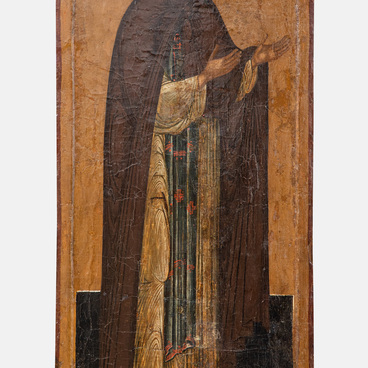
The genre of the hagiographic icon originated in Byzantium no later than the 9th century and spread to the Balkans, Italy and Russia, where it became especially popular. Natalia Komashko and Elena Sayenkova even call this type of icon an important contribution of the “Russian people to the treasury of Christian art.”
The direct source for such works were hagiographies: “acts of martyrdom”, later — memories of ascetics compiled by eyewitnesses. The icons traced the full cycle of service of the saint with additional stories about the death, the finding of relics and posthumous miracles.
Hagiographic icons reached their heyday at the turn of the 16th century. The masters of that period began to pay great attention to literally everything, including the details of clothing, everyday life, and landscape. Each border scene was distinguished by “special historicity, ‘authenticity’ of the image” (Olga Podobedova, “Moscow School of Painting under Ivan IV. The Evolution of Hagiographic Icons”).
The displayed frame apparently repeats the composition of the miraculous image of St. Macarius, painted in the 1630s in the Khergozersky Monastery. Instead of the original eleven scenes, this image contains only seven, complemented by the scene “Coronation of the Virgin” — the middle image of the uppermost row. The frame depicts the following scenes from the upper left corner to the right: two scenes from Macarius’s youth (coming to the monastery and talking with his father), four scenes related to the destruction of the Yellow Water Lake Monastery by the Tatars (the capture of Macarius, the liberation from Tatar captivity, the burial of the murdered monks, the move to Unzha with the miracle of the moose) and one posthumous miracle (the rescue of Maria, a female resident of Unzha, from captivity).
The absence of stories about the birth and death of the saint, as well as about the monasteries founded by him, make this set of scenes atypical for the hagiographic genre. Of the presented plots, the most common is considered to be the “Miracle of the Moose”, while the depiction of the burial of monks, on the contrary, is extremely rare. Each scene is accompanied by the quotes from the hagiography.
Despite the absence of a signature on the frame,
stylistic features allowed researchers to determine that it was created by the
masters of Ivan Ivanovich Bogdanov-Karbatovsky’s artel, which was famous in the
Kargopol region in the second half of the 18th century.