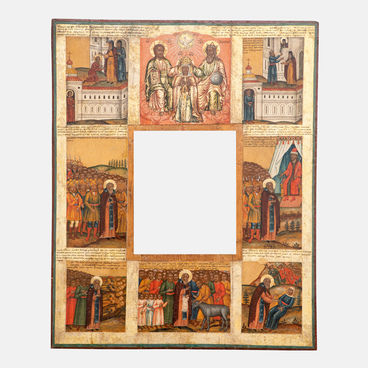
The Venerable Nikodim (born Nikita) of Kozhozero, or Khozyuga, came from the peasants of the Rostovsky Uyezd. After the death of his parents, he moved to Moscow and worked as a blacksmith, leading the life of a pious layman: he helped the suffering and went to church often.
Once, the fool-for-Christ Elijah greeted him as a “Khozyuga hermit.” Nikita, heeding the call, sold his property and came to the Chudov Monastery, where he took vows and spent 11 years. Having felt a craving for solitary service, he asked for the blessing of Archimandrite Paphnutius (at that time Metropolitan of Sarai) to become a hermit.
For a year and a half Nikodim lived in the Kozheozersky Monastery, founded in 1560 by the Venerable Serapion. Then he built a small cell in the forest on the bank of the Khozyuga River and spent 35 years there, praying for peace. He also helped the brethren as much as possible — he grew turnips for the monastery and fished. For his ascetic life, he received from God the gift of unceasing prayer, foresight and healing.
The hagiography of the monk became known thanks to his disciple Hieromonk Iakov; the first mention of Nikodim in the menologium dates back to the 1640s. The incorrupt relics of the ascetic were found in 1695, after a fire in the Kozheozersky Monastery. Thanks to them, as well as the mantle and the rod of the saint, many sick people were cured. Appearing in dreams, Saint Nikodim helped travelers, fishermen and navigators who lost their way. In addition, the holy hermit was revered as the heavenly patron of the monastery.
In 1662, the hagiography of the ascetic was published in the Prologue; the iconography of the saint developed according to the descriptions given there. Initially, he was traditionally painted full-length, in monastic attire — a mantle and a koukoulion, standing in a prayer or turned to the Savior. Later, frontal images of the saint appeared. The vast majority of his icons, painted in the 17th–18th centuries, originate from the Onega and Kargopol counties.
In the 17th century, the Kozheozersky
Monastery, associated with the name of St. Nikodim, was part of the Kargopolsky
Uyezd, Olonets Governorate. After 1784, it belonged to the Arkhangelsk
Governorate. Currently, it has been transformed into a convent and is
considered the most inaccessible of the existing monasteries.