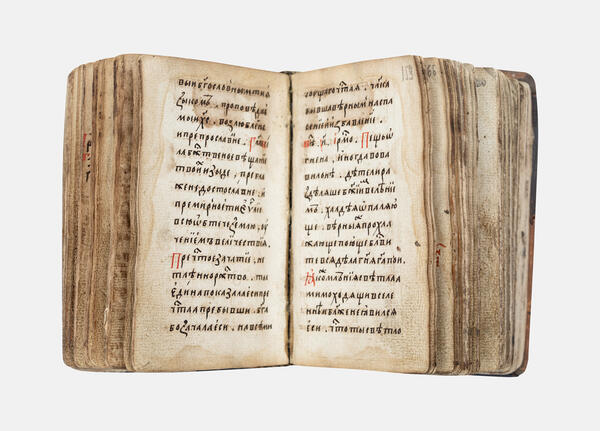
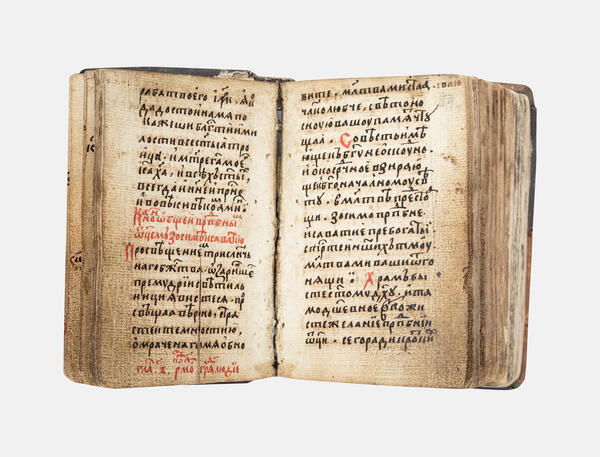
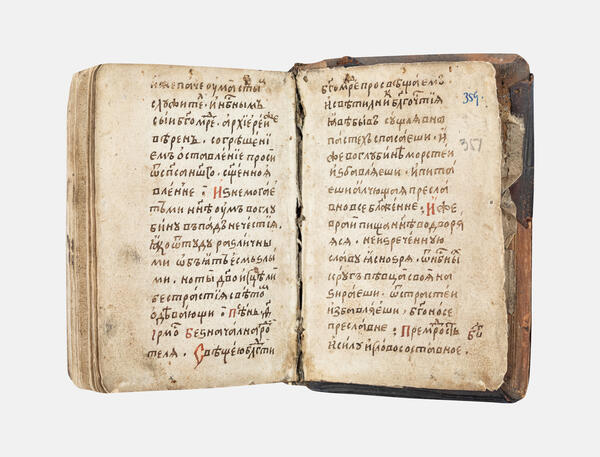
The Kargopol Museum houses 6 manuscripts and 23 printed books from the Transfiguration Monastery. The chronologically earliest one is a handwritten collection of liturgical texts with an entry about the donor.
Such entries on the pages of books were a frequent occurrence: they provided information about the donor, the previous owner or the seller. The donor entries recorded the name of the specific person who donated the book to the church or monastery; the owner entries documented the name of the former owner of the item; the seller entry noted the fact of purchase and sale. The entries were made on the end-papers or on the pages.
In the latter case, one word or even one syllable was written on each sheet one after another. To read the message, it was necessary to scroll through the entire book and put together fragments of the text.
The entry encrypted in this way in the presented book says that it was donated to the monastery by Iakov Simonov, son of Trapeznikov, for the commemoration of his parents — his father Simon and mother Ksenia.
Judging by the dates of publication and the inscription on the pages, the book was kept in the Trapeznikov family for several generations, it was frequently reread and notes were left on the pages. Among them is an unusual prayer to the cross for protection from adversity and troubles. Fragments of a rather interesting text are also preserved. It concerns the war with Napoleon Bonaparte: one could read the words of a plea to grant the victory to “our blessed Emperor Alexander Pavlovich”. The last entry, about the donation, was made by Iakov Simeonovich himself. He concluded it with the words: “And signed with his own hand.”
The Trapeznikov surname is mentioned in the documents of Kargopol archives since the 17th century. It is also listed in the memorial book of the Transfiguration Monastery.
In order to streamline the records on donations to the monastery, so-called contribution books were kept, which documented the size of the contribution, the name and social status of the donor, and the conditions under which the donation was made. The term “contribution book” first appears in written sources at the turn of the 18th century.
In addition to books, benefactors donated church or
household items, money, livestock, food and even their serfs. Monks prayed in
the appropriate church or monastery for the health of benefactors and their
families, as well as for the repose of the deceased for a certain period of
time. The annual commemoration of one name cost 1 ruble. The most generous
contributors were also entitled to funeral liturgies and a multi-year
distribution of alms in their name.