Embroidery hoops are devices that hold the fabric taut to work with embroidery. In Russia the first definition of such hoops was given by the ethnographer Vladimir Ivanovich Dal in his dictionary, “… a woman’s needlework frame to stretch fabric for sewing or quilting.” This is how he described the device, which was popular in the mid-19th century.
Embroidery hoops were usually round or oval but could also be rectangular. They were always two frames, one slightly smaller than the other, in between which the fabric was placed and stretched. As a rule, the hoops were small in size so that they could be easily held with one hand.
Frames of larger sizes were also in use, but they were mostly attached to a tabletop or floor stand. In this case, both hands of the craftswoman remained free, which facilitated the process of embroidering and allowed to do the work at the highest artistic level.
Despite the simplicity of the design, the embroidery hoops were constantly improved. The first hoops were made of a flexible wooden rod, which was bent into a ring and the fabric was tightly stretched inside it with the help of twine. In Ancient Greece at the turn of the 5th century BC trapezoidal hoops were used. Then two rings appeared, which were made of wood, and in special cases even of ivory.
In the first decades of the 19th century in Russia, embroidery frames made of expensive wood, such as Karelian birch or mahogany, came into use. They consisted of a table with a frame with an adjustable angle of tilt. On the inner side of the hinged lid the necessary tools for embroidery were fixed: needles, scissors and an awl. These frames were expensive, so only women from wealthy families could afford them.
Peasant women embroidered on rectangular hoops. They looked like a massive frame on legs, which was made of sturdy laths. Four craftswomen worked simultaneously at such large embroidery frames. They were popularly called “circular” because the women sat at them in a circle.
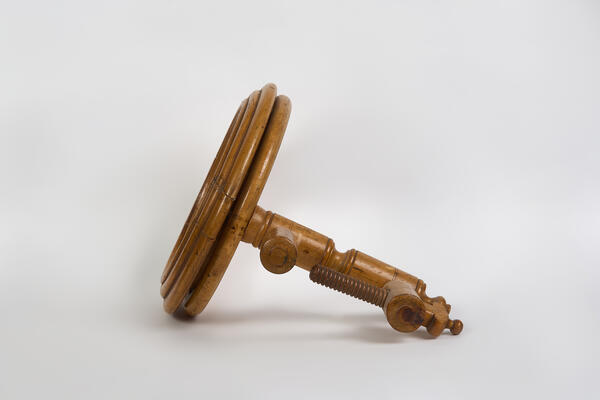
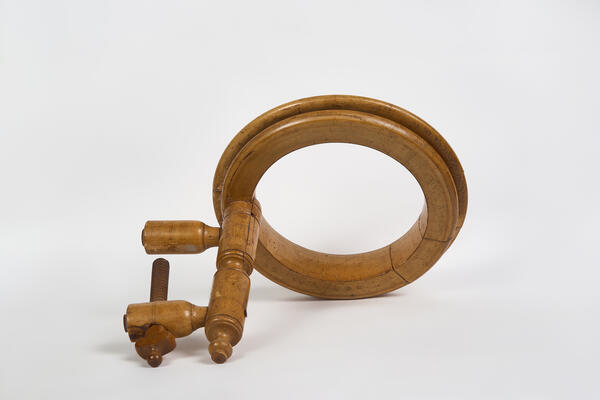
In the 19th century, circular hoops became common. Two wooden circles fit tightly into one another, and the fabric was fixed. The tension of the fabric was achieved by means of a special screw, which was mounted on the outer circle. Rectangular hoops were also used, either hand-held or with legs to be placed on a tabletop.
Currently, wooden embroidery hoops are still popular, but collapsible plastic devices are becoming more common.