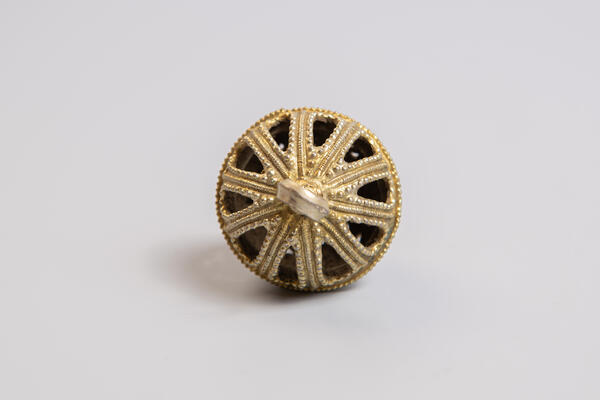
The Museum “The Smolensk Fortress” houses an exhibition called “The World of the Streltsy” with a special showcase dedicated to women’s jewelry. The showcase displays a collection of buttons that were used to decorate rich garments of the 17th century.
These are independent works of jewelry that have not faded and retained their brightness. They were made of precious metals — gold and silver. Such items were used to adorn both women’s and men’s costumes.
Particular attention is drawn to a large spherical button, which was soldered from precious wire. Due to the openwork design, the button is light. Given that artisans could use up to 17–19 buttons to create rich vestments, decreasing the overall weight was an important task.
The jeweler deliberately made the bottom half of the item a little heavier to maintain the overall orientation of the button. The relief belt in the middle around the button simultaneously serves as a support and helps to keep the shape of the product. Thus, the artisan also acted as a technical designer. A large loop made it possible to attach the button.
The abundance of gold became a distinctive feature of the Russian ceremonial costume in the 16th and 17th centuries. Heavy fabrics, including those with metal threads, looked solemn, but somewhat slowed down the movements of boyars and princes. Only Peter I, upon his return from the Great Embassy, canceled the magnificent court outfits.
A distinctive feature of the button displayed in the exhibition of the museum is granulation — the so-called small metal balls with a diameter of up to 0.4 mm, which artisans soldered onto the base of the product in rows or a complex pattern. The brilliance of the granulation created a play of light. This technique of artistic metal processing was one of the most economical, saving both the time of the craftsman and the precious material itself.
Often gems or pearls were also inserted into the buttons. Items from the museum’s exhibition do not have such inserts, but this does not deprive them of their ostentatious brightness. Everyday costumes of the townspeople had smaller copper or silver buttons.
These are independent works of jewelry that have not faded and retained their brightness. They were made of precious metals — gold and silver. Such items were used to adorn both women’s and men’s costumes.
Particular attention is drawn to a large spherical button, which was soldered from precious wire. Due to the openwork design, the button is light. Given that artisans could use up to 17–19 buttons to create rich vestments, decreasing the overall weight was an important task.
The jeweler deliberately made the bottom half of the item a little heavier to maintain the overall orientation of the button. The relief belt in the middle around the button simultaneously serves as a support and helps to keep the shape of the product. Thus, the artisan also acted as a technical designer. A large loop made it possible to attach the button.
The abundance of gold became a distinctive feature of the Russian ceremonial costume in the 16th and 17th centuries. Heavy fabrics, including those with metal threads, looked solemn, but somewhat slowed down the movements of boyars and princes. Only Peter I, upon his return from the Great Embassy, canceled the magnificent court outfits.
A distinctive feature of the button displayed in the exhibition of the museum is granulation — the so-called small metal balls with a diameter of up to 0.4 mm, which artisans soldered onto the base of the product in rows or a complex pattern. The brilliance of the granulation created a play of light. This technique of artistic metal processing was one of the most economical, saving both the time of the craftsman and the precious material itself.
Often gems or pearls were also inserted into the buttons. Items from the museum’s exhibition do not have such inserts, but this does not deprive them of their ostentatious brightness. Everyday costumes of the townspeople had smaller copper or silver buttons.